Child of the regiment (L’Enfant du Regiment)
John Everett Millais (1829-1896)

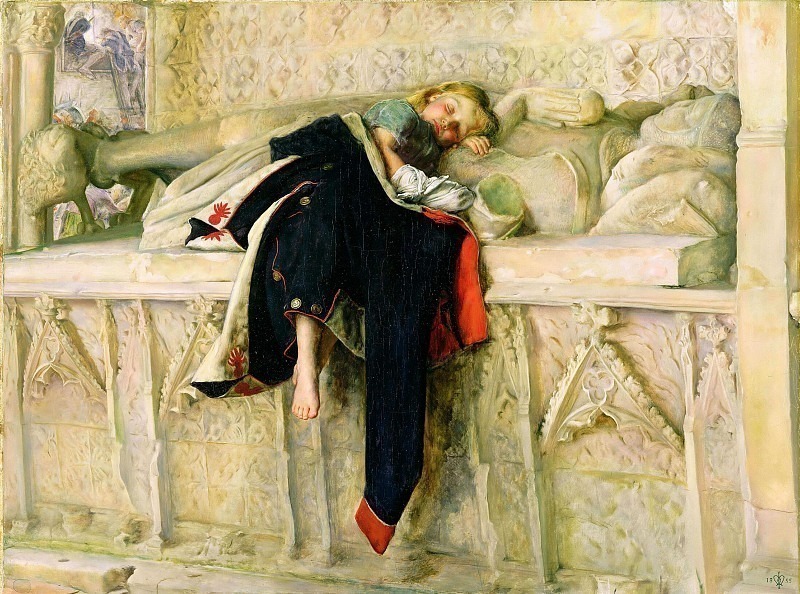

John Everett Millais – Child of the regiment (L’Enfant du Regiment)
1854 to 1855. 45×61
Edit attribution
Download full size: 2993×2231 px (0,7 Mb)
Painter: John Everett Millais
Location: Yale Center for British Art, Paul Mellon Collection, New Haven.
Album navigation:


You cannot comment Why?
The background establishes a setting that appears to be a grand, ornate chapel or mausoleum. Several sculpted figures are visible in the distance, partially obscured by shadow and depth, hinting at a lineage or historical significance associated with this place. The stone structure upon which the boy rests is intricately carved with decorative motifs, adding to the sense of solemnity and grandeur.
The artist’s use of light contributes significantly to the paintings mood. A soft, diffused illumination highlights the boy’s face and clothing, emphasizing his vulnerability and innocence against the backdrop of imposing stone figures. The contrast between the warm tones illuminating the foreground and the darker recesses of the background creates a sense of depth and mystery.
Subtexts within the work revolve around themes of childhood, loss, and memory. The juxtaposition of military regalia with the boy’s peaceful slumber suggests a poignant commentary on the disruption of innocence by war or conflict. His sleep might be interpreted as an escape from harsh realities, a symbolic return to a state of untroubled repose. The elaborate setting implies that he is part of a larger narrative – a story of lineage and sacrifice – and his presence upon the tomb hints at mortality and remembrance.
The painting evokes a sense of melancholy and quiet contemplation, inviting viewers to consider the fragility of life and the enduring power of memory within a historical context.