Christ in the House of Martha and Mary
Henryk Semiradsky (1843-1902)
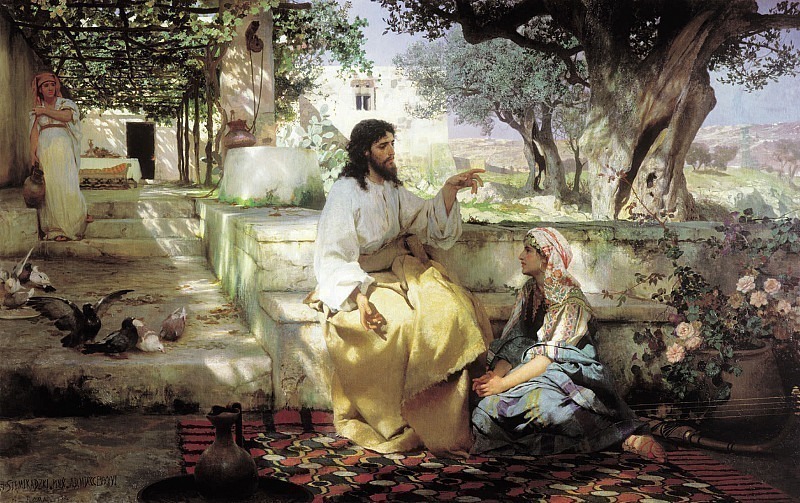
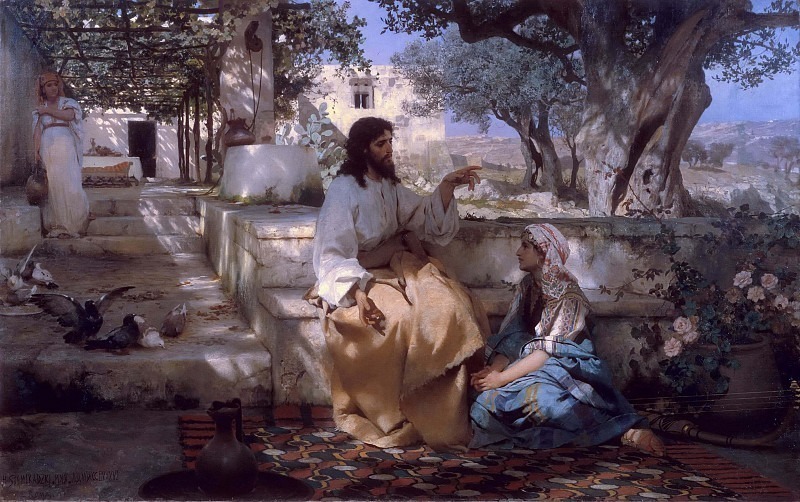

Henryk Semiradsky – Christ in the House of Martha and Mary
1886. Canvas
Edit attribution
Download full size: 1751×1100 px (0,4 Mb)
Painter: Henryk Semiradsky
Album navigation:


COMMENTS: 16 Ответы
Take a look at how this picture is embroidered with cross-stitch! http://olusja.gallery.ru/watch?ph=Cg3-brFK1
I want to buy this painting.
A BEAUTIFUL PICTURE.
Excellent work! Critics say theres not enough drama or expression... But its Christ, not Ivan the Terrible...
Western Ukraine, 1950. A Greek Catholic priest was exiled to Siberia. He asked my grandfather to keep a reproduction of the painting Christ at Martha and Mary for him, should he return. He said it was the most valuable thing he owned. He died en route to Siberia. The reproduction is now with my relatives in the Transcarpathian region.
The painting is wonderful! It evokes a sense of peace and tranquility, and whats more, its masterfully painted.
In churches, they usually sell a reproduction of a different version of the same painting. I think this one is better. At least, it has Semiradskys signature.
My wife and I saw this painting and fell in love with it! It radiates such peace and warmth... Where can we buy it?
Vitaly, for example, here is a link: http://slyepukhin.in.gallerix.ru/expo/sakralnaya-zhivopis/xristos-v-dome-marfy-i-marii-115/
Heres another artist painting a work by Semiradsky:
http://prikota.in.gallerix.ru/expo/kopii-kartin/kopiya-kartiny-genrixa-semiradskogo-xristos-i-samarityanka-xolst-maslo-60x130sm/
This painting was purchased by the Volokolamsk merchant Zinovev, a collector of art. In the 1920s, the Zinovev house was requisitioned and became the building for the OGPU. The Zinovev family moved to live with their relatives, the Surikov merchants. The Surikovs had ten children, and they were not affected by the first wave of repressions. Only this painting was saved from the entire collection. The frame was destroyed, and the painting was stored rolled up. According to the merchants great-granddaughter, after 1918, the painting in a simple frame hung in Moscow, where the Zinovev family moved. The painting disappeared during a fire in their house. On the Wikipedia page dedicated to Semiradskys work, it is stated that the Russian government purchased the painting for the Museum of the Imperial Academy of Arts. It is possible that the Zinovevs were forced to give it up in exchange for easing repressions against their family (the merchant Zinovevs son became a well-known physicist in Soviet times and worked in Dubna), or it may be a copy of the painting.
There is a picture, if you are interested, please write.
How can I place a photo of this painting on this page?
This painting by Semiradsky is located in Tbilisi and they want to sell it. If anyone is interested, please let us know.
Deception. The situation in Russia. And they will not sell it.
Shes actually here with me!!! Would you like to buy her?
In my opinion, he is the best artist.
You cannot comment Why?
To the left, another female figure stands near a water jar and a scattering of birds, appearing somewhat removed from the central interaction. Her posture suggests a state of distraction or perhaps mild disapproval. The background reveals a glimpse of a whitewashed building and a landscape extending into the distance, punctuated by olive trees and rolling hills under a bright sky. A richly patterned rug lies at the base of the steps where the two figures are seated, adding a touch of domestic comfort to the setting.
The artist’s use of light is significant; it illuminates the central figures while casting portions of the courtyard in shadow, creating depth and drawing attention to the interaction between the man and woman. The placement of the standing figure on the left suggests a contrast – a visual representation of differing priorities or approaches to hospitality and spiritual engagement.
The scene evokes themes of contemplation versus action, intellectual pursuit versus practical duties. The central male figure embodies a source of wisdom or teaching, while the young woman represents receptiveness and active learning. The presence of the other female figure hints at potential conflict between these ideals – perhaps symbolizing the tension between domestic obligations and spiritual devotion. The overall impression is one of quiet contemplation within an idyllic setting, subtly exploring complex human relationships and moral choices.