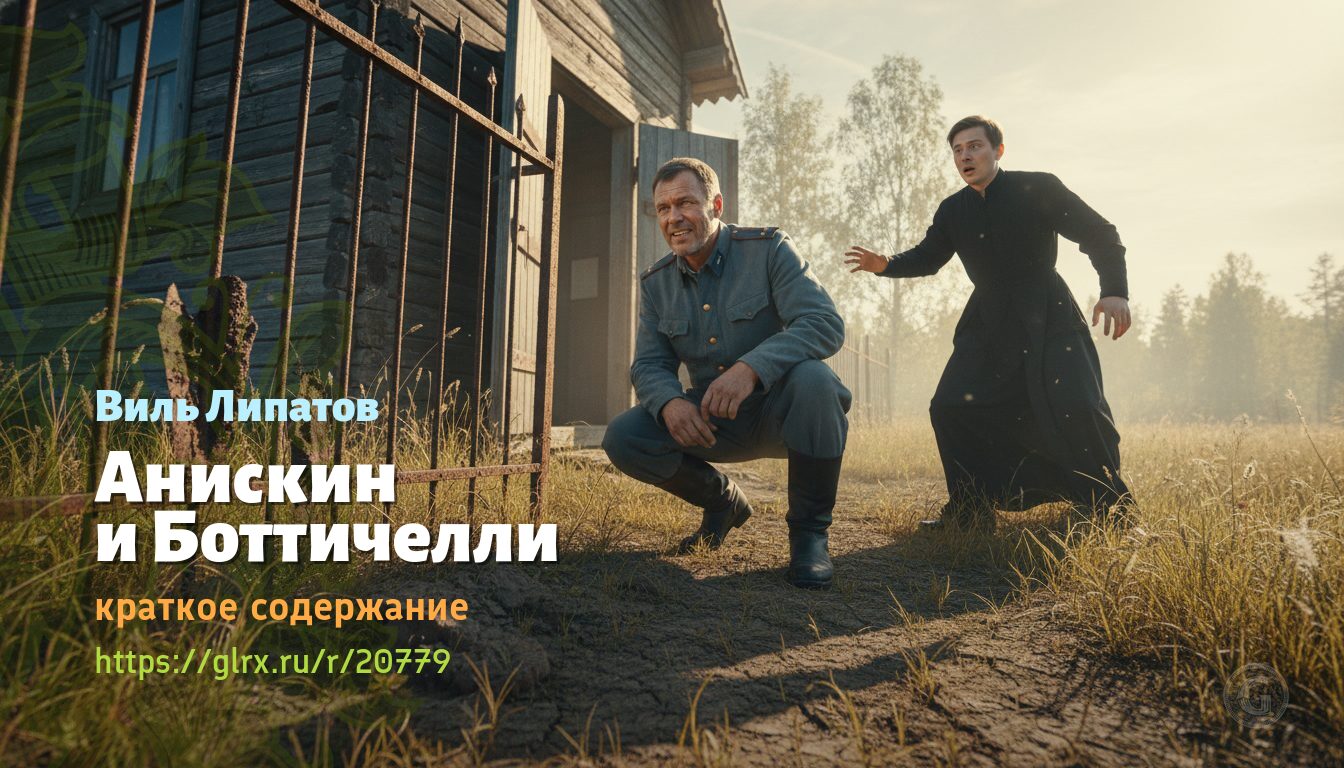
"Aniskina and Botticelli" by Vilya Lipatov, summary
 Automatic translate
This book, written in 1975, tells the story of how an established village life collides with a daring crime from the world of high art. Siberian police officer Fyodor Ivanovich Aniskina investigates the theft of ancient icons, drawing on his intimate knowledge of the characters of his fellow villagers. The work is filled with apt humor and vivid depictions of Siberian life.
In 1977, the story was successfully adapted into a three-part film, "And Again Aniskina." Mikhail Zharov brilliantly portrayed the police officer, and the film was beloved by millions of viewers.
Theft in the temple and the first suspects
One summer day, a young priest, Father Vladimir, bursts into the office of district police officer Fyodor Ivanovich Aniskina, who was dozing in the heat. The priest reports an unheard-of event: a wooden church has been robbed. The thief acted with astonishing skill. He stole twenty-three expensive antique icons and left behind cheap modern replicas. Aniskina goes to the crime scene. Inspecting the high metal fence, the policeman discovers fresh, deep scratches. The police officer determines that the marks were made by soldiers’ boots with massive horseshoes.
Right there in the church, the local police officer interrogates Father Vladimir. It turns out that it was physically impossible for one person to carry such a heavy load at once. The conversation then moves to the priest’s luxurious home. There, Anichkin meets Larisa Dmitrievna, the priest’s wife. This woman is accustomed to city life and is bored among the pilgrims. The couple lists new parishioners who might be eyeing the church’s treasures. The list includes Georgy Sidorov, a geologist, Yuri Burovskikh, a sociable construction worker who works part-time, and the devout Vera Kosaya.
Aniskina decides to consult with the village school principal, Yakov Vlasovich, an avid collector of Siberian antiquities. The principal’s spacious house has been converted into a veritable museum. The walls are covered with rare artifacts. Yakov Vlasovich enthusiastically tells the local police officer about the immense artistic value of ancient Russian painting, underestimated by amateurs. He proudly displays a unique image of St. George the Victorious. According to the principal, an unknown, rebellious icon painter concealed a portrait of Yemelyan Pugachev himself, painted during his lifetime, under layers of dark paint.
After visiting the collector, Anichkin pays a visit to the construction workers at the unfinished silo tower. Foreman Ivan Petrovich gives the policeman a hostile reception, boasting of his past criminal record and prison sentences. The other civilian workers, as well as the cheerful guitarist Yuri Burovskikh and the taciturn Yevgeny Molochkov, watch the verbal altercation with interest. The policeman reprimands the foreman and leaves. On the way, he asks drilling rig worker Vasily Opanasenko to send two smart boys, Petka and Vitka. The policeman entrusts them with an important secret mission.
Night gatherings and village secrets
That evening, Fyodor Ivanovich decides to check the ramshackle house of the former defrocked priest Vaska Neganov. A local drunken group is gathering there. Inside, the walls are covered with vodka labels, and garlands of corks hang from the ceiling. Among the guests, the police officer notices a tall, two-meter-tall sailor, Ivan Grigoriev, who deliberately stayed behind the steamship "Proletary." Peering behind the stove curtain, Anichkin finds Vera Kosaya lurking there. This discovery arouses serious suspicion. Kosaya doesn’t drink alcohol and is known for her extreme greed. Nevertheless, she brought Neganov vodka and was whispering something to the out-of-control riverman.
During the official interrogation, Grigoriev acts cautiously and denies any dealings with Kosa. Meanwhile, a curious incident occurs: geologist Sidorov catches worker Lyutikov red-handed. This volunteer assistant, working on an unofficial assignment from Aniskina, had been spying on the suspects and tried to foist a cheap icon on Sidorov. Exposed, Lyutikov flees in fear and sells the icon for one ruble to the day laborer Burovskikh. Burovskikh, laughing, brings the icon back to the team. This action incurs the furious wrath of foreman Ivan Petrovich, who fears any legal trouble.
While Anichkin conducts interrogations, his wife Glafira conducts covert reconnaissance among the old women. She extracts invaluable information. It turns out that a strange visitor recently visited the local pilgrim, Valeryanovna. A tall man with dark glasses, a false beard, and an unnatural stutter introduced himself as a friend of her student grandson. He persuaded the trusting grandmother to sell two old icons for a pittance.
Soon, news spreads through the village: the house of school principal Yakov Vlasovich has been robbed. The thief stole almost the entire household collection. Only light stains and a couple of damaged, worthless planks remained on the walls. Inspecting the principal’s trampled vegetable garden, Aniskina again finds the print of a soldier’s boot with its distinctive horseshoe. Soon, Father Vladimir brings a typewritten note, tossed on the church threshold along with the damaged planks. The text reads: "What are they teaching you in theological seminaries, idiot? These icons can’t be hung in the toilet! Botticelli." The principal’s wife prompts the puzzled Aniskina that Botticelli is the name of an Italian artist.
A suitcase with a secret
Aniskyn continues to unravel the tangle of secrets. After speaking with the saleswoman Duska, he uncovers a strange detail. A miser named Vera Kosaya has returned eighty-two empty bottles to the store. The local police officer comes to Kosaya’s house, confronts her with irrefutable evidence, and confiscates Grigoriev’s uniform jacket, which he had recently spent on drink. Aniskyn understands the criminal scheme. Kosaya supplies local drunks with alcohol in exchange for goods, receiving money from an unknown, generous puppeteer.
Under the cover of a moonless night, a lanky man carries heavy packages containing stolen icons deep into the dense forest. He hides them in a secure hiding place. The thief disguises his steps by tying a resemblance to a fox tail to his belt and leans on a thick, gnarled stick. However, these cunning precautions are of no avail. The boys, Petka and Vitka, combing the taiga on assignment from the local police officer, discover the hidden forest cache.
Aniskyn contacts Igor Kachushin, an investigator from the district center, by phone. Meeting at the pier, the officers board the ship "Proletary" and head straight to sailor Grigoriev’s cabin. After inspecting the premises, the officer notices a plywood suitcase with no locks, hidden under a folding table. Aniskyn opens the secret latch and finds part of the stolen treasure inside — priceless church icons, ready for transport.
Pressed against the wall, Grigoriev confesses. Vera Kosaya paid him fifty rubles to secretly smuggle a suitcase to the city of Romsk. There, the cargo was to be picked up by an unknown man in dark glasses, who would answer to the password "Botticelli loves Kafka." Under interrogation, Kosaya swears that she received instructions through typed notes and has never seen the man who ordered it. Kachushin devises a daring interception: a sailor with a fake suitcase is sent to the city. Alas, the investigator’s perfect plan goes awry. The cautious criminal fails to show up for the meeting.
Ambush at the hiding place and the capture of Botticelli
Deciding to play it safe, Anichkin and Kachushin set up a night ambush in the taiga, hiding near a cache of icons. To provoke the thief, they leave a gnarled stick he’d forgotten in plain sight. Soon, a tall figure wearing cloth shoe covers, a false beard, and a black wig appears among the trees. Kachushin snaps a sharp photo with a flash. Blinded by the bright light, the criminal dodges and disappears into the undergrowth at the speed of a deer. The captain tries to catch up. Anichkin remains perfectly calm, knowing the fugitive’s exact route.
A panicked thief bursts into Vera Kosaya’s hut. He takes off his faux leather jacket and those same tarpaulin boots with their heavy metal heels. After washing and changing, he emerges from the next room, now disguised as a blond village boy, vaguely resembling the poet Sergei Yesenin. Grabbing an ordinary plywood suitcase, the fugitive strides confidently toward the pier. He hopes to disappear among the bustling crowd of passengers and safely depart on the morning cruise.
The police catch up with the suspect right in the single-berth cabin of the departing ship. Identifying himself as geologist Gleb Moldavsky, the young man tries to deny the accusations. However, under pressure from irrefutable evidence, he gives in and, with a smile, removes his blond wig. Hiding behind the guise of the elusive antique dealer is the moonlighter Yevgeny Molochkov, aka the Moscow restorer and experienced artist Yegor Tupitsyn.
During the final interrogation, the police officer explains his ironclad logic in detail. Of the four initial suspects, Burovskikh was distracted by his courtship of a beautiful saleswoman. Geologist Sidorov turned out to be an ordinary, somewhat rude worker. Sailor Grigoriev came from a family of hereditary drunkards, far removed from art. Only Molochkov remained, possessing the long, dry fingers of a professional painter and the keen eye of a connoisseur. School director Yakov Vlasovich unwittingly led the criminal to the village when he was careless enough to send letters to Moscow collectors containing a detailed catalog of his icons.
The exposed thief confesses to his crime, admiring the Siberian policeman’s natural intelligence and observation. All the confiscated antique icons are returned intact to their rightful owners. Bogomolka Valeryanovna, impressed by the knowledge and talent of the capital’s artist, promises to shelter Tupitsyn in her home after he serves his well-deserved prison sentence. Satisfied with the results, Fyodor Ivanovich Aniskina closes yet another complex case.
You cannot comment Why?