"The House That Swift Built" by Grigory Gorin, summary
 Automatic translate
This book is a philosophical satirical play written in 1980. The text masterfully blurs the line between literary fiction and harsh reality, transforming the writer’s spacious home into a safe haven for the characters he creates. The author deeply explores the true nature of human creativity, personal freedom, and social absurdity. Here, normality becomes a boring convention, and wild fantasy serves as the only reliable defense against everyday cruelty.
This unusual play was successfully adapted into a film in 1982. Mark Zakharov’s two-part television film featured a superb cast and deservedly became a golden classic of Russian cinema.
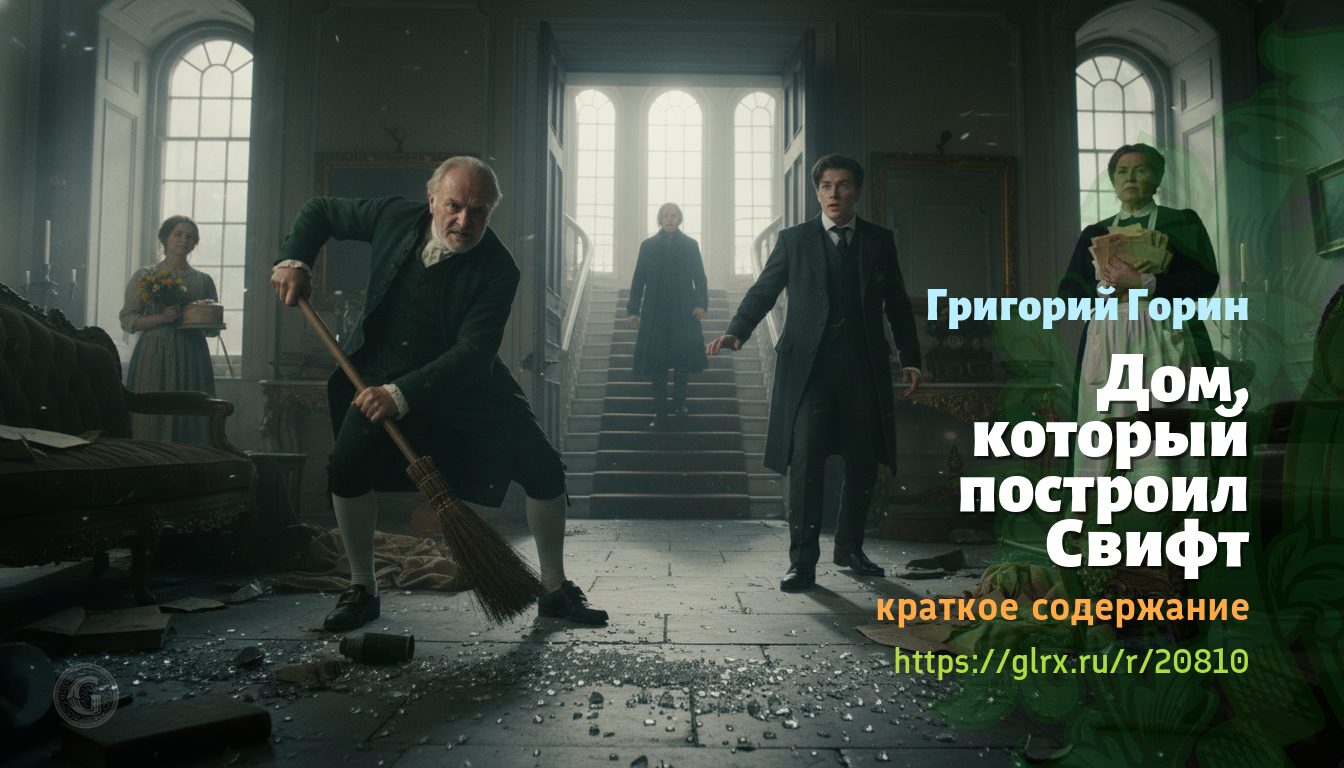
In 1745, a young psychiatrist named Richard Simpson from Nottinghamshire arrives in gloomy Dublin. The Board of Trustees has officially hired him to perform the forced treatment of Jonathan Swift, the famous Dean of St. Patrick’s Cathedral. Near the cathedral’s walls, the doctor hears the mournful ringing of bells. Onlookers eagerly report the writer’s death. They firmly believe the dean is exceptionally punctual and regularly passes away at precisely five o’clock in the evening. Soon, Swift, alive and well, passes by the stunned doctor. Simpson persistently tries to engage the patient, but the writer remains sternly silent.
Arrival at the House of the Mad
The Dean’s mansion is in chaos. The imperturbable butler, Patrick, routinely sweeps up the shards of broken glass. The stern housekeeper, Vanessa, meticulously records street incidents in a special journal. Patrick angrily complains about the strange guests. The enormous mansion is overrun by intelligent horses called Houyhnhnms, people from a floating island, the giant Glum, and an immortal man named Someone, who is confused by millennia. The butler is particularly irritated by the Lilliputians scurrying underfoot. The owner’s will left all his property to madmen. Simpson rightly suspects the guests of brazen charlatanism. Vanessa busily sorts through the morning mail. The writer receives rave reviews from France, and newspapers frighten the townspeople with the appearance of a floating island over Manchester. Esther Johnson peers timidly through the open window. The woman brings wildflowers and sweet apple pudding. Vanessa rudely shoos her rival out into the garden. Swift frowns painfully and hurries out of the room, leaving the fresh tea untouched.
Two tiny midgets, Flim and Relb, are arguing fiercely at the dining table near a giant teacup. The two men are trying in vain to move a heavy lump of refined sugar. Relb angrily criticizes the uncomfortable Saxon porcelain and the strange English customs. The tiny husband is openly jealous of Flim’s relationship with his gravely ill wife, Betty. The men get into a heated argument about their own heights. Flim nimbly stands on Relb’s shoulders, uses a dessert fork as a support, and climbs to the very edge of the porcelain cup. From this perilous height, he enthusiastically describes the shimmering moonlight on the crystal glasses. Relb suddenly notices the thick cork insoles in his friend’s shoes. A brief scuffle ensues. Flim loses his balance and falls with a loud scream into the hot tea. Relb, panicked, bangs on the walls and calls for help.
Swift, Vanessa, and Simpson immediately appear in the dining room. The doctor notices a living creature floundering in a cup. The medic confidently mistakes the drowning midget for a common fly, disdainfully shakes it out onto the tablecloth with his finger, and returns the cup to the dean. The offended writer, without hesitation, splashes the remaining liquid right in the doctor’s face.
In the morning, Simpson begins examining the imperturbable patient. Vanessa openly expresses her indignation at the capital’s doctor’s utter ignorance. The doctor is completely unfamiliar with Swift’s great works. Esther patiently explains to the physician the true nature of what is happening: in this house, people settle accounts with death in a special way. She speaks frankly about the dean’s beloved women. The writer loved Stella and Vanessa equally, but avoided marriage to both. Suddenly, a deafening thud is heard. Patrick shouts angrily at the invisible owner of two enormous shoes. The giant Glum persistently challenges the fearless knight Lancelot to mortal combat. Simpson decisively removes the ancient armor from the wall. He orders the stunned butler to sound the signal for a knight’s tournament.
Tournament and the exposure of the troupe
A plump man of perfectly normal height timidly enters the room. Glum sadly recounts his astonishing origins. His father was a 100% giant from the land of Brobdingnag, standing nearly sixty meters tall. Glum Jr. inherited colossal height and phenomenal intellect from birth. The young man sincerely tried to offer wise advice to the English king. The monarch arrogantly rejected his help and sent an army of knights. Glum spared his compatriots and chose a path of degradation. He regularly drank strong alcohol and followed a grueling diet. The giant forgot all learning and painfully shrank to one hundred and seventy centimeters. Swift reawakened his forgotten noble aspirations. Simpson categorically refuses to draw his weapon. Glum draws a sharp sword and inflicts a mortal wound on himself. An excited crowd of townspeople enthusiastically cradles the doctor in their arms and loudly praises Lancelot.
Judge Biggs, Simpson, and two armed constables rudely interrupt the bloody spectacle. The shocking truth is revealed: Patrick had secretly hired traveling actors to create the perfect illusion of mass madness. The cunning butler simply wanted to avoid an influx of genuine, riotous lunatics. The judge mercilessly sends the arrested performers to the prison van. Vanessa is officially dismissed as housekeeper. Esther is legally given a set of keys and becomes head nurse. An enraged Vanessa throws her personal correspondence into the fireplace. Swift carefully removes the flaming sheets from the fire with her bare hands and tenderly kisses Esther’s burned palm. The police securely install a sturdy iron grate on the actors’ van.
Late in the evening, a red-haired and a black constable stand gloomily by a van. The red-haired guard, Jack, eagerly engages in conversation with the immortal Someone. The wise actor easily coaxes Jack into mentally recalling past lives. The constable obediently returns through the depths of time. He discovers with horror the immutability of his fate. Jack clearly recalls 1933. He stood indifferently on guard in Jerusalem during the trial of Jesus Christ. The guard suddenly realizes the full weight of his centuries-long inaction. He hastily takes out an iron key and attempts to unlock the van. The black constable coldly kills his partner with his service pistol. Jack dies relieved in the arms of Simpson, who arrives just in time. The free actors silently exit the van, and the frantic crowd of townspeople rewards the bloody scene with thunderous applause.
Flying Island
The Board of Guardians, in a panic, holds an emergency meeting. Governor Sir Walp is extremely concerned about the growing street unrest across Ireland. Officials peer fearfully through telescopes at a huge oval object. A local scientist confidently calls it a tailless comet or a mass hallucination. The judge expressively reads a terrifying passage from Swift’s book about a punitive flying island. The island mercilessly descends on rebellious cities, crushing buildings and their rebellious inhabitants. Simpson firmly declares the dean’s 100% sanity. The doctor honestly reports that the corresponding medical report has been sent to London. The officials are genuinely horrified. The writer’s fictitious insanity served as a reliable cover for many years, allowing the British authorities to completely ignore his sharp political pamphlets. The governor openly hints at the urgent need for Swift’s physical elimination. The floating island would be perfect for concealing a planned assassination.
In his office, the Dean dictates an angry written response to yet another London critic to his faithful Esther. The writer firmly believes that man is a cruel animal, only rarely receptive to clear reason. A heavy stone suddenly flies through the broken window. An enraged Simpson drags a desperately resisting Patrick into the office. The doctor directly accuses the butler of attempting to kill his master. Esther ardently defends her faithful servant. She explains simply: flying cobblestones always replace delicate flowers for a satirist. The dead silence and cold indifference of well-fed spectators slowly kill a true artist. In a blind rage, Simpson grabs the Dean’s book and throws it hard through the glass. A cold wind instantly scatters the torn pages across the damp courtyard. Reassured, the shamed doctor obediently helps Patrick gather up the wet sheets of paper.
The butler insistently advises the doctor to carefully leaf through an adapted children’s edition with color pictures. Simpson obediently flips through the thick book and spends a long time examining the familiar illustrations. The doctor suddenly realizes he’s a real-life Gulliver. He feverishly dons a green traveling jacket and a wide-brimmed hat. Simpson furiously drums on the keys of an antique harpsichord, loudly sings a cheerful Nottinghamshire song, and leaps out the open window. The assembled crowd of townspeople cheers his heavy fall.
Journey to the Land of the Dead
The stricken doctor awakens on a soft sofa. Esther and Patrick insistently urge him to remain silent and communicate exclusively through his thoughts. A noisy crowd of strangely dressed Laputians from the distant future brazenly bursts into the office. They click camera shutters incessantly and behave with defiant rudeness. A self-assured Laputian tour guide publicly calls Swift a forgotten and boring writer. The uninvited guest takes an academic publication of the Board of Trustees from his briefcase. It clearly states the exact date of the dean’s death: October 19, 1745. Simpson silently draws a heavy pistol and decisively expels the insolent newcomers from the room.
Swift breaks his long-standing vow of silence for the first time. He directly asks the doctor the exact time of his impending death. Simpson categorically refuses to tell his patient. The brilliant writer instantly calculates: he has exactly two short hours left to live. Swift firmly resolves to orchestrate his own death according to the strict laws of theatrical art. He authoritatively dictates a detailed medical protocol to Simpson. The dean orders it recorded: "The writer voluntarily embarks on a long journey to the mysterious land of the dead to openly mock the Grim Reaper."
Patrick and Esther hastily fetch their devoted actors. The giant Glum happily announces the good news: his legs have begun to grow rapidly again. Someone loudly envys the writer’s long-awaited death. Swift tearfully asks the women to beautifully enact a farewell romantic scene at the altar. Esther and Vanessa instead begin a furious argument over the right to love the dean. The exhausted writer frankly admits: both beautiful women will forever remain in his torn heart. The heavy bell of St. Patrick’s Cathedral rings loudly. Flim, the midget, and the revived red-haired constable Jack appear on the threshold. They silently call for the dean to follow them. Swift obediently steps out into the dark square to the roaring crowd of curious onlookers.
Simpson remains alone in the empty office. The doctor clearly hears the growing noise of the crowd and thunderous applause. The doctor carefully writes the final, fateful lines in the official report. He describes in detail the motionless body of Jonathan Swift on the cold ground. The doctor mentally touches his cooling hand and prepares to publicly announce his death. At that very moment, the deceased winks cheerfully and cheekily at the stunned doctor. Simpson finally understands: before him lies a great, unrivaled actor, capable of easily stopping his own breathing for the triumph of art. Faithful actors carefully carry the body backstage. The audience calmly disperses to their homes. The mournful ringing of bells increases, signifying the eternal triumph of pure fantasy over physical death.
- “Thank You for Arguing: What Aristotle, Lincoln, and Homer Simpson Can Teach Us About the Art of Persuasion” by Jay Heinrichs
- The long-awaited meeting of Goncharov’s novel with an English reader. It remains to translate "Cliff"
- Exhibition of Contemporary Art "Alchemy"
- Group exhibition of film artists "Bedtime Story"
- Igor Dryomin: Doll Puppet Stories
- "Gulliver’s Travels" summary
You cannot comment Why?