"Visit to the Minotaur" by Arkady and Georgy Vainer, summary
 Automatic translate
This book is a detective novel written in 1972. The plot is based on the true story of the robbery of the apartment of the eminent Soviet violinist David Oistrakh. The authors add to the narrative the theft of a unique Stradivarius violin. The text is divided into two parallel timelines. The investigation of the theft in Soviet Moscow is interspersed with historical chapters about the lives of violin makers in Cremona, Italy, in the seventeenth century.
In 1987, a highly successful television series of the same name was made based on the novel. Director Eldor Urazbaev assembled a superb cast, and the classical music gave the film a particularly philosophical tone.
Historical line of Cremona
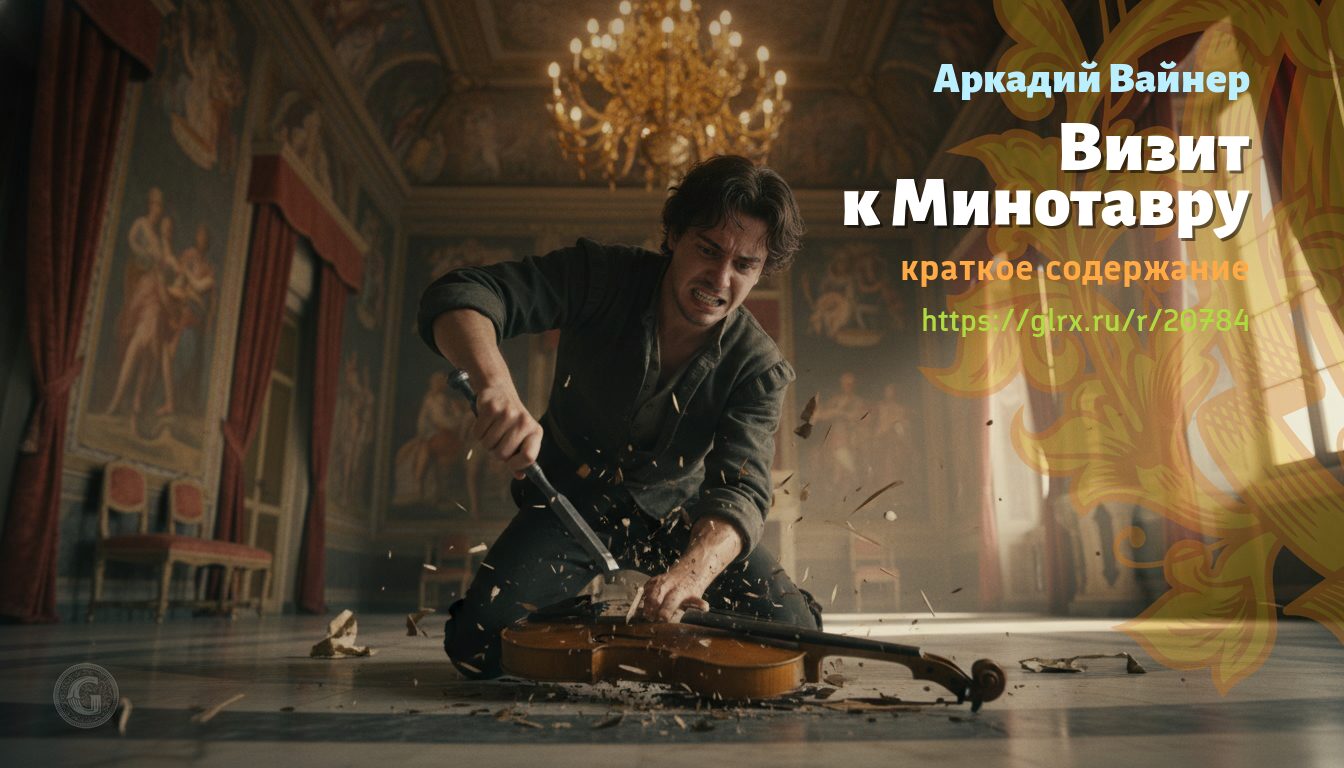
Woodcarver Antonio Stradivari suffers a terrible humiliation at a reception with Count Monzi. The violin he made sounds dull and heavy. In despair, the young man breaks the instrument with a chisel. Soon, Antonio becomes an apprentice to the renowned Niccolò Amati. The young man yearns to find the perfect tone and the secret of the famous varnish. Amati asks, "What will you give me in return?" Antonio replies, "I know how to learn…" He spends long nights searching for the right proportions and chemical compounds.
Over time, Antonio develops his own varnish recipe. He adds the juice of the poisonous Caucasian spurge to the brew. Old Amati acknowledges his apprentice’s undoubted superiority and blesses Stradivari to set out on his own. Antonio acquires his own house in Cremona. He marries Francesca Feraboschi and has sons. However, at first, no one buys the young master’s instruments. For many years, the family lives in dire poverty. Stradivari works tirelessly, day and night.
One day, the French merchant Duvernoy begins buying Antonio’s violins for next to nothing. Gradually, Stradivarius achieves great fame and immense wealth. Meanwhile, family life brings bitter disappointments. His sons are deprived of their father’s gift. The eldest son, Paolo, suggests that his father abandon his craft and open a commercial house for trade. The master angrily dismisses his heir, accusing him of bourgeois greed. Antonio realizes he is doomed to the loneliness of genius.
Through agonizing mathematical calculations, Antonio creates a violin of unprecedented power. He names the magnificent instrument "Santa Maria." Later, a poor young man, Giuseppe Guarneri, asks to become his apprentice. The old Stradivarius refuses the sick young man. Guarneri falls into harsh bondage to the Jesuits. For fifteen years, to earn a living, he creates brilliant instruments for the order under the Del Gesù brand.
At Antonio Stradivari’s funeral, the forgotten, tuberculosis-stricken Guarneri plays his violin. Great, free music resounds over the astonished crowd of townspeople. Art proves its superiority over worldly vanity, envy, and wealth. The small, hunched man walks away, taking with him the secret of great mastery.
Moscow investigation
A daring crime occurs in Moscow in the 1970s. A Stradivarius violin, the "Santa Maria," disappears from the apartment of Lev Osipovich Polyakov, a conservatory professor and People’s Artist of the USSR. Senior Criminal Investigation Inspector Stanislav Tikhonov and his assistant Elena Lavrova inspect the scene. The thief gained entry by picking keys. The criminal left behind burnt matches and a portrait of the Belgian queen thrown from the wall. Forensic expert Khaletsky finds traces of blood on the shards of broken glass.
A heavy thief’s crowbar with embossed lightning bolts lies in the chair. Detectives find the remains of burned pages from a phone book on the floor. A used trolleybus ticket is discovered in the hallway. Inspector Tikhonov uncovers the first details of the theft. The keys to Professor Polyakov’s apartment were kept by a neighbor, Evdokia Petrovna. The neighbor’s husband, a heavy alcoholic named Sergei Obolnikov, had access to them. Detectives travel to a drug treatment clinic to question the suspect.
Obolnikov swears to the investigator that he was not involved in the instrument’s disappearance. He is forced to confess to Tikhonov: "I secretly snuck into Polyakov’s apartment at night to drink someone else’s wine." Investigators are closely investigating Polyakov’s former friend and longtime rival. Violinist Pavel Ikonnikov has long since given up music. Embittered by the world, the herpetologist works in a serpentarium, breeding deadly venomous snakes. He has long harbored a grudge against Polyakov because of his musical success and worldwide fame.
In conversations with Tikhonov, the herpetologist philosophizes about the biblical Cain. He proves the innocence of the first murderer. Ikonnikov is certain: "The Minotaur of laziness, vanity, and envy dwells within each of us, slowly devouring the human soul." During the conversation, the herpetologist frightens Tikhonov by throwing a live coral snake. The detectives simultaneously interrogate other acquaintances of the victimized professor. Among them, the elegant piano tuner Grigory Belash stands out.
In his youth, Belash showed great promise and studied with Ikonnikov. The boy broke his arm, forever losing his chance to become a virtuoso. The tuner claims to investigators that he was on a business trip to Leningrad at the time of the theft. His alibi is ironclad with travel documents and the testimony of credible witnesses. Soon after, Ikonnikov dies in the laboratory from the bite of a deadly venomous snake. A blue krait stings its owner. The tragedy is made to look like an accident.
The dead Ikonnikov leaves a suicide note. The former musician writes to investigator Tikhonov: "I was cleverly used as a cover to distract the police." Ikonnikov asks him to convey his sincere apologies to Polyakov. Tikhonov is absolutely certain that Ikonnikov’s death was the deliberate suicide of a man driven to a dead end by his own fears and illness. The inspector begins to search for hidden connections between the defendants in the criminal case.
Exposing the criminals
Forensic experts miraculously recover the burned phone number from Polyakov’s notebook. The inspector contacts an elderly locksmith named Melnik, who lives in Golitsyno, near Moscow. It was this grim-faced man who made the duplicate keys and the thief’s crowbar. A search of Melnik’s log house turns up a Philips tape recorder and some of Polyakov’s stolen medals. The violin is not among the confiscated property. The old man confesses to the crime to the detectives but denies having accomplices. The investigator catches the old man in a lie.
Melnik explains that he was hired by a repeat offender named Yakov Krest for a certain Owner. The locksmith merely broke open the front door. The Owner entered the apartment and quickly left empty-handed. Melnik, out of greed, ransacked the apartment himself, taking all the belongings. Tikhonov understands the essence of the cunning operation. The Owner broke into Polyakov’s office and took only a Stradivarius violin. The inspector analyzes the facts and retrieves old criminal records. He establishes the identity of the true mastermind of the theft.
An unpleasant truth about the piano tuner’s past comes to light. In his youth, Belash participated in an apartment robbery with hardened criminal Yuri Lopakov. On that occasion, Belash miraculously escaped trial. The criminal underworld continued to hold him tightly captive. A repeat offender, Nikodimov, escapes from prison across the frozen Yenisei River with Lopakov. He finds the piano tuner in Moscow. Belash, consumed by envy of Polyakov, leads Nikodimov to the professor’s apartment. Nikodimov uses the criminal nickname Yakov Krest.
On the night of the theft, Belash provided himself with a foolproof alibi. He pretended to sleep at the European Hotel in Leningrad. The violin tuner himself secretly took a red-eye flight to Moscow. Belash posed as the mysterious Master and stole the violin from Polyakov’s apartment. He then handed the instrument over to Krest in the square near the train station. In the early morning, Belash returned to Leningrad on the overnight Yerevan-Murmansk train. The alibi he had constructed crumbled before the detectives’ eyes. Tikhonov formally charged Belash.
Confronted by Melnik, the piano tuner completely loses his composure. Pressed by the evidence, the criminal confesses to orchestrating the kidnapping. Belash confirms the grim theory of his late teacher, Ikonnikov. The piano tuner admits: an inner Minotaur of envy and malice has completely destroyed his personality. The musician is hysterical, but has no idea where Krest is currently hiding. An empty tin of pickled mushrooms suddenly becomes the investigation’s main lead. Lavrova notices this jar among the dirty dishes in Belash’s apartment.
Detectives decipher the factory code on the metal lid of the jar. Lavrova identifies the village store in the Vladimir region where the mushroom shipment was delivered. Detectives set up an ambush in the local general store. They decisively detain the mushroom procurement officer, Polozov. This unassuming identity was actually the fugitive killer Nikodimov. The police thoroughly search the arrested bandit’s suitcases. A Stradivarius violin hidden in a sack of flour is carefully retrieved. The two-hundred-year-old instrument is returned to a happy Lev Polyakov.
- Igor Dryomin: Dmitry Ikonnikov. Upstream flight. Vernissage in ARTSTORY
- "Music of Russian Ballet" Swan Lake, The Nutcracker and Sleeping Beauty
- "Inner circle". Exhibition of works by Dmitry Ikonnikov
- "Kitchen of the artist or "entrance from the yard"
- Friends/Strangers 18+
- The development of instrumental music in the Baroque era
You cannot comment Why?