"Chagin" by Evgeny Vodolazkin, summary
 Automatic translate
"Chagin" is a novel about the archivist and mnemonist Isidor Chagin, written by Evgeny Vodolazkin and published in 2022 by Elena Shubina Publishing House. The book is structured as a dual narrative: first, a documentary chronicle constructed from Chagin’s own diary entries and commentary by the young archivist Pavel Meshchersky; then, Meshchersky’s correspondence with a woman named Nika. The epigraph is lines from Joseph Brodsky’s poem "Odysseus to Telemachus": memory, oblivion, and the price of betrayal — these are the three axes around which the entire novel revolves.
In 2023, the novel received the first Big Book award, the third such award for Vodolazkin after Laurel (2013) and Aviator (2016).
An archivist with a phenomenal memory
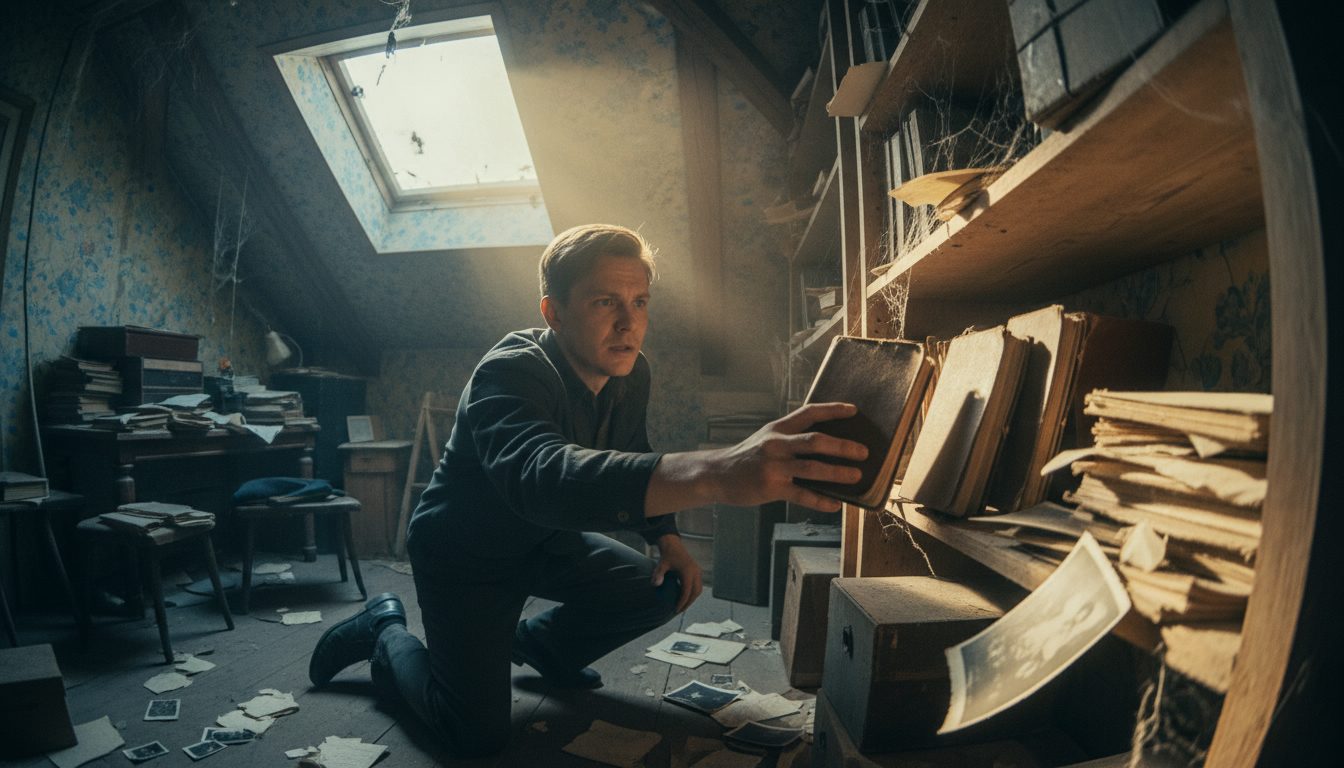
The narrative opens with the death of Isidor Panteleevich Chagin (1940–2018). Archivist Pavel Meshchersky receives an order from the director to sort through the personal archive of his late colleague — the very same mnemonist whose sessions were once featured in journals but are now almost forgotten. In an attic on Pushkinskaya Street, Meshchersky discovers four notebooks — Chagin’s diary, begun on January 1, 1957, and kept without missing a single day. The manuscript is soon stolen, and Meshchersky reconstructs it from memory and his own notes — this very circumstance plays on the theme of gift and its fragility.
Chagin grew up fatherless in Irkutsk: shortly before his son’s birth, his father, Panteley Chagin, left the family, leaving only the phrase, "If it’s a boy, his name will be Isidor." The name is biblical, almost celebratory — his mother wasn’t happy about it, but they grew accustomed to it. His childhood occupies a special place in the diary: the tasteless semolina porridge in kindergarten, the orange-threaded bloomers his grandmother wore inside out, a trip with his mother to Moscow’s Gorky Park, the Christmas tree at the Irkutsk House of Pioneers — Isidor records everything with the precision of a CCTV camera. Nothing in these years suggests a phenomenal memory.
Leningrad and recruitment
At the philosophy department of Leningrad University, the gift reveals itself by chance: during a term paper defense, it turns out that Chagin’s work is a verbatim copy of Professor Spitsyn’s book. Discovering that Isidor simply reproduced everything he read, the dean (later to become rector) turns the phenomenon into a tool for his own aggrandizement — the student twice recited his congress report to a Moscow commission, to applause. The rector finds Chagin a job in Leningrad instead of the Irkutsk he was supposed to be assigned to, but another force is behind this: two secret service agents posing as librarians — the gallant Nikolai Petrovich and the brutal Nikolai Ivanovich. They offer Isidor an apartment on Pushkinskaya Street in exchange for a visit to the Schliemann Circle and a detailed account of its meetings. Their argument is a precisely thrown champagne cork, which flies silently into a crystal vase.
The Schliemann circle meets at the home of the historian Velsky. At first, the conversation revolves around Troy and Schliemann, and the Codex Sinaiticus, sold by the Soviet government to the British Museum for one hundred thousand pounds in 1933 — exotic but innocuous topics. Gradually, the tone shifts: Velsky begins to discuss the Novocherkassk massacre of 1962 and other crimes of the regime. Chagin records everything and recounts it to Nikolai — and simultaneously falls in love with Vera Melnikova, a member of the circle. When Velsky is arrested and convicted of anti-Soviet agitation, Isidor shouts from the courtroom, "Georgy Ivanovich, forgive me!" — but there is no reconciliation. He confesses to Vera himself, and she leaves, unwilling to hear excuses: for her, betrayal is the only thing she will not forgive.
Life as asceticism
Chagin’s subsequent existence is a long renunciation of everything that came with his Leningrad apartment and his brilliance as a mnemonist. A gray suit, a gray tie, a nylon raincoat the color of wet asphalt, tar soap with which he washes his hands after every handshake, a black umbrella that has become a walking stick. Repentance is not declared, but embodied physically — a man literally paints himself the color of self-removal. Working in the Archive, he describes other people’s documents with the same meticulousness with which he once memorized other people’s texts — and so decades pass.
Correspondence and the finale
The second part of the novel consists of letters between Meshchersky and Nika, an employee of the nursing home where Vera is spending her final years. Pavel tells Nika about the Diary, and Nika responds by describing the current life of Vera and Chagin: they are finally reunited — Isidor has rented a dacha in Komarovo, and they sit together on a fallen pine tree by the Gulf, silently listening to the wind. Vera, ill and almost paralyzed, smiles with her eyes closed.
The correspondence becomes a novel within a novel: Pavel and Nika also fall in love, separate, and finally find each other, repeating the story of Isidore and Vera. The final chapter is called "Lethe and Eunoea" — after the two rivers of Dante’s Purgatory: one erases the memory of sins, the other restores memories of good deeds. Chagin dies in Totma, a small northern town — he went there in the final months of his life. In old age, his phenomenal memory fades: he forgets his purpose and confuses dates. Meshchersky remarks that this seems to be precisely what Isidore had been striving for all his life — the right to finally forget something.
You cannot comment Why?