"What’s the Price" by Dmitry Glukhovsky, summary
 Automatic translate
This book is a short satirical story, first published in 2008 in the magazine "Russian Pioneer" and later included in the collection "Stories about the Motherland." With dark humor, the work describes the brutal underbelly of Moscow’s 19th-century construction projects, where human life has a strictly fixed price and migrant workers literally become biological raw material for a clandestine industry.
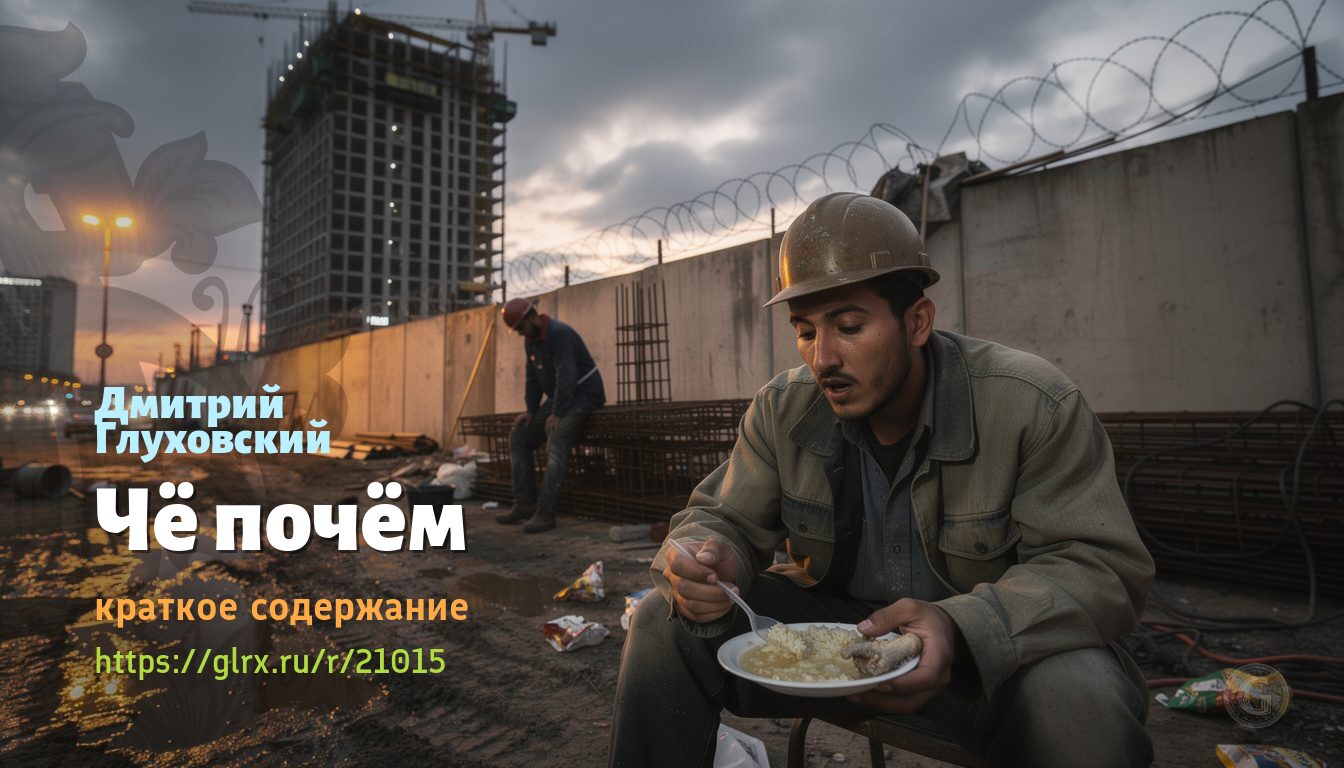
Lunch break and worker’s nightmares
Abdurakhim, a young migrant worker from Tajikistan, is eating lunch at a construction site. His plate contains a thin pilaf. The food is made from cheap, skinny chicken legs. The meat is completely fat-free. In his distant homeland, the village of Pongoz, authentic pilaf is always made from fatty lamb. According to local custom, the dish is eaten with the hands. People crunch the thick, yellow-fat rice into tight lumps. On the construction site, however, the workers use fragile plastic forks.
Finding good meat in slushy, smoky Moscow is practically impossible for migrants. For Abdurakhim, the vast capital is confined to a space of just one square kilometer. Life takes place behind a high, three-meter-tall concrete fence. Beyond this perimeter, the real Moscow begins. However, leaving the perimeter is dangerous. The city is patrolled by police officers. They constantly circle around the construction sites of the century. The security forces are looking for easy prey among disenfranchised newcomers. Abdurakhim has experience dealing with security guards. He served time in prison in his home country. In Moscow, his meager vocabulary is insufficient to deal with the patrols.
Welder Farukh from the third team once tried to smuggle a piece of fresh lamb through a checkpoint. Security confiscated the meat. The entire team was severely punished. The construction workers received a harsher reprimand than for attempting to smuggle hashish a week earlier. There are many rules on the construction site. Management doesn’t tell the migrants about all the local laws.
Abdurakhim’s team is being prepared for immediate transfer to a new site. To celebrate, the cooks have made chicken pilaf. The workers are being sent to build the colossal Pamir Tower. The building is located far beyond the ring road. Its upper floors reach high into the damp clouds. The top of the tower is almost never visible. The builders are terrified of this new location. There are persistent rumors that people die in accidents at Pamir. Workers who have served their time are quickly sent home. Management explains this is due to visa compliance. However, salaries at Pamir are twice as high as usual.
That night, Abdurakhim has a disturbing nightmare. He’s trying to climb a long ladder to the very top of a tower under construction. There’s no end in sight. Suddenly, an invisible voice tells him his plan is futile. The tower turns out to be a living organism, constantly growing upward.
Concerns of the construction site owner
Meanwhile, the owner of a construction business wakes up. Arkady Petrovich Krotov is awakened in the backseat of his two-tone Maybach. The businessman feels extremely tired. He spent the previous night with a fashion model, celebrating his rise up the rich list. Krotov is required to clean up the construction site. A high-ranking inspector is scheduled to arrive today. The owner wants to avoid problems and possible fines. The Pamir Tower is managed by a special internal management team. Security there is extremely strict. It is a veritable construction site within another construction site. Only a select few are allowed inside.
Krotov’s sapphire-encrusted cell phone rings. The device is equipped with a special magic button. It usually connects wealthy owners with concierges. Krotov reprogrammed the button to the number of the head of security. On the phone, Arkady Petrovich irritably discusses logistics issues. He refuses to fly his personal Bombardier jet for another shipment of sensitive cargo. Krotov orders a simple chartered Il-76 to be chartered. The businessman advises selling the damaged goods, without certificates, to Indians at a reduced price.
Then Krotov switches to the second line. He discusses the recent purchase of a large restaurant chain. The businessman is preparing a gift for Lyalya’s birthday. Krotov suggests renaming the chain "Organika" and making it completely vegetarian. Meat is already on the wane. After this, he gives clear instructions to bribe a certain professor. Krotov is willing to pay the scientist twenty thousand rubles a month. In exchange, the professor must send his young students to the company.
Accident at height
The next day, Abdurakhim’s team is assigned to different floors of the gigantic "Pamir." The Tajik worker ends up on the sixty-second floor. Inside, the skyscraper looks wild and half-abandoned. In places, the exposed concrete has already been covered with smooth drywall. Electrical outlets are scattered across the walls. Nearby, concrete slabs covered from floor to ceiling are visible, covered in graffiti. The pungent smell of musty urine permeates everything. Abdurakhim’s colleagues are withdrawn. The worker decides that his fellow countrymen are abusing parcels from the Chui Valley.
For five hours, the migrant worker squats in front of a huge panoramic window. It offers a magnificent view of Moscow. Then he approaches the foreman. The supervisor is listlessly tinkering with crossword puzzles. The foreman’s scratched cell phone rings, blaring Fergana melodies. The foreman listens to a short order and sends Abdurakhim to work. The construction worker is assigned to fill the cracks between the drywall screens and the ceiling.
A worker climbs a rickety stepladder. The ladder rests in a puddle among coils of exposed wires. As soon as Abdurakhim reaches the ceiling, an electric shock pierces his body. The current runs from his left foot to his right. The young construction worker’s career ends there.
Guests from high offices
Expensive cars are parked near the tower. A predatory "seven" with government license plates is cooling off in the parking lot. Two commercial Mercedes with flashing lights are parked nearby. On the seventy-eighth floor, Krotov is receiving three high-ranking guests. An elderly man in a blue suit stands out among them. Gold cufflinks featuring general’s stars gleam on his cuffs. Nearby sit a plump, bespectacled official with an English tie and a tall, balding man with a narrow skull.
The general is drinking expensive Scotch whiskey. He starts talking about the increasing number of accidents at the construction site. Krotov justifies the rare misfires. The general reminds them of the established fees for press silence. Each prevented publication costs one hundred and ninety thousand rubles. A three-percent penalty is imposed for published material. The fat official is surprised by this approach. He asks why Krotov hires Tajiks instead of conscientious German workers, given such enormous budgets.
Arkady Petrovich explains his position. Germans drink a lot of beer and damage their livers. Tajik workers don’t drink alcohol. At construction sites, migrants undergo a special three-month rehabilitation course. The workers’ bodies are cleansed of harmful substances. The migrants become fit. The bald official admires the modern approach of the thrifty owner.
Operating room under the roof
Abdurakhim regains consciousness. His head is splitting. The worker lies naked on a gurney. His body is covered with a forlorn sheet stained with blood. A sour smell assaults his nose. The migrant rejoices at his miraculous survival. Russian medicine was able to revive him after the electric shock. In his homeland, he would have already been buried.
Soon, the migrant notices a large operating table. Three surgeons in green scrubs are fussing over a patient. The doctors are covered in fresh blood. Abdurakhim recognizes a tiler he knows named Fakhraddin. The patient is breathing through a plastic mask with a corrugated hose.
The medics work quickly and cynically. One of the surgeons demands the patient be turned over. The doctor makes an incision and removes a kidney. The organ is placed in a portable plastic refrigerator. Then a medical saw begins to whine. The surgeons open the tiler’s chest. Bones crunch. The heart monitor emits a monotonous, thin beep. The doctor removes the twitching heart and tosses it into a container. The surgeon declares the remaining organs unusable. He orders the body to be placed in a refrigerator and the next worker prepared. Abdurakhim realizes the true purpose of his presence in the tower.
Merger of capital and security forces
In Krotov’s office, two officials go to the restroom. The general is left alone with the businessman. The security official takes out a notepad and gets to the main point of the conversation. He praises Arkady Petrovich’s secretive business. The general cites precise demographic data from a report. Tajikistan’s population is growing steadily. The birth rate exceeds the death rate by almost four times. This is an ideal and eternally renewable resource.
The general cites current prices on the black market for transplants. A single human kidney costs one hundred thousand dollars. A set of two is valued at two hundred and fifty thousand. A liver sells for between one hundred and fifty and three hundred thousand. A heart costs up to three hundred and fifty thousand dollars. One healthy migrant brings its owner around six hundred thousand dollars in net profit. With a daily rate of twenty processed people, the profits are astronomical. The general calls this scheme a brilliant innovation. Krotov turns pale with fear. He approaches the open window, preparing to jump.
A deal and a sudden ending
At the same time, a naked Abdurakhim leaps from the gurney. He races down the clinic’s corridor. Chrome-plated machinery flashes past. The bodies of his dead compatriots soak inside the tanks. A worker runs past rows of refrigerated chambers. Nameplates with the construction workers’ names hang on the doors. Abdurakhim pushes past the guards. A bright observation balcony looms ahead. The worker runs out into the fresh air. High above, clouds float far below. Abdurakhim hopes to find a fire escape, but there is none. Armed guards and doctors block the way back. The cornered migrant climbs onto the parapet.
On the seventy-eighth floor, the general stops Krotov at a window. The security official offers a lucrative deal. Government agencies take fifty percent of the turnover. In addition, Krotov must voluntarily donate organs to a fund for veterans of special forces groups. The general inquires about the methods for disposing of the workers’ remains. Krotov alludes to a chain of shawarma kiosks. The general criticizes this method. He advises the businessman to enter into a contract with the large Mikoyan Meat Processing Plant. The security officials have complete control over this enterprise and shield it from inspections.
Arkady Petrovich accepts the terms. He wipes his palms on his pants and returns to the table. Animated officials emerge from the restroom. They admire the touch-sensitive bathroom fixtures and invite Krotov to join the party. The businessman is about to answer, but a dark figure flies past the window. A short, broken scream is heard. Krotov flinches. The general takes out a pencil. The security official makes a note in his notebook. He tells Krotov, "This is the standard rate." The guest advises him to relax and adds, "That’s it, happy ending!"
You cannot comment Why?