"The Blade of Era" by Vlad Rayber, summary
 Automatic translate
"The Blade of the Era" is a fantasy novel, dated 2013 in the text itself, in which everyday Moscow life, with its hospital, buses, school, and cramped apartment, gradually reveals itself as a thin veneer over an alien and far more brutal reality. The author has also described the book as an urban fantasy with elements of "time travel," and this formula accurately conveys its course: the fate of a girl from another world becomes intertwined with the lives of ordinary people who, for a long time, don’t know who they’ve let into their home.
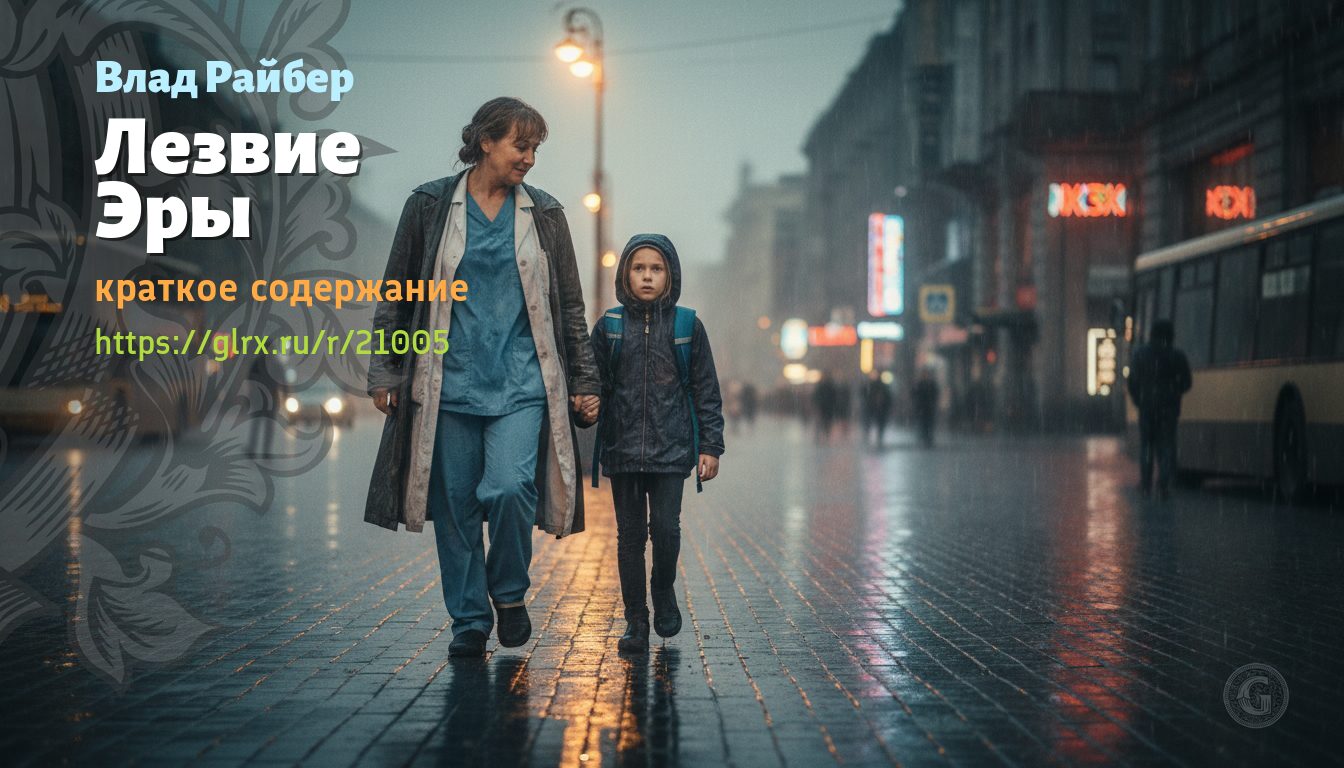
The book begins with Inna, a nurse who has been living for a long time after the death of her young daughter, seemingly by inertia. She works night shifts, avoids unnecessary conversations, and clings to routine, because her empty apartment and memories of the past hurt her more than fatigue. At the hospital, her life changes dramatically: amidst the turbulent shift, a strange girl appears, silent, wary, and clearly out of place. Inna is drawn to her not only out of pity — in this child, she senses a chance to become a mother again and save at least someone, since she couldn’t save her own daughter.
The woman takes the girl in, and with this decision, their new family begins. The girl’s name is Era, though this name conceals a much older and more difficult history. Inna teaches her the basics of everyday life: waking up in the morning, getting ready for school, eating at the table, following a schedule, and not being afraid of people and city noise. For Inna, caring for Era becomes a way to return to life, while for the girl, Moscow life seems temporary, as if she’s trying on someone else’s role and doesn’t yet know her true place.
A year after their meeting, life has seemingly stabilized. Era is already going to school, living as Inna’s daughter, and trying to accept the quiet order that has developed in their apartment. Yet, she constantly feels alienated: she sees familiar things as if for the first time, overreacting to the weather, city faces, bus stops, and sudden details that have long since become background noise for everyone else. Her memory seems to be split in two, and her peace lasts only until the past begins to return in brief, painful flashes.
In parallel, the story of Maxim, a Moscow teenager haunted by the same dark force, unfolds. He is tormented by dreams in which a creature doesn’t try to kill him outright, but slowly terrifies him, drives him into a corner, and feeds on his fear itself. Maxim senses that these are no longer ordinary nightmares or a mental breakdown, but a real presence that has taken up residence alongside or within him. While Era is just learning to live in Inna’s world, the novel is already tying their destinies together.
The turning point comes when Era meets Aizhan. This girl arouses in her not a schoolboy’s interest or everyday sympathy, but a sense of dangerous recognition, as if behind a familiar face lies a door to a long-lost life. Through Aizhan, and then through Saule, a layer of memory long sealed off from Era enters the narrative. Everything that seemed an oddity in her character begins to take on a new meaning: her language, her reactions, her fears, fragments of images, and the acute sense that someone else is hidden behind the guise of a Moscow schoolgirl.
The novel then increasingly detaches itself from Moscow and reveals Erra’s past — this is Era’s true form in another world. There is another home, different laws, the vast steppe, stern adults, Laia and Gammel, and there lies the beginning of her duty. Erra is associated with weapons, with the scythe, with the very idea of cutting off evil, which doesn’t always have a body of its own and often lives within people, parasitizing on their weakness, pain, and confusion. From these chapters, it becomes clear that the girl is not a random, lost orphan, but a participant in a struggle that has come to Moscow from an entirely different space.
The return of her memory doesn’t free Era. On the contrary, the more clearly she remembers her former self, the harder it is for her to remain Inna’s daughter and an ordinary schoolgirl. She increasingly lives in tension between two names, two sets of feelings, and two responsibilities: one part of her longs for the warmth of home, Inna’s care, the rare moments of friendship and peace, while the other demands that she complete the task for which, in essence, she came into this world. It is in this internal fissure that the book is most powerful: Era doesn’t want to be an executioner, but she cannot escape her task.
In this story, Inna remains a person who knows nothing for certain, but senses the tragedy in her heart. She loves Era simply and directly, like a mother, and therefore feels her coldness, isolation, and sudden breakdowns especially keenly. For Inna, the girl is salvation after years of loss; for Era, Inna is a nearly impossible, late-stage form of a home she should never have had. Because of this, every scene between them is tinged with hidden pain: one tries to keep her child close, the other already knows that she may have to go somewhere beyond the reach of a mother’s love.
The closer the denouement gets, the more clearly Era sees the connection between herself, Maxim, and the creature that has grown around him. She understands that Maxim himself is not equal to evil, though evil speaks through him, lives alongside him, and hides behind a living human soul like a shield. Hence the book’s main moral burden: the host must be destroyed, the one who still harbors goodness, the memory of family, fear, shame, and the ability to regard falling snow as a miracle. Even when Era learns more about his father’s role and the long-ago operation, this knowledge doesn’t simplify the choice, but makes it even more terrifying.
Before the finale, Era falls gravely ill, or, more accurately, allows her body to weaken because her soul resists what must happen. Inna nurses her, not realizing that the fever is not caused by a cold, but by a breakdown of will and memory. Then snow falls — a rare moment of purity in the book, against the backdrop of which Era and Maxim’s final meeting unfolds. On the roof, Maxim no longer hides or attacks her: he knows the truth, guesses its origin, senses how the creature within him fears the girl, and almost calmly accepts the outcome.
Their conversation before the execution is structured not like a fight, but rather a brief respite from the inevitable. Maxim speaks of fate, of light, of snowfall, recalling his childhood, and seems to be moving away from the filth that has consumed his life for so long. Era hesitates until the last minute, because before her is no longer a monster, but a living man, tormented by someone else’s darkness. A single blow of the scythe decides everything: Maxim’s head separates from his body with almost frightening ease, the snow around him is stained with blood, and the book ends on this harsh, cold, and merciless image.
The ending doesn’t soften the blow or hide the price of victory. Era fulfills her duty, but that duty demands not a heroic gesture, but the execution of a man in whom evil lurked behind the last vestiges of light. Therefore, the novel ends not with a sense of triumph, but with a heavy silence: gray clouds roll over the roof, snow falls, and the girl, having discovered her past, can no longer return to her former innocence.
You cannot comment Why?