The technology behind the creation of Russian Dymkovo toys
 Automatic translate
Dymkovo toys are one of the oldest clay crafts in Russia, originating in the village of Dymkovo on the right bank of the Vyatka River, near the town of Khlynov (now Kirov). For several centuries, local artisans hand-molded, fired, and painted vibrant figurines from red clay. This craft has come a long way from a family craft to a recognized folk art form, while preserving its handmade nature and distinctive manufacturing techniques.
The settlement of Dymkovo and the emergence of the industry
It is believed that the clay industry originated in the 15th and 16th centuries in the Dymkovo settlement, located on the low-lying right bank of the Vyatka River. The settlement’s founding dates back to the reign of Ivan III (1462–1505). The local red clay and abundant river sand created natural conditions for pottery. Generations of settlement families mined clay, kneaded it, made paints, and sculpted figurines.
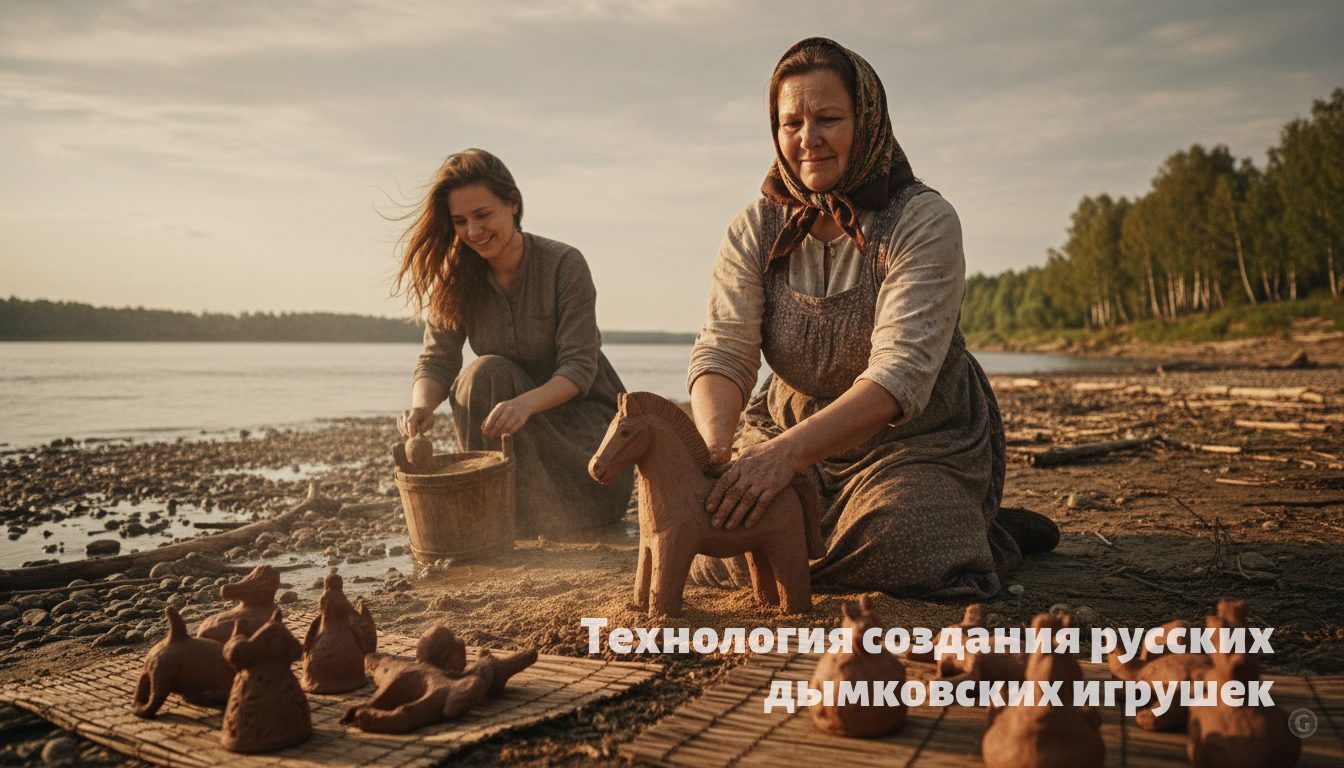
The tradition was passed down through the female line — from mother to daughter. Gradually, entire dynasties of craftswomen emerged: the Nikulins, the Penkins, the Koshkins. Each family distinguished itself with its own style of sculpting, the proportions of the figurines, the color scheme, and the patterns. In the 19th century, between 30 and 50 toymaking families worked in the village at any one time.
The work cycle was tied to the season. From autumn to spring, families sculpted, dried, and fired clay figurines. Closer to the fair, they were whitened with chalk diluted in skimmed cow’s milk, painted with egg wash, and decorated with gold leaf. The goods were then ferried across the river by boat to the town of Vyatka.
Whistling - the holiday that gave birth to the craft
The production of Dymkovo toys was historically linked to the Vyatka festival of Svistunya (or Svistoplyaska). This festival took place on the fourth Saturday after Easter and lasted three days. The origins of the festival are linked to the tragic event known as the Khlynovsky Massacre.
According to legend, in the early 15th century (variously cited as 1418 or 1421), a detachment of Ustyug residents marched to the aid of the Vyatka residents, who were besieged by the enemy. The allies approached Khlynov at night. In the darkness, the townspeople mistook the Ustyug residents for enemies and attacked them. A bloody battle ensued, in which, according to legend, over four thousand people on both sides perished. Historians, however, point to other versions of the events — in particular, that the clash was caused by a conflict between Novgorod natives Mikhail Rossokhin and Anfal Nikitin, who were vying for power in Khlynov.
A chapel was erected at the Razderikhinsky Ravine in memory of those who perished. Every year, the morning began with a memorial service, followed by a noisy celebration. Townspeople whistled clay whistles, threw clay balls into the ravine, and purchased brightly painted figurines.
General Khitrov, who attended the festival in 1811, left a description: "Residents gathered in crowds at the chapel, sang requiems, and then strolled around, whistling into small clay whistles and buying ’clay dolls, painted and gilded." Vyatka writer V.V. Lebedev recalled that in the square, everyone held a clay figurine worth three or five kopecks in front of their faces — a two-headed animal or a ram with gold spots on its sides — and whistled at the ram’s tail."
The Svistunya festival existed until the 1920s, after which it was lost. However, for centuries, it set the rhythm of the work of Dymkovo craftswomen and generated demand for their products.
Raw materials and preparation of clay
The main material for Dymkovo toys is local bright red clay mixed with fine brown river sand. The sand was collected right there, on the river beach near the settlement. The collected clay was chopped with a shovel, mixed with sand, turned over repeatedly, and moistened with water. In the old days, the mixture was literally kneaded with feet, achieving the desired homogeneity and pliability.
The proportions of clay and sand were determined empirically. Sand reduced the clay’s fat content and reduced cracking during drying and firing. Clay that was too rich would deform, while clay that was too lean would crumble. The artisans knew the right consistency by touch, without any measuring instruments.
Today, artisans no longer mine or knead the clay themselves. Raw material preparation is performed by machines at the ceramics production facility, supervised by a technologist. The finished clay arrives at the workshops in 10-kilogram polyethylene briquettes, packaged and ready for sculpting. This frees the artisans from heavy physical labor and allows them to focus on their creative work.
Sculpting: from a lump of clay to a figurine
Dymkovo toys are entirely handmade. Each figurine is crafted by a single artisan from start to finish. This is a fundamental difference from many other crafts that employ division of labor or molding.
The constructive principle of modeling
The figurine is sculpted piece by piece, not from a single block. The craftswoman divides the prepared clay into pieces of the desired size and rolls them into balls, ropes, or flat cakes. These pieces are then used to form the individual parts of the future toy — the body, head, arms, legs, and clothing.
They always start with the largest and most massive part. For animal figurines, this is the body. For a lady, it’s the skirt: a clay pancake is rolled out and folded into a cone. The result is a hollow shape with walls about 4-6 mm thick. The walls of the cone are smoothed out by rotating the piece in your hands.
Then, the remaining parts are attached — or "glued" — to the main body using water. Liquid red clay serves as a binding material, a sort of glue. The sausage-shaped handles and the ball-shaped head are attached to the cone-shaped skirt. All joints between the parts are smoothed with a damp cloth or wet finger to ensure the figurine appears cohesive. The molding marks are smoothed to give the surface a smooth finish.
Detailing and characteristic techniques
After assembling the main parts, the craftswoman begins decorating the figurine with small details — the kokoshnik, muff, handbag, braids, hat, and the dog in the lady’s arms. It is at this stage that the craftswoman’s individual style emerges.
Craftswoman Anna Afanasyevna Mezrina began sculpting the lady with the "mortar" — a wide skirt — by rolling out a pancake and folding it into a cone. Other craftswomen might begin differently, but the basic design principle — assembling parts — remained the same for all.
The size of the figurines varied. Small whistles, 5–7 cm tall, were made quickly and sold in large quantities. Large exhibition compositions could include dozens of figures and reach considerable dimensions. Craftswoman Zoya Vasilyevna Penkina created sets of 4 to 80 pieces united by a common theme.
Drying: Patience and attention to the weather
Don’t immediately place the molded toy in the oven — it must dry completely. Drying occurs in the air at room temperature. The drying time depends on the size of the figurine and the humidity.
Small toys dry in two to three days. Larger figures take a week, and sometimes even longer — up to fifty days. The oldest craftswoman, E. I. Penkina, recalled that toys were usually dried on polaty — special shelves above the stove, where it was warm and dry.
As the clay dries, moisture evaporates, causing the figurine to shrink noticeably. If dried too quickly — in direct sunlight or near a source of intense heat — the surface will dry before the core, causing the toy to crack. Therefore, craftswomen always dried gradually, controlling the process manually.
Firing: Fire transforms clay into ceramics
After drying completely, the toy is fired. Firing is the process of heating the clay to a high temperature, which sinters the clay and strengthens it. Without firing, the figurine would remain fragile and become soggy from water.
Firing in a Russian oven
In the old days, firing was done directly in a Russian oven. The toys were placed on an iron baking sheet, which was then placed on a firewood fire. The oven was heated and the heat was gradually increased.
A characteristic glow signaled readiness: when the clay heated up and began to glow a steady red light, the firing was complete. The toys were then allowed to cool slowly in an extinguished kiln. Rapid cooling was unacceptable, as it would cause cracking.
The firing temperature in a Russian kiln was approximately 600–900°C. The process lasted three to four hours. The artisans monitored the firing process visually, by the color of the clay’s glow, without any measuring instruments.
Modern firing
Nowadays, muffle furnaces are used, which can maintain a stable temperature. Firing occurs at temperatures exceeding 1000°C, which gives the products even greater strength. Muffle furnaces are quite large, and toys are loaded into them in batches.
The transition to muffle kilns freed the artisans from the need to monitor the wood and heat for several hours. Firing results became more predictable and uniform, and the defect rate decreased.
Whitewash: A white background as a calling card
After firing, the clay figurine acquires a brownish-red color. However, Dymkovo toys have always been distinguished by their bright white background, onto which the painting was applied. This white background is one of the characteristic features by which Dymkovo toys are immediately recognizable among the products of other crafts.
The old method of whitewashing
Traditionally, chalk diluted in skimmed cow’s milk was used for whitewashing. The toy was completely dipped in this solution. The milk on the surface soured, forming a strong film of casein glue. The chalk, fixed with casein, produced a smooth, matte white coating that adhered well to the clay.
The whitewash was applied in two or three layers, allowing each layer to dry. The whitewashed surface had a slightly velvety feel and accepted paint well for subsequent painting.
Modern whitewashing
Since the mid-20th century, the composition of whitewash has changed. Now, tempera whitewash is used, applied with a brush. Its chemical composition has become more complex, but the principle remains the same: to create a smooth white background against which the painting will appear most vibrant.
Painting: color, pattern, symbol
Painting is the most spectacular and recognizable stage of Dymkovo toy production. It is the vibrant colors and distinctive geometric patterns that make these figurines so memorable.
Paints and tools
In the old days, paints were prepared by hand. Dry pigments were ground with egg yolk, and fermented kvass or vinegar was added. The palette was modest: soot produced black, magenta produced crimson, and chrome produced green and yellow. Split sticks and feathers were often used instead of brushes.
These homemade paints had a muted tone, as if they were only imparting some of their color to the clay. Over time, craftswomen switched to commercial paints — first casein-oil tempera, then PVA tempera and gouache. Egg was traditionally added to the mixture. Now, many craftswomen work with acrylic paints — they are bright, durable, and require no additional binders.
Soft brushes of various sizes are used. Thin brushes allow for the finest details — dots, strokes, and the finest lines. However, this isn’t always beneficial: excessive detail can sometimes lead to an oversaturated design.
Palette and principles of color scheme
The traditional Dymkovo painting palette is built on bright, saturated tones: red, crimson, blue, yellow, orange, green, and brown. The colors are combined based on the principles of contrast and complementarity. The multicolored palette is emphasized by the presence of a white background and black, which is used to highlight small details such as eyes, eyebrows, and ornamental elements.
Each artist selects colors differently. For example, Evdokia Zakharovna Koshkina’s works were characterized by a calm, slightly washed-out palette. Zoya Vasilyevna Penkina, however, preferred more contrasting and vibrant combinations. The painting was done by Penkina’s daughter, Valentina Vasilyevna Kiseleva, who selected the colors, highlighting the essence of the theme and plot.
No two Dymkovo toys are alike. Even when repeating the same image — a lady, a turkey, a horse — each craftswoman adds her own nuances, her own pattern layout, her own rhythm of lines.
Geometric ornament and its elements
The painting of Dymkovo toys is based on geometric patterns. The main elements are circles, dots, straight and wavy lines, checkers, stripes, and zigzags. These simple shapes are combined in a wide variety of patterns, creating an endless variety of designs.
Researchers associate some elements of the design with ancient symbolism. A circle with a dot or star inside could represent the sun. Wavy lines were associated with water and celestial moisture. Diamonds were linked to ideas of fertility. However, by the 20th century, most craftswomen perceived these patterns more as decorative elements than as symbols with specific meaning.
The ornament is constructed using a variety of compositional patterns. Checks, stripes, and circles are applied in various combinations. The craftswoman arranges the elements on the figurine according to her vision, taking into account the shape of the piece — the horse’s round flank, the lady’s bell-shaped skirt, the turkey’s fan-shaped tail.
Gilding: the finishing touch
The painting is completed by gluing on pieces of gold leaf or gold leaf (an alloy of copper and zinc that imitates gold). Small squares of shiny metal are placed on ladies’ hats, collars, military epaulettes, turkey tails, and ram horns.
Gold leaf and gold leaf alternated with each other several times throughout the 20th century. Today, both materials are used by craftswomen. The shimmer of gold flakes, combined with bright colors and a white background, creates a festive, elegant look for the figurine.
Traditional images and plots
Over the centuries, Dymkovo toys have reproduced a specific set of images, constantly expanding and updating it.
Whistles
The oldest type of Dymkovo toy is the whistle. Figurines of birds, rams, horses, and two-headed animals have a whistle hole in the tail or base. It was these whistles that were sold at the Svistunya Fair and gave the festival its name. The whistle was a utilitarian item: it was whistled into and played with by children.
Ladies, wet nurses, water carriers
Female figures in bell-shaped skirts and high kokoshniks are among the most recognizable images. Ladies, nannies, wet nurses, and water carriers are distinguished by their details: one holds a child, another a yoke with buckets, a third an umbrella or a dog. The bell-shaped skirt is the structural basis of the figure, and it defines its distinctive silhouette.
Craftswoman Z. V. Penkina created the image of "Mother of Many Children" (1961) — a wet nurse in a high kokoshnik, with child figures pinned to her skirt, and holding two swaddled babies in her arms. This work has become one of the recognized masterpieces of the craft.
Horsemen, cavaliers, military men
Male figures are most often depicted on horseback. Riders in peaked caps, hats, or top hats have been a popular subject since the 19th century. Among the male images are also peasants with accordions, hunters, and officers with epaulettes.
Animals and birds
The dapple-colored horse — with large blue circles on its flanks — is one of the most famous Dymkovo images. A turkey with a lush fan-shaped tail, a rooster with a bright comb, a ram with gilded horns, a cow, and a deer — all these are recurring characters. Animals and birds are sculpted both realistically and fantastically, often endowed with exaggeratedly curvaceous forms.
Multi-figure compositions
Since the 1920s and 1930s, multi-figure compositions on a common base — the so-called "pancake" — emerged in the Dymkovo craft. Several figures, related in meaning, were combined into a single scene. This technique made it possible to depict genre scenes: boating, weddings, tea parties, and fairs.
Craftswomen turned to literary and fairy-tale themes. Z. V. Penkina created compositions based on Pushkin’s fairy tales — "The Tale of Tsar Saltan," "Ruslan and Lyudmila," and "The Tale of the Priest and His Workman Balda." Among these works is a golden-domed city, reminiscent of St. Basil’s Cathedral with its domes, designed for circumambulation. In 2003, L. D. Vereshchagina completed the composition "The Feast of the Transfiguration," consisting of 120 figures, recreating life at the Vyatka Transfiguration Monastery.
Saving the Fishery: Mezrina and Denshin
By the end of the 19th century, the Dymkovo craft was on the verge of extinction. The spread of plaster products, wooden toys, and papier-mâché undermined the demand for fragile clay figurines. Many craftswomen abandoned the craft — it no longer provided a living. Some toymakers switched to painting plaster castings. Only one craftswoman continued to sculpt from clay in the traditional way.
Anna Afanasyevna Mezrina (1853–1938) was the last keeper of the living Dymkovo tradition of sculpting. She worked throughout her life, passing on her skills to her two daughters, Alexandra Ivanovna Mezrina (1874–1934) and Olga Ivanovna Konovalova (1886–1979). Through her, the Dymkovo tradition continued into the 20th century.
The second savior of the craft was the Vyatka landscape artist Alexei Ivanovich Denshin (1893–1948). From the age of fifteen, he became fascinated with the work of Dymkovo craftswomen — he sketched their toys and studied the molding and painting processes. He was able to discern true art in the works of these illiterate craftswomen.
After the 1917 Revolution, Denshin created three albums: "Vyatka Clay Toys in Drawings" (1917), "Vyatka Clay Toys. Elegant Dolls" (1919), and "Vyatka Antique Clay Toys" (1926). The sketches were executed on lithographic stones and hand-colored with egg wash, faithfully copied from the originals. These editions were published in small print runs and immediately became bibliographical rarities. Denshin also assembled toy collections and donated them to museums in Moscow and St. Petersburg. Thanks to him, the general public learned about the Vyatka craft.
Denshin’s efforts bore fruit. In 1934, Mezrina was granted a personal pension. In the 1930s, Dymkovo toys appeared at the World’s Fairs in Paris and New York. Denshin brought experienced craftswomen back into the trade — Elizaveta Alexandrovna Koshkina (1871–1953) and Elizaveta Ivanovna Penkina (1882–1948) — and attracted young ones.
Generations of Craftswomen: From Artels to the Union of Artists
In the 1920s and 1930s, the Dymkovo craft remained a home-based industry. There were no cooperatives, as in other crafts. Beginning in 1934, the craftswomen handed over their toys as homeworkers — first to a plaster factory in the village, then to the "Kirov Artist" partnership. A little later, the Great Patriotic War dealt a blow to the craft — the craftswomen were left without orders. But in 1942, production resumed.