A summary of Jules Verne’s "The Southern Star"
 Automatic translate
This adventure novel, co-authored in 1884 with Pascal Grousset, is a popular science fiction account of the South African diamond rush and 19th-century chemical experiments. It is part of the famous "Extraordinary Voyages" series, number 25, alongside the novels "Around the World in 80 Days," "The Children of Captain Grant," and "20,000 Leagues Under the Sea."
The novel has been adapted for film twice. The first silent film was directed by the writer’s son, Michel Verne, in 1918, and in 1969, a major Anglo-French adventure film was released starring George Segal and Ursula Andress.
The rich farmer’s refusal and the beginning of the search
French mining engineer Cyprien Mairet arrives in Griqualand, South Africa, on a scientific mission. The young scientist asks John Watkins, a wealthy diamond mine owner, for his daughter Alice’s hand in marriage. Watkins categorically refuses: Cyprien is poor, living on a modest professor’s salary, and plans to take the girl to Paris. The local farmer wants a wealthy Afrikaner like the wealthy James Hilton as his son-in-law.
Cyprien decides to prove his worth. He leases a claim at the Vandergaart Spear mine jointly with Lancashire prospector Thomas Steele. For the heavy excavation work, the engineer hires two local Kaffirs, Matakit and Bardik. Cyprien befriends an impoverished Dutch diamond cutter, Jacobus Vandergaart. The old man reveals that Watkins defrauded him of his diamond claim, forfeiting his property through the English courts.
The Birth of an Artificial Giant
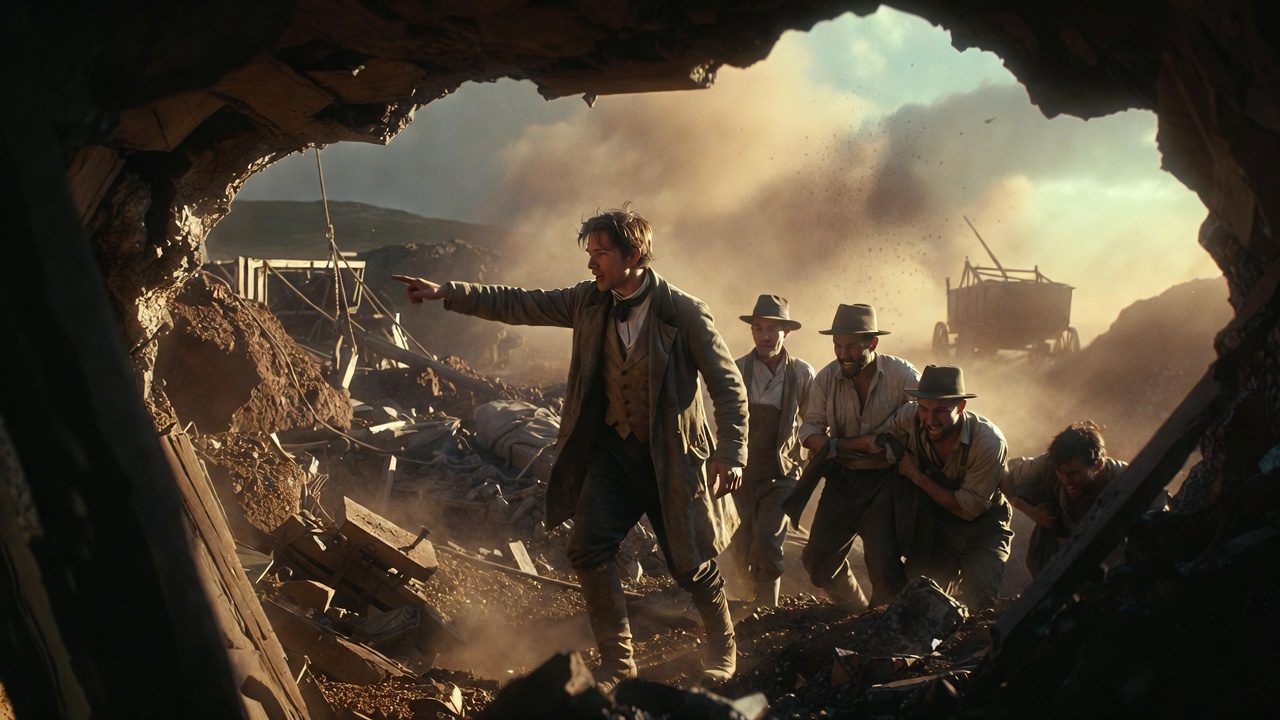
Soon, Cyprien saves the Chinese man Li, who was being tormented by the evil Neapolitan Annibal Pantalacci, from committing suicide. The Chinese man becomes the scientist’s loyal servant. A massive landslide occurs at the mine, trapping Matakit under the rubble. Cyprien personally organizes the rescue efforts and brings the Kaffir back to life.
Alice Watkins suggests that Cyprien abandon hard physical labor and apply his knowledge of chemistry to creating an artificial diamond. The engineer takes a piece of a cannon barrel, fills it with chemical reagents and marsh gas, coats the inside with clay, and keeps it in a red-hot oven for two weeks. As it cools, the steel barrel cracks under the pressure, but inside the clay cocoon, Cyprien discovers a huge black stone.
Jacobus Vandergaart polishes the find. The resulting black diamond weighs 432 carats and is recognized as the largest gemstone in the world. Cyprien gives it to Alice, who christens the giant crystal "The Southern Star."
The disappearance of the jewel and the beginning of the chase
John Watkins throws a lavish banquet in honor of the remarkable stone, displaying it on a pedestal. In the midst of the celebration, the lights go out, and when they come back on, it turns out the "Southern Star" is missing. A search of the guests and the Kafirs serving them yields no results. Amid accusations of theft, Matakit suddenly flees the village.
Watkins promises his daughter in marriage to whoever returns the treasure. Four suitors — Cyprien Maire, James Hilton, Herr Friedel, and Annibal Pantalacci — pool their funds to purchase a wagon and oxen and set out in pursuit across the Transvaal. Cyprien is followed by his loyal servants, Lee and Bardick.
Trials in the Transvaal Desert
The journey proves fraught with deadly danger. Along the way, the German Friedel spends the night by the river, despite warnings, contracts swamp fever, and dies suddenly.
Later, Pantalacci hatches a plot: he bribes Hilton and discreetly removes the cartridges from Cyprien’s gun before an elephant hunt. An enraged, wounded elephant rushes toward the defenseless Frenchman. The Chinese Li displays agility: he slips under the giant’s feet and slashes his tendon with a hunting knife. The elephant falls, but not before crushing Hilton, who had gotten too close.
Then the Kaffirs take the oxen from the camp, and Bardik disappears. Pantalacci steals all the remaining horses and rides off alone, abandoning Cyprien and Lee in the wilderness.
Unusual transport and retribution
A Frenchman and a Chinese man show ingenuity: using rope lassos, they catch two wild giraffes, train them to wear harnesses, and continue their journey on horseback.
They soon catch up with Pantalacci, who is racing after Matakit, who has escaped in a fast two-wheeled cart with an ostrich. The Neapolitan becomes stuck in a giant bird net, spread by locals in a cornfield. A hurricane and frightened birds of prey lift the net and the man into the air. Pantalacci falls from a great height and dies.
Cyprien falls ill with a severe fever. He is saved by an old friend, the French hunter Faramond Barthès, who just happens to be nearby in an ostrich camouflage suit. Barthès nurses Cyprien back to health, placing him in a makeshift earthen oven for intense heating.
The Mystery of the Sacred Grotto
Bartes takes Cyprien to the ruler of the local tribe, King Tonaye. It turns out that Matakit has been captured by the natives and locked in a sacred cave. The white guests ransom the young man.
Entering the cave, Cyprien is astonished: the underground grotto is formed by gigantic natural crystals of diamonds, sapphires, and rubies. The scientist realizes that before him lies the cradle of the planet’s precious minerals, the value of which defies calculation. Keeping his oath to the king, Cyprien leaves the treasures untouched. Taking the freed Matakit with them, the travelers return to Griqualand.
The threat of execution and unexpected surgery
Upon their return, the prospectors rebel against Cyprien. A secret nighttime tribunal sentences the scientist to death, believing that his method of diamond synthesis will ruin all the inhabitants. To save his master, Matakit confesses: he himself planted the real diamond in the furnace, having found the stone during a cave-in. Cyprien is released, and Matakit is sentenced to hang for stealing Watkins’ treasure.
Soon, Dada, the pet ostrich, swallows Watkins’ deed to the mine. The enraged farmer plans to shoot the bird. Cyprien volunteers to save the ostrich and performs surgery on her crop. Inside the crop, the swallowed paper is discovered, along with the missing "Southern Star," which, due to the bird’s internal temperature, has turned from black to pink. Matakit is released due to his innocence.
A Cartographic Error and the Triumph of Justice
Cyprien conducts geodetic measurements and makes a discovery. When compiling official British maps of Griqualand, the magnetic compass deviation, which is 29 degrees west, was not taken into account. Because of this shift, the legal boundary of the meridian changes: the rich Vandergaart Kopje mine is actually located on the land of Jacobus Vandergaart, not John Watkins.
Vandergaart attends Watkins’ banquet with the sheriff’s representative and claims all the farmer’s property. But the old stonecutter displays magnanimity: he declares Cyprien and Alice his sole heirs and grants them the mine. John Watkins gives his blessing to the marriage of his daughter and the young scientist.
The end of the story
Suddenly, a clap of thunder rumbles, and the Southern Star crumbles into fine dust before everyone’s eyes. Due to the high internal stress, the crystal self-destructed from a natural electrical discharge.
John Watkins is unable to bear the loss of his wealth and dies two weeks later. Cyprien Maire and Alice have a modest wedding. Having sold his share of the mine for 100,000 francs, Cyprien, his young wife, and Jacobus Vandergaart leave for France. Matakit, Bardik, and Lee receive generous rewards and successfully establish themselves.
You cannot comment Why?