A summary of "Kashcheev’s Chain" by Mikhail Prishvin
 Automatic translate
"Kashcheev’s Chain" is an autobiographical novel by Mikhail Prishvin, written between 1922 and 1954. The author labored over the text for over thirty years, reflecting on his own spiritual maturation and the historical upheavals in Russia in the late 19th and early 20th centuries. The narrative reveals the inner journey of Mikhail Alpatov, known as Kurymushka in childhood, who strives to break free from the constraints of human personality and find freedom.
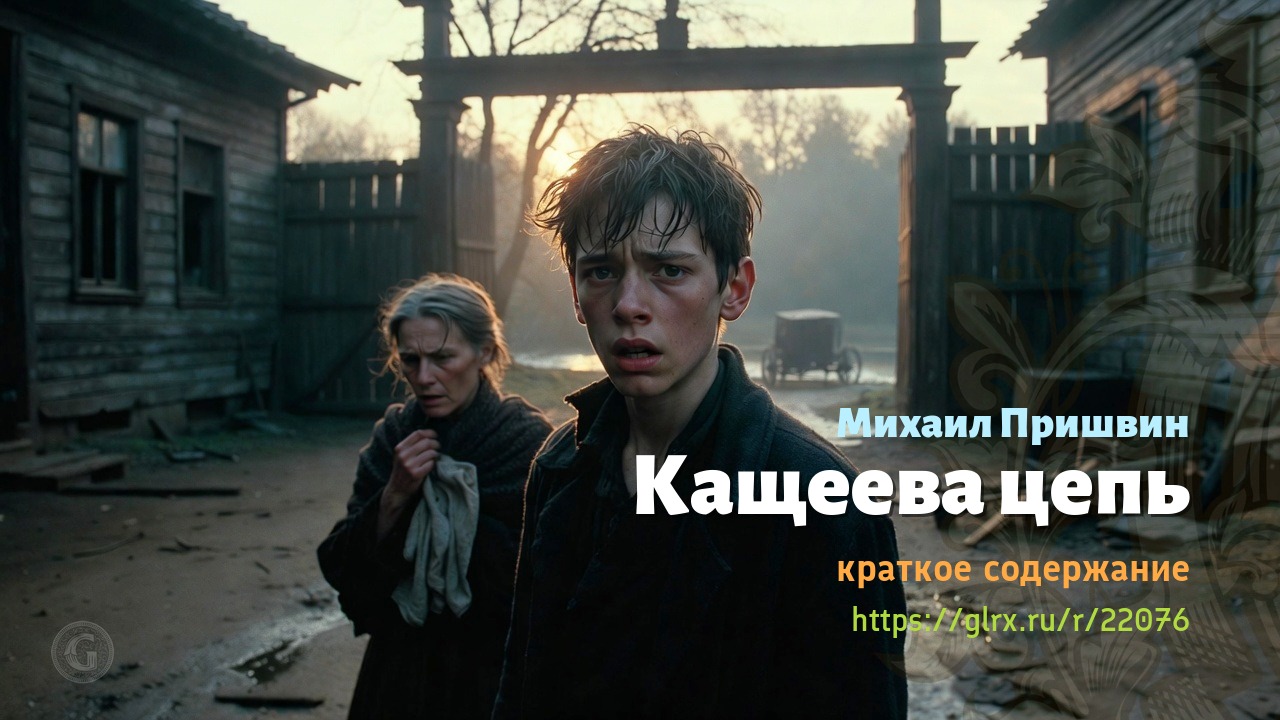
Childhood in Khrushchev and the fairytale world of Kurymushka
The action begins on the Khrushchevo estate in the Yeletsky district of the Oryol province, where the protagonist was born in 1873. A boy named Kurymushka grows up in an impoverished merchant family who lost his father early in life. His mother, Maria Ivanovna, is forced to work constantly to pay off her bank debts and provide her five children with higher education. In the child’s mind, everyday life becomes intertwined with fairy tales. The enormous antique "Kurym" chair, his father’s drawings of mysterious blue beavers, and the stories of the mongrel dog Gusok about quail shape the boy’s unique view of nature.
Kurymushka painfully experiences the injustice of the noble and merchant classes. Meetings with guests at the estate, stories about the Narodniks, and the gunshots of his brothers’ revolvers give him his first understanding of power, truth, and evil. A key role in his life is played by his meeting with his guest, Marya Morevna, who gives him a book of Andersen’s fairy tales. The boy learns to overcome his childhood fears, engaging in impromptu combat with the dark forces of nature and his own fantasies.
Grammar school years and a conspiracy with Asia
Kurymushka is sent to the Yelets Gymnasium, where he encounters a harsh system of discipline and formalism. The math teacher, nicknamed Cow Death, and the geography teacher, Goat, represent the students’ heartless obedience to rigid rules. The boy finds the school’s oppression difficult to bear, seeking refuge in maps and travel books.
Together with his comrades Achilles and Rurik, Kurymushka plans an escape by boat down the Sosna River. The teenagers dream of reaching Asia via the Don and Black Seas to discover forgotten lands there. Police officer Krupkin intercepts the fugitives on the riverbank and returns them to the city. The escape ends in failure, but the dream of other lands leaves a deep mark. Later, after a conflict with his geography teacher, Kozl, Alpatov is expelled from school with a black mark. The boy rips the shiny buttons off his coat and sews on black ones, suffering profound emotional shame.
Siberian wanderings and the search for the "Golden Mountains"
To save the young man from being abandoned by the streets, his mother sends him to Siberia with his uncle, a wealthy Siberian steamship owner named Ivan Astakhov. A journey along the Kama and Ural Rivers reveals to Alpatov the vastness of the country. On steamships and barges, he encounters settlers, seekers of "White Waters" and "Golden Mountains," taiga workers, and exiles. In Tyumen, he meets Captain Aukin and his daughter, Alyona.
In Siberia, Alpatov studied at the local gymnasium and became a top student, overcoming his previous backwardness. However, success at the state-run school did not bring him joy. He noticed that the best students had rallied around the principal and were engaged in underground work. Alpatov realized that an official career in his uncle’s merchant or bureaucratic circle was alien to his nature. He refused to serve his uncle and decided to return to European Russia to take his exams and continue his education.
Revolutionary underground and imprisonment
Returning home, Alpatov began to associate with local revolutionary circles. In Yelets, he met his former high school classmate, Yefim Nesgovorov, and the leader of the underground movement, Danilych. The young man read the works of Karl Marx, translated August Bebel’s "Woman and Socialism," and participated in propaganda among workers and debates with the Narodniks.
Alpatov’s underground activities lead to his arrest. He is placed in solitary confinement in a model prison. While incarcerated, the young man observes nature through the prison window, watches migratory birds, and taps messages to Nesgovorov through the wall. During interrogations by Prosecutor Anatsevich, Alpatov refuses to testify or admit guilt. In exchange for his intercession and surety, he is allowed to study abroad.
University years in Germany
Alpatov arrived in Berlin, where he stayed in the apartment of metalworker Otto Schwarz. He attended rallies of German Social Democrats and saw speeches by August Bebel and Wilhelm Liebknecht. The young man then moved to the University of Leipzig, where he enthusiastically studied chemistry, philosophy, and national economics.
At university, Alpatov attempts to combine natural science with his quest for truth. He meets fellow student Ambarov and engages in a student duel with a German student playing schläger. However, the tidy German way of life and abstract theories gradually become disillusioning. The young man seeks out Inna Rostovtseva, the girl he saw through prison bars and with whom he was in love.
Paris meeting and return to Russia
Alpatov sets off to Paris to search for Inna. He finds her during the Mikarem festival. The young couple stroll through Paris, visiting the Luxembourg Gardens, the Louvre, and Versailles. However, a profound difference emerges between them: Inna strives for a respectable position in society and fears the wrath of her mother, the countess, while Alpatov is unwilling to sacrifice his personal freedom for a career in government.
Realizing the inevitability of separation, Alpatov returns to Russia with the intention of working as a peat engineer draining swamps. Upon his arrival, he learns of the death of Inna’s father, Actual State Councilor Pyotr Petrovich Rostovtsev, and of the death of his childhood friend, the hunter Gusok. An attempt to obtain a government posting in St. Petersburg ends in a run-in with the police and the complete collapse of his hopes for personal happiness with Inna.
Letting go of illusions and finding your own voice
Finding himself without a job and without his beloved, Alpatov experiences a spiritual crisis. In a deserted forest clearing, he burns his past letters and diaries by the fire. Meetings with simple villagers — the hunter Churka and the woodsman Grigory — return the young man to a more direct understanding of the land.
Alpatov realized that his calling lay neither in political dogma nor in the struggle for official status. The true victory over the "Kashchei Chain" — a symbol of spiritual and social slavery — was creative union with nature and his native people. He began writing stories about nature, discovering his own unique path in literature.
You cannot comment Why?