Mikhail Prishvin’s "Forget-Me-Nots," a summary
 Automatic translate
The book was created throughout the author’s creative life, from 1905 to 1954, and became the definitive collection of philosophical and poetic miniatures, diary entries, and reflections. First published as a separate edition in 1960, this collection is the writer’s testament, in which philosophical observations of nature are intertwined with thoughts on art, love, the human personality, and history. The collection is not part of a series of works and has never been directly adapted for film. The writer collected these notes over many years, and after his death, his widow, Valeria Dmitrievna Prishvina, prepared the manuscript for publication.
Nature and Man
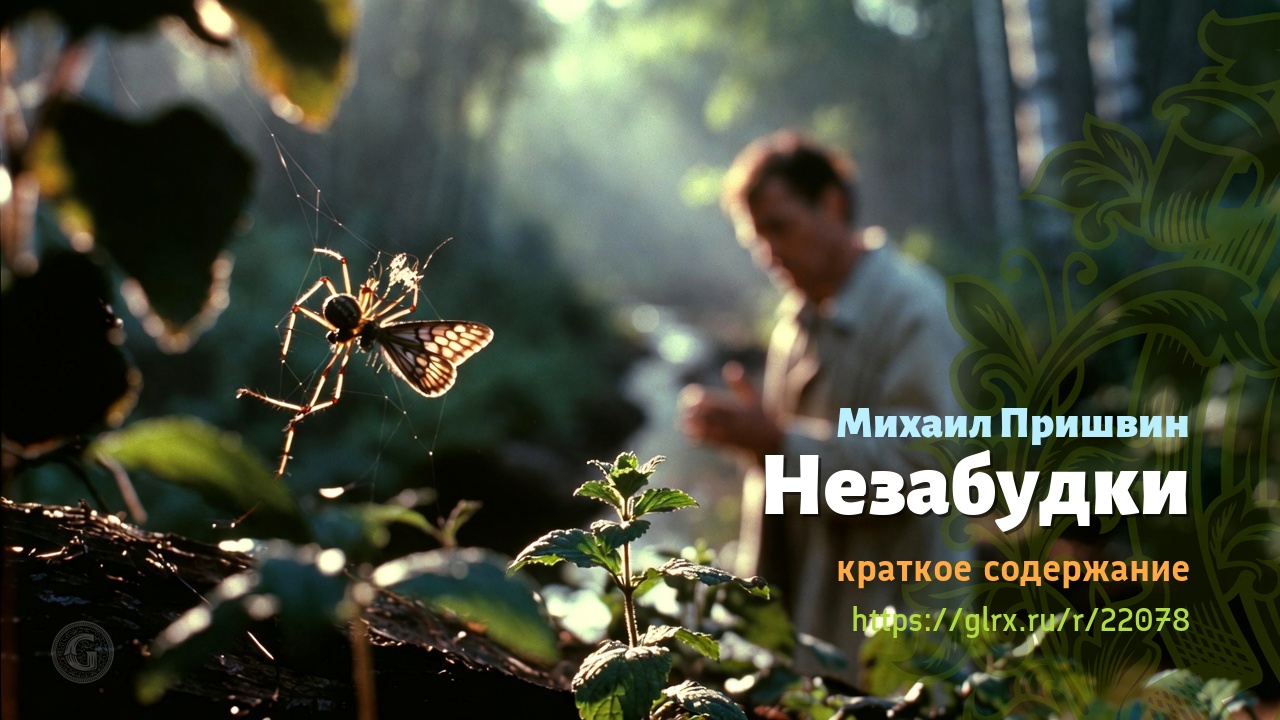
Nature appears as both a caring mother and a stern stepmother. It reveals the brutal struggle for existence, as a spider sucks out a butterfly right on a mint flower. Humans bring an innate sense of harmony and reason to this world. Sensitive contemplation allows us to overcome the fear of physical death.
All artistic creativity is akin to motherhood. The image of a future work germinates in the soul, like a child in the womb. True mastery must be subservient to this maternal instinct. Talent grows from love for the world and people, and true poetry is born where the wound of the soul is healed by a healing balm, like resin on diseased trees.
Creative attention becomes the artist’s tool. Attention selects a single detail from the endless stream of impressions and encloses it in a conventional frame, transforming a particular fragment into a reflection of the entire world.
Art as behavior and creative work
Creativity is seen as a certain way of life and moral conduct. A writer must maintain the integrity of their personality, without becoming a tinkerer. Freedom lies not in the absence of limitations, but in the conscious choice of one’s "yoke" — duty and service.
Artistic form cannot be copied. Every new concept requires a unique expression. Attempts to rationalize the origins of art lead to formalism and the substitution of verbal constructs for living feeling. True realism lies in the ability to see the human soul through images of the surrounding world.
Science and art flow from the same source. The scientific method breaks down phenomena into their elements, analyzes them, and formulates laws. Art, on the other hand, connects the parts into a living whole, restoring a sense of wonder and the joy of existence. A true artist avoids envy and vanity, transforming inner pain into wisdom.
Poetry of prose and the unprecedented
The writer possessed a rare sense of modernity. His sense of time helps him find the core of the era even when describing the simplest things. Man is the sole source of the "unprecedented" in nature — that unique and unrepeatable experience that each individual brings.
Fairy tales and legends connect passing and coming generations. Maintaining a childlike sense of wonder at the world allows people to see the miraculous in everyday life. A simple strawberry, the babbling of a forest stream, or the song of a nuthatch conceal a poetic song within.
Russian literature sought strength not in beauty, but in truth. Ascetic humility before the grandeur of truth gave birth to genuine realism. Kindness and love stand above aesthetic contemplation, for it is kindness that transforms the surrounding reality.
The path to a friend and the birth of personality
Society is characterized by types, but history is driven by unique characters. The writer sees people as individuals with their unique traits. The human journey is a relentless movement toward another person, overcoming loneliness through the formula "We are with you."
A cherished motif running through the entire collection is the memory of "Phacelia" — a blue field of honey-bearing flowers that became a symbol of lost first love. This personal, unrealized love was transformed into an all-encompassing, familial concern for all living things.
Love requires work, patience, and compassion. A true marriage and the union of two souls is a shared journey toward unanimity, where a "third" is born — a child or a creative image. The feminine maternal principle emerges as a powerful creative force, enduring the most difficult trials and giving birth to the future.
A beautiful moment and creative immortality
The artist’s primary goal is to capture and immortalize a beautiful moment. A forest stream, overcoming a tangle of driftwood and rocks, symbolizes human life forging its way to a shared ocean. Obstacles don’t impede the flow; they create time itself and give it meaning.
Death is feared only by the lonely egoist. A creative person overcomes the fear of nonexistence by giving the fruits of their labor to others. Dying to themselves, the artist is reborn in their works and in the memory of their descendants.
The consciousness of an individual resembles the crescent moon, sensing its unity with the entire disk. The personality acts as the engine of the shared soul, connecting the past, present, and future of a person.
Living water and historical time
Generalizations without attention to the individual are like dead water. Laws and dry principles are merciless if they obscure the individual. Russian history has evolved in a constant search for the highest truth, where "Oblomov-like" peace confronted meaningless vanity, awaiting true service.
The Great Patriotic War was a severe test for the entire nation. During the years of extreme suffering, the Siege of Leningrad, and losses at the front, the people’s spiritual fortitude was revealed. Victory was achieved through the enormous labor, patience, and love of ordinary women and soldiers.
A sense of homeland grows from one’s native language, childhood memories, and folk culture. Alexander Pushkin’s story "The Captain’s Daughter" exemplifies the harmonious simplicity and moral purity that nourishes national identity.
The soul of nature and the eternal search
Nature is perceived as a living, thinking being, whose manifestations are consonant with the movements of the human soul. The trees in the forest — oaks, birches, aspens, and spruces — are in a constant struggle for light, their tops reaching upward. In this silent struggle, the laws of human growth are revealed.
Animals possess an inexhaustible reserve of tenderness and devotion. A dog looks into its owner’s eyes with a human gaze, a water voles displays a glimmer of intelligence during a flood, and a duck and swallow show maternal care for their young.
The real world is full of light and shadow. Life on Earth exists thanks to the harmonious combination of sunlight and protective shade. The small forget-me-not flower, with its yellow sun inside and blue petals, carries within itself a reflection of the entire universe, affirming the victory of life and immortality.
You cannot comment Why?