"Louis Lambert" by Honoré de Balzac, summary
 Automatic translate
Honoré de Balzac’s philosophical novel, written in 1832, unfolds the spiritual quest of a gifted young man whose intellectual energy gradually destroys his physical form. The narrative draws on the author’s autobiographical recollections of his years at the Collège Vendôme and his understanding of the concepts of Emanuel Swedenborg. The novel is a profound exploration of the human psyche, willpower, and the boundaries between genius and madness.
This work is part of the grand cycle "The Human Comedy" and occupies a prominent place in the section "Philosophical Etudes." Along with the novels "The Shagreen Skin," "The Search for the Absolute," and "Seraphita," this book provides the theoretical foundation for Balzac’s entire epic.
Early years and the formation of a thinker
Louis Lambert was born in 1797 in the town of Montoire, the son of a small tannery owner. From the age of five, the boy avidly read the Bible, which shaped his future destiny and sparked his passion for reading. At the age of ten, his parents sent him to his uncle, a former Oratorian priest in the town of Mer, wanting to spare their only son from military conscription.
In his uncle’s library, where thousands of volumes from noble estates destroyed during the Revolution were stored, Louis mastered the most important scientific, religious, and philosophical works in three years. Reading became an insatiable thirst for him. He studied dictionaries, analyzed the origins of words, and formed his first conclusions about the connection between speech and thought.
The boy possessed a rare memory and imaginative ability, allowing him to reproduce in detail the images he read. In 1811, at the edge of the forest, the fourteen-year-old Lambert was reading a translation of Emanuel Swedenborg’s "On Heaven, the World of Spirits, and Hell." Impressed by the maturity of his judgment, she financed his education at the Collège Vendôme.
Studying at the College Vendôme
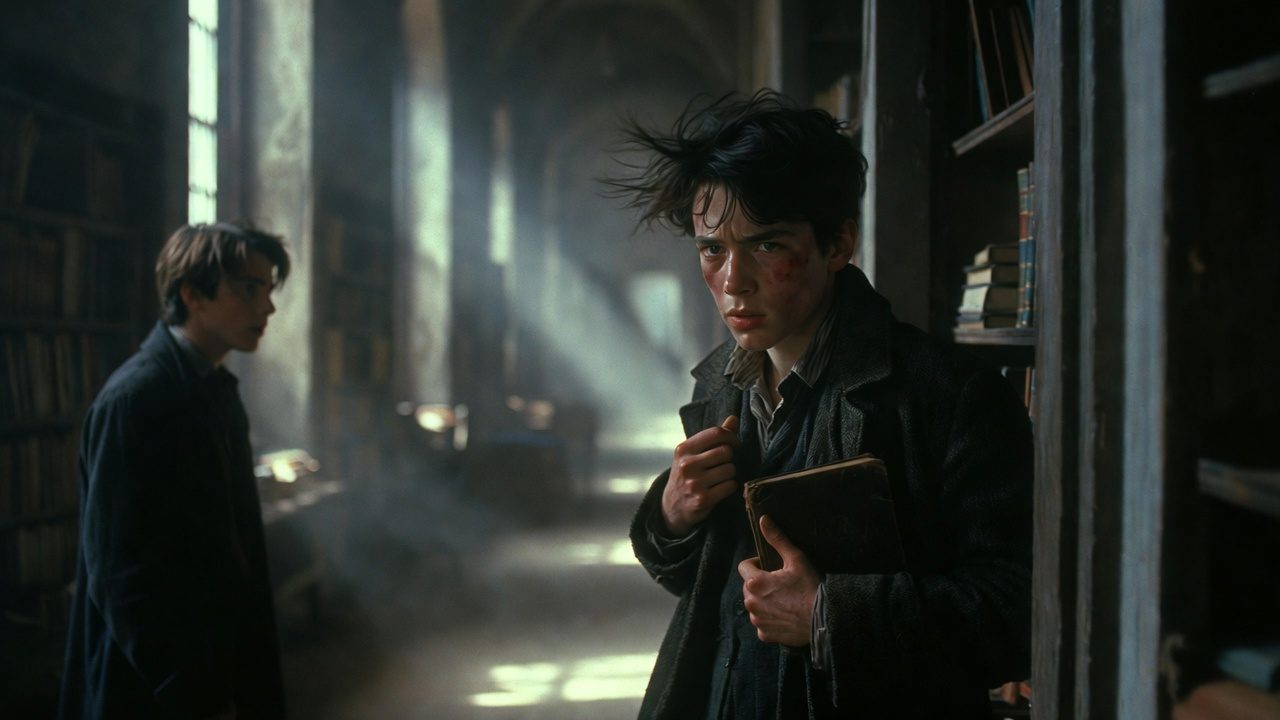
The Collège Vendôme was distinguished by its strict monastic and semi-military lifestyle. The two hundred students were forbidden to leave the premises until completion of their course, and their lives were subject to strict discipline and corporal punishment. Unhygienic conditions, dampness, dirt, and cold caused painful wounds in the children, and any individuality was suppressed.
Louis Lambert, accustomed to freedom and country air, found the confined classroom atmosphere difficult to bear. The teachers considered him a lazy student and constantly handed him "pensums" — severe written penalties — and also punished him with a leather belt. The teachers were irritated by Lambert’s penetrating gaze, which expressed a profound disdain for the school routine. The teachers failed to understand that during lessons, Louis immersed himself in a contemplative state, completely detached from the physical world.
Louis’s only close friend was a storyteller nicknamed "The Poet," while Lambert was nicknamed "Pythagoras." Their classmates nicknamed them "The Poet and Pythagoras." The friends kept aloof from the other students, avoided active games, secretly read books from the library, and engaged in philosophical discussions.
Development of the Treatise on the Will
Pondering the alluring mysteries of the human mind, Lambert developed the idea of the duality of human nature — "Homo duplex." According to his concept, an inner, active being and an outer, corporeal shell coexist within a person. He explained dreams, visions, and the instantaneous transcendence of space through the imagination as the spirit’s ability to temporarily separate from the body.
In the spring of 1812, during a walk to the Château de Rochambeau, Louis saw a valley with a winding river for the first time and was struck by the fact that he had seen these places in detail in a dream the previous day. This event finally convinced him of the reality of spiritual travel and prompted him to begin writing his scholarly work, "Treatise on the Will."
In his work, Lambert defined will as a concentration of inner force, and thought as its direct product. He asserted that thought processes are subject to the laws of electricity, and that human will, when highly concentrated, is capable of influencing material objects.
However, the young genius’s seminal work only drew ridicule from his fellow students. During a school fight, the box containing the manuscripts was smashed, and the papers fell into the hands of the tutor, Father Og, who confiscated them and sold them to a local merchant. At the end of 1812, due to deteriorating health, the narrator left college, and the friends parted ways.
Life in Paris and disillusionment with society
In 1815, eighteen-year-old Lambert graduated from college, having lost both his parents by then. Having received a modest inheritance, he set off for Paris, hoping to continue his education and meet Madame de Staël. However, he arrived at her house on the day of her death. In the capital, Louis encountered poverty, loneliness, and indifference.
Life in Paris caused him deep suffering. In letters to his uncle, Lambert criticized the social order, where everything was driven by money and scientific research lacked unity and common purpose. He concluded that state systems prevented people from achieving genuine progress, and that external society was doomed to decay.
While visiting the Théâtre Français, Louis experienced a painful attack of passion upon seeing a beautiful woman in the adjacent box. This incident demonstrated to him the destructive power of unbridled emotions. Realizing that the capital was destroying his spiritual strength, Lambert returned to Blois in 1820 to live with his uncle Lefèvre.
Love for Pauline de Villenoix and disaster
In Blois, Louis met twenty-year-old Pauline de Villenoix, a wealthy heiress from a noble Jewish family. She possessed a rare, biblical beauty and a noble character. A deep passion flared between the young people. Lambert’s surviving letters reveal his transformation from a pure idealist into an ardent lover, willing to undertake any feat for his beloved.
However, on the eve of the wedding celebration, a tragic event occurred. Due to colossal nervous strain, Louis fell into a fifty-nine-hour catalepsy. Upon awakening, he sank into a profound melancholy, imagined himself powerless, and attempted to mutilate his sexual organs. Renowned doctors declared him incurably insane.
Pauline refused to leave her lover. She moved Louis to her estate in Villenoix and devoted her entire life to him. She believed that her beloved had not lost his mind, but had ascended to a higher level of spiritual clairvoyance, inaccessible to ordinary people.
The last meeting and the final
In 1823, the narrator met Lefèvre’s uncle by chance on a stagecoach and learned of his friend’s sad fate. He immediately set off for the Château de Villenoix. The narrator found Lambert in a dimly lit room: he was leaning against the paneling, pale, his gaze dull, and constantly rubbing his legs together.
Louis responded to his attempts to engage in conversation with only one cryptic phrase: "Ангелы — белые" "…." Pauline explained to her guest that she had learned to understand the movements of her husband’s thoughts, whose inner being had finally freed itself from the shackles of the body. The girl showed him the philosophical aphorisms Lambert had written down about movement, number, instinct, abstraction, and clairvoyance.
On September 25, 1824, twenty-eight-year-old Louis Lambert died in Pauline’s arms. He was buried on an island in Villenoix Park under a simple stone cross with no inscription or dates.
You cannot comment Why?