"Catherine de Medici" by Honoré de Balzac, summary
 Automatic translate
The historical novel "Catherine de’ Medici," completed in 1842, is a comprehensive study of the political thought of the Reformation. This book is a defense of Henry II’s widow against lingering historical slanders, demonstrating her harsh government decisions as the only way to preserve the power of the Valois dynasty and save France from disintegration. The work is part of the "Human Comedy" cycle, complementing the "Philosophical Studies" section, along with the novels "The Shagreen Skin" and "The Search for the Absolute."
The Queen’s Historical Justification
The author begins with reflections on historical injustice. Protestant pamphleteers and later historians created the image of Henry II’s widow as a cruel and treacherous sovereign. Catherine de Medici, a Florentine by birth from a merchant family, suffered years of humiliation at court due to her all-powerful mistress, Diane de Poitiers.
After her widowhood, the queen found herself caught between the Catholic Guise clan and the Protestant House of Bourbon. Superficial observers accused her of double dealing. Balzac argues that the queen’s flexible policy was dictated by the vital need to retain the throne for her sons and prevent the state from being destroyed by religious strife.
Martyr of Calvinism
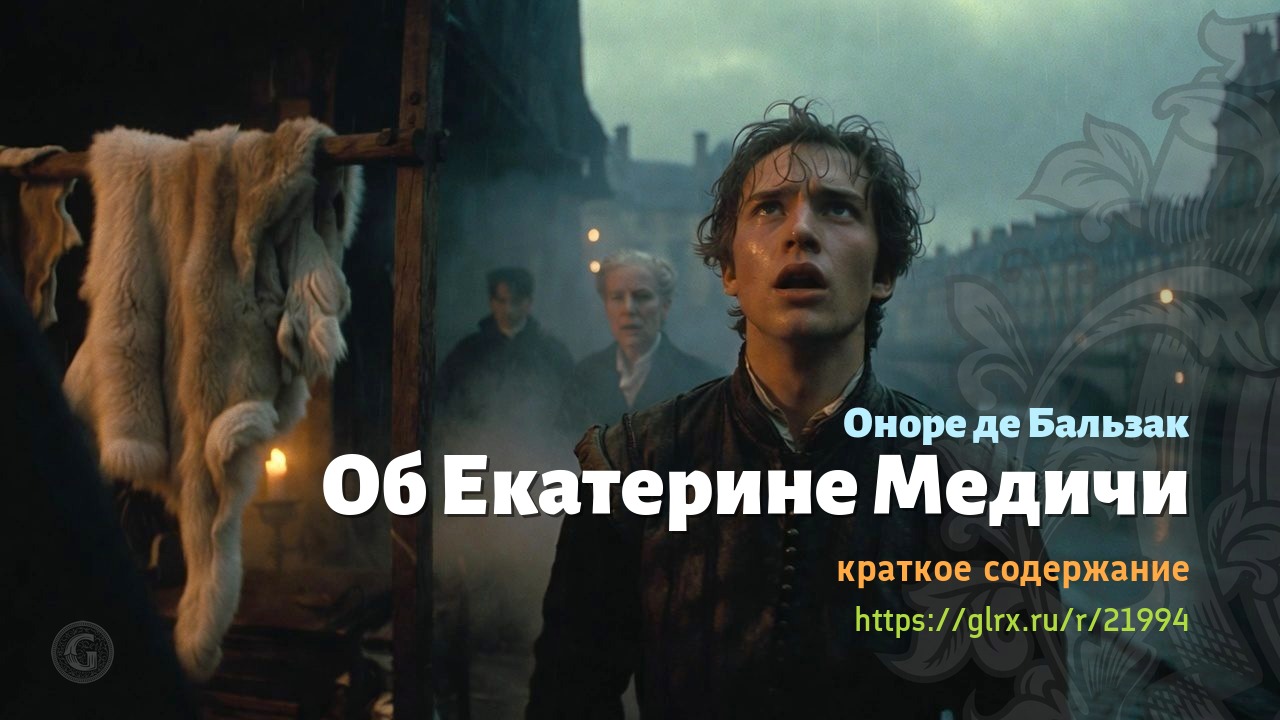
The main action of the first part takes place in April 1560 in Paris. On Rue Vielle-Pelterie, near the Pont d’Amende, stands the house of Lecamus, the head of the furriers’ guild. The fur trade flourished in the 16th century, and furs themselves were worth their weight in gold. The merchant’s twenty-two-year-old son, Christophe Lecamus, secretly joins the Protestants. The preacher Chodieu brings the young man together on the Seine with the leaders of the conspiracy — La Renaudie and Prince Louis de Condé.
The conspirators instruct Christophe to deliver secret documents to the Queen Mother, Catherine de’ Medici, in Blois. These papers contain the terms of an alliance between the Reformed and the crown against the dominance of the Dukes of Guise. Christophe’s father, a wealthy and cunning citizen, allows his son to go to court under the pretext of collecting money for a fur coat made for the young queen.
At the Château de Blois, the young Queen Mary Stuart and her uncles, Duke François de Guise and Cardinal Charles of Lorraine, exert complete control over the sickly young King Francis II. Catherine de Medici, bereft of any real influence, awaits the opportune moment for revenge.
Christophe infiltrates the castle and delivers a letter from the Prince of Condé, disguised among the accounts, to the Queen Mother. At that moment, Mary Stuart unexpectedly enters the study. To save herself and her son, Catherine strikes a preemptive blow: she denounces Christophe as an impudent heretic who planted forgeries on her.
The young man is arrested and interrogated. The Guises send Christophe to the dungeon, where the executioners squeeze his feet in "Spanish boots." Inhuman torture and the driving of wedges into his joints fail to break the young man. Christophe displays incredible courage: he remains silent, refusing to betray either Catherine or the Prince of Condé, merely repeating the name of the preacher, Chodieu. Catherine was present during the interrogation and expressed outward stern approval of the torture, but with a secret glance, she gave Christophe hope.
The Guises uncover a Reformed conspiracy and carry out a bloody massacre of the rebels in Amboise. The condemned nobles march to the scaffold, singing psalms, before the eyes of the royal court. The court moves to Orleans, where the Estates General is in session. The Prince of Condé is arrested, and he and Antoine of Navarre face the scaffold. Christophe is held in the Saint-Aignan Tower in Orleans.
Suddenly, sixteen-year-old King Francis II falls gravely ill with an abscess in his ear. Renowned surgeon Ambroise Paré rushes to perform a craniotomy to save the monarch. However, old Lecamu begs Paré to refrain from the operation, understanding that the monarch’s death will save his son and the Prince of Condé.
Francis II died on December 5, 1560. Catherine de’ Medici immediately took control of the state, declaring herself regent for her ten-year-old son, Charles IX. She freed the Prince of Condé, exiled Mary Stuart to Scotland, and won over the Bourbons and Constable Montmorency.
Christophe is freed. The Queen Mother generously rewards him for his silence. The young man abandons his revolutionary plans, becomes a Catholic lawyer in Parliament, marries Babette Lallier, and purchases a noble estate in Picardy.
The Mystery of the Ruggeri Brothers
The second part takes the reader to October 1573. After the St. Bartholomew’s Day massacre, Charles IX is tormented by illness and suspicion. In his free time, the king works passionately in the forge or writes poetry. He seeks solace in his only love, Marie Touchet, who bore him a son, Charles of Valois. The king distrusts Catherine de’ Medici, suspecting her of trying to poison him to secure the accession of her beloved son, Henry, King of Poland.
At night, Charles IX, in disguise, sneaks across the rooftops of Paris with Marshal Tavannes. They infiltrate the secret laboratory of the perfumer René and the alchemist Lorenzo Ruggieri on the Rue de l’Autruche. The room is filled with ovens, skeletons, and stuffed animals, and a maiden lies cataleptically asleep on a couch.
The king interrogates Lorenzo Ruggieri and his brother Cosimo, Catherine de’ Medici’s astrologer. Lorenzo expounds to the king the doctrines of materialism and alchemy. The goal of alchemists is not the simple extraction of gold, but the understanding of the unified matter, mastery of the laws of nature, and the prolongation of human life.
Lorenzo predicts the future: the imminent death of Charles IX himself, the assassination of Henry III, the accession of Henry IV of Bourbon and his subsequent assassination, and the long life of Marie Touchet and her son. Charles IX is struck by the elder’s profound insight and refuses to carry out the execution.
Two dreams
The action of the third part takes place in August 1786, on the Place Vendôme in Paris. A distinguished society is gathering in the salon of the treasurer of the naval department, Bodart de Saint-James: the Minister of Finance Calonne, the writer Beaumarchais, the scientist Lavoisier, and Madame de Genlis. Two unknown provincials — a young lawyer from Arras, Maximilien Robespierre, and the physician Jean-Paul Marat — also attend the gathering.
The conversation turns to the summoning of spirits and Count Cagliostro. Robespierre recounts a dream he had in which Catherine de Medici appeared to him. The Queen Mother argues for the need for harsh government measures. She explains that to preserve the integrity of the country, the ruler must shed the blood of the enemies of power, otherwise chaos will destroy the nation. She predicts Robespierre’s role as the builder of a new order and his inevitable death on the scaffold.
Jean-Paul Marat then describes his dream of microscopic creatures devouring the body from within, and of surgical intervention saving the whole by destroying the affected parts. The dinner guests disperse into the night rain, unaware that they have witnessed the origins of a great revolutionary storm.
- "The Number 13" by Elena Rudenko, summary
- "Death at Versailles" by Elena Rudenko, summary
- "Mozart and Casanova" by Edward Radzinsky, summary
- Beatrice Sandomierska. 1894–1974
- A summary of Victor Hugo’s "Ninety-Three"
- “A Path Appears: Transforming Lives, Creating Opportunity” by Nicholas D. Kristof , Sheryl WuDunn
You cannot comment Why?