The Dark Tower by C.S. Lewis, summary
 Automatic translate
First published in 1977, The Dark Tower brings together unfinished works of fiction, memoirs, and essays by British writer C.S. Lewis. The poetics of the published texts encompass the search for a spiritual ideal, understanding personal loss, and philosophical reflections on time and human consciousness. The collection’s title story is part of the well-known Space Trilogy series, consisting of the novels Out of the Silent Planet (1938), Perelandra (1943), and The Hideous Strength (1945), linking them through a common character: the philologist Alvin Ransom.
Spiritual autobiography and personal tragedy
In his memoir, "Overtaken by Joy," the author recounts his childhood in Belfast, where he and his brother, Warren, created the fictional country of Boxen. His mother’s death from cancer in 1908 shattered the family. His time at the private boarding schools of Belsen, Campbell, and Wyvern became a time of severe physical and emotional trials. The young man retreated into a world of imagination, becoming fascinated with Norse mythology, poetry, and the music of Richard Wagner. His rejection of religious faith was influenced by the superstitious talk of his governess and the skepticism of his school.
Studying with the former headmaster, William Kirkpatrick, from 1914 to 1917 instilled in the young man a rigorous logic and a love of Homeric epics and classical languages. Reading George MacDonald’s fairy tale "Phantastes" in 1916 illuminated his imagination with a sense of the sacred. Serving in the infantry on the battlefields of World War I, the frontline trenches near Arras, and being wounded in 1918 reinforced his previous pessimism.
Studying and teaching at Oxford, as well as interactions with Owen Barfield and J.R.R. Tolkien, forced the author to reconsider his previous views. Childhood flashes of mystical "Joy" were recognized as a yearning for a higher ideal. In 1929, he embraced theism, and in 1931, he made a final return to Christianity.
The treatise "Exploring Grief" contains journal entries written under a pseudonym after the death of the author’s wife, Joy Davidman, in 1960. The four notebooks reflect the physical and mental manifestations of grief, similar to fear. The author journeys from acute bouts of despair and doubts about the Creator’s goodness to the understanding that true love requires the renunciation of selfish self-pity.
The Dark Tower
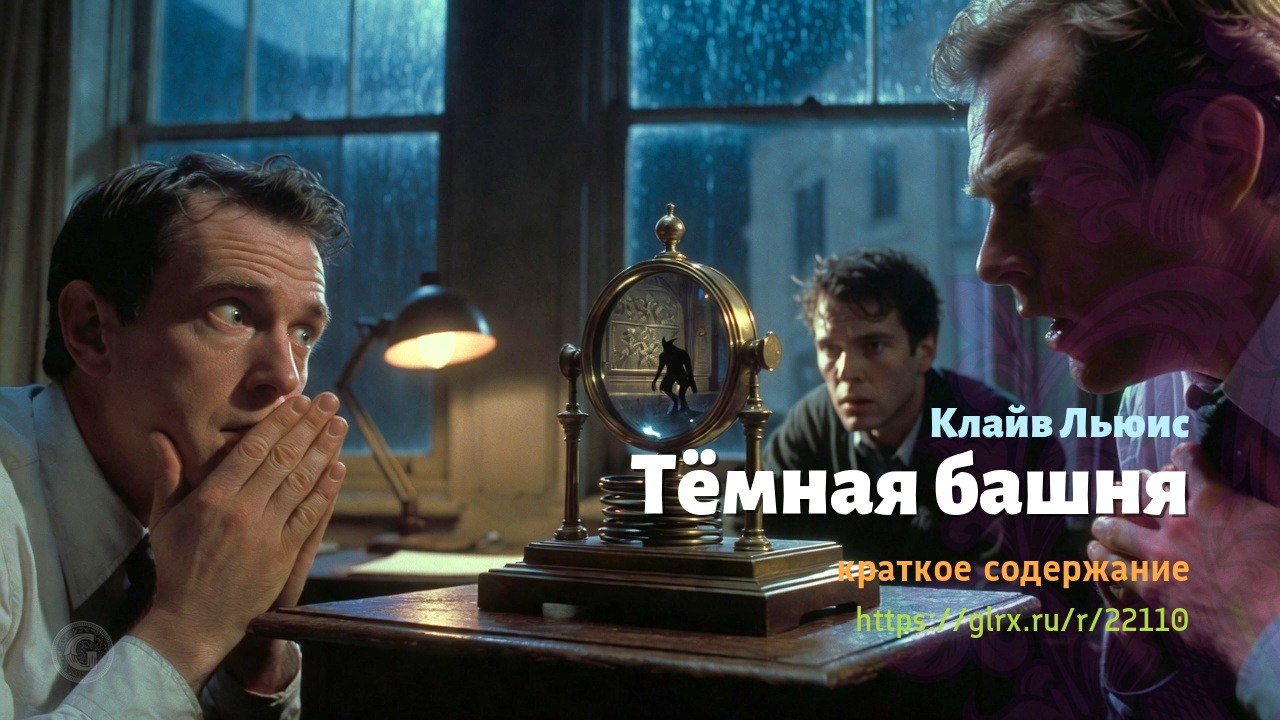
The unfinished story begins in the office of the Oxford scholar Orpheus. Along with his assistant Scudamore, the skeptic McPhee, the philologist Ransom, and the narrator Lewis, he tests a chronoscope — a device with a lens made of a special brain substance that allows one to observe events from another time on a screen.
The screen shows an unfinished building, outwardly identical to the Cambridge University Library, which researchers call the Dark Tower. Inside is a room decorated with a dense pattern of bas-reliefs and an idol composed of numerous distorted human bodies. Seated in a chair is the Stinger — a terrifying creature with a horny growth on its forehead. Using its stinger, it injects venom into the spines of young people, turning them into obedient automatons — "twitchers."
Soon, a doppelganger of Scudamur appears on the screen, experiencing excruciating labor pains and transforming into the Complainer himself. When a girl resembling Scudamur’s fiancée, Camilla, enters the room, Scudamur, in a fit of rage, leaps into the chronoscope. His consciousness is transferred to the body of the doppelganger in another time, and the Complainer finds himself in Cambridge in 1938 and escapes.
Scudamur settles into the body of the Complainer and refuses to harm the girl. He learns that the tower’s inhabitants are waging war against the White Riders. While exploring the local library, he reads scientific papers on the theory of two-dimensional time and time angles. The text ends with a description of experiments involving exchanging personalities between parallel dimensions.
Short fiction and unconventional plots
In the story "Born Blind," the young man Robin regains his sight after surgery but is unable to comprehend the nature of light. Accustomed to the tangible world of Braille, he becomes confused by visual terms. Unable to understand the explanations of his loved ones, Robin mistakes the white fog over an abandoned quarry for pure light, takes a step forward, and dies.
The story "Fake Lands" describes the hero’s transport into a false, simplified world constructed from the superficial desires of his acquaintance, Peggy. Amidst the primitive trees and display cases of clothing, a gigantic advertising figure of Peggy herself rises. The hero hears the distant calls of God and the girl’s fiancé, trying to reach her soul.
In the satirical story "Minerary Angels," two women — a haughty researcher and an elderly brothel dweller — are sent to a Mars station to relieve the men’s emotional tension. The crew is horrified by this kind of assistance, and the technicians secretly steal the spacecraft to return to Earth.
The story "The Shapes of Invisible Things" describes astronaut Jenkins, who arrives on the Moon. He discovers the frozen figures of past explorers and believes them to be statues. Turning back, Jenkins meets the gaze of Medusa the Gorgon and is frozen forever.
The unfinished historical novel "Ten Years After" depicts the end of the Trojan War. King Menelaus and his army enter the wooden horse and capture Troy. However, instead of the young beauty, he finds a withered, aging Helen, which only brings him bitterness. Later in Egypt, Menelaus encounters priests who claim that only a phantom was in Troy, and the real Helen is hidden with them. The manuscript ends with the mysterious apparition appearing.
- Галерея Льюиса Глюксмана, Корк
- Эйфелева башня, Париж: факты, архитектура, история
- Перси Уиндем Льюис: абстракционист, основатель вортицизма
- “Вавилонская башня” — Питер Брейгель Старший
- Трупный синод – тёмные века Рима
- Фредерик Уильям Бертон, ирландский художник: Встреча на лестнице башни
- Гюстав Эйфель: французский архитектор, инженер
- Искусствоведы: известные художественные критики
- Романский стиль
You cannot comment Why?