"Candidate of Sciences" by Gavriil Troepolsky, summary
 Automatic translate
A satirical novella exposing careerism in Soviet agricultural science in the 1950s, written in 1957. This book is a scathing pamphlet on pseudo-scientists who concealed their professional incompetence behind grandiose phrases about ideological devotion. The plot is built on the contrast between the reality of collective farm work and the reality-defying, armchair theory. For years, these armchair workers simulate scientific research, squandering public funds without the slightest practical benefit.
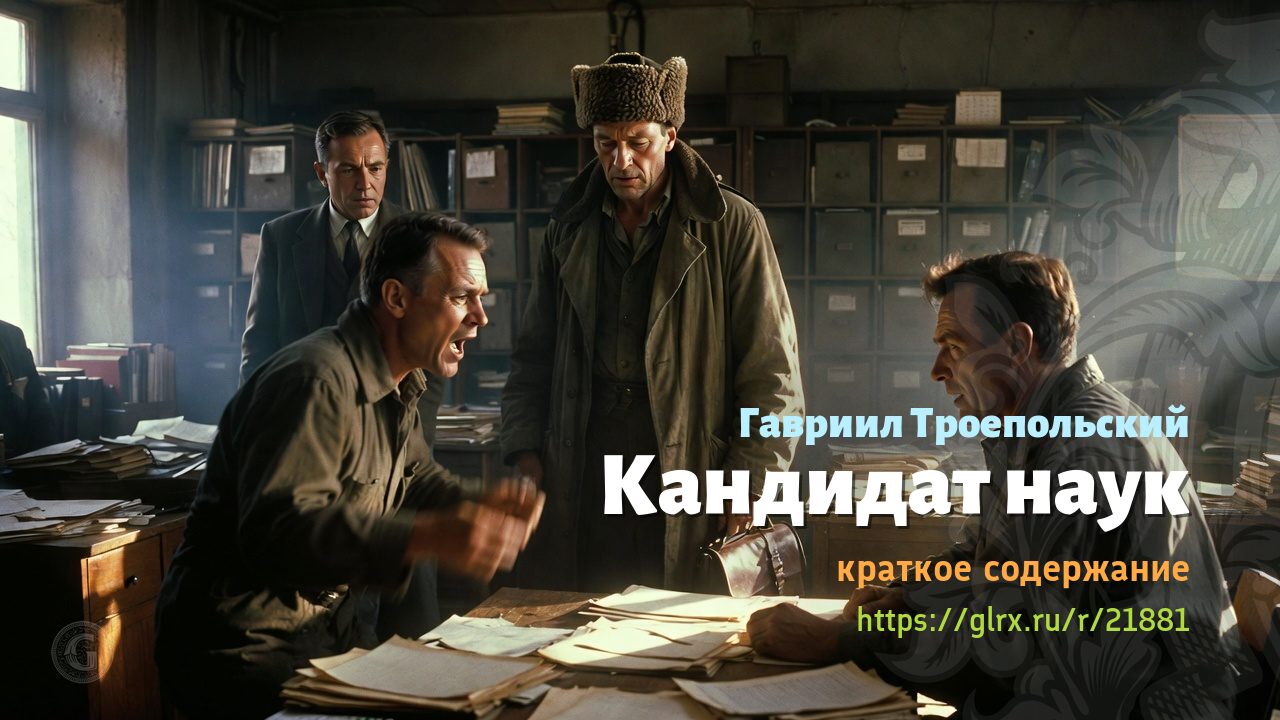
Everyday life of the Interregional feeding and waste bureau
Only two people work in a small institution dealing with horse feeding. The head of the office, Karp Stepanovich Karlyuk, and his subordinate, Irakli Kiryanovich Podsushka, spend their working hours reading novels and flipping ink caps on their desks. Their quiet life is interrupted by the arrival of Philipp Ivanovich Yegorov, an agronomist in an old padded jacket and tarpaulin boots. Yegorov has come to apply for a job at the experimental station. Karlyuk recognizes him as a former classmate of his, whom he strongly dislikes and frankly fears.
Agronomist Yegorov recently lost his position at the Pravda collective farm. District management accused him of violating established regulations. He had arbitrarily deviated from Academician Williams’s grass-cutting system in the name of increasing crop yields. Karlyuk was forced to sign the order appointing Yegorov, but immediately began plotting his own schemes. He sent the new employee to his patron, Professor Yefim Tarasovich Chernokharov, for experimental topics.
The Clash of Two Worlds
Professor Chernokharov is considered an infallible authority. He refuses to assign Yegorov serious work, citing his questionable independence of judgment. Chernokharov demands blind faith in the tenets of the grass-farming system, even if they contradict common sense. Yegorov leaves empty-handed. Soon, he meets another scientist, Professor Gerasim Ilyich Maslovsky.
Maslovsky is passionate about the future of the harvest, constantly arguing with dogmatists and testing his hypotheses on the ground. The professor advises Yegorov to ignore empty talk handed down from above and instead focus on pressing issues. Maslovsky suggests focusing on weed and wireworm control in real field conditions. He urges Yegorov not to give up and to fight for what’s right.
Karp Karluk’s past
Fearing exposure from Yegorov, Karlyuk decides to act preemptively. He studies his application and recalls his path to science. Karlyuk received his PhD for a preposterous study on the influence of lunar phases on tractor fleet performance. His defense was successful only thanks to Chernokharov’s support and some cunning behind-the-scenes maneuvers.
Karlyuk also recalls events from the war years. During the German advance, he cowardly fled to the rear, saving his wife, Izida Yerofeyevna, their dog, and their feather beds. On the road, the fugitives encountered Yegorov, who was en route to the front in an officer’s uniform. Izida Yerofeyevna accidentally let it slip that her husband had received a fictitious military service permit. Karlyuk fears that Yegorov will use these facts against him. Together with Podsushka, he concocts a denunciation of his collaborator and sends it to the Party.
Kabluchkov and expulsion from the party
The denunciation reaches the acting secretary of the district party committee, Kabluchkov. This arrogant official rules the district with commands and reprimands. He summons Yegorov to a meeting of the party bureau. Taking advantage of Karlyuk’s slander and the death of Yegorov’s father in German captivity, Kabluchkov pushes through a decision to expel the agronomist from the party.
The collective farm chairman, Nikolai Petrovich Galkin, courageously defends his friend, but the bureau bows to the secretary’s pressure. Philip Ivanovich is deeply affected by the incident. At night, he goes out into the fields and collapses in despair on the damp earth. Galkin and Yegorov’s mother help him cope with his emotional crisis. The friends decide not to give up and prepare a detailed letter to the Central Committee. Meanwhile, Karlyuk dismisses Yegorov from the institution. He remains working on the collective farm as a simple field worker.
Autumn battle for bread
A rainy autumn arrives. The fields turn into impassable mud. Unharvested grain rots, and heaps of wheat on the threshing floors become soggy. Kabluchkov sends meaningless, threatening telegrams, while Yegorov and Galkin spend days in the fields. They organize the work during the rare hours without precipitation.
To save the grain from burning moisture, Yegorov invents a portable covered threshing floor. The collective farmers move the structure right to the grain piles, sheltering the harvest from the downpours. With enormous effort, the collective farm completes the harvest and plowing of the fallow land. This shared effort further unites the disgraced agronomist with the common people. Galkin sends a letter in defense of his comrade to the new secretary of the regional party committee.
Banquet and the failure of the dissertation
Karlyuk is preparing to defend his doctoral dissertation. The topic of his new work is devoted to replacing oats with pumpkins and tomatoes in horses’ diets. To appease the right opponents, he organizes a fake party at home — the thirteenth anniversary of his scientific career. Chernokharov, Associate Professor Svyatokhin, and Professor Stolboverstov come to visit.
The drinking bout ends in a huge scandal. A drunken Chernokharov starts a riot, shouting, "They’re polluting science with all sorts of crap!" and beating Karluk’s beloved dog, the spaniel John. Izida Yerofeyevna, enraged, punches her husband. The next morning, Chernokharov apologizes, and peace is restored. The scientists go to a council meeting to hear Karluk’s preliminary report.
The presentation proceeds in a sleepy atmosphere until Professor Maslovsky takes the floor. He tears apart the speaker’s pseudoscientific arguments. Next comes Yegorov, who has arrived from the collective farm. Loudly and bluntly, he accuses the entire company of wasting the people’s millions. The meeting breaks down when Yegorov shouts out, "Nonsense!" Karlyuk panics.
Weathervanes change course
New trends are emerging from the capital. Williams’s teachings on the grass-farming system are being reconsidered. Chernokharov and Stolboverstov instantly change their minds. Yesterday’s dogmatists publish an article rejecting grass-farming and praising the tillage system. Yegorov writes an open letter to the newspaper, denouncing their opportunism, but the publication is rejected due to its harsh tone.
The letter lands on the desk of the regional committee secretary, Natov. He summons Yegorov for a serious discussion. Soon, large-scale inspections begin in the region. Karlyuk’s office is subject to liquidation. Having lost his job, Karp Stepanovich unsuccessfully tries to find a new job. Through the Society for the Dissemination of Knowledge, he is sent to give anti-religious lectures on collective farms.
The lecturer’s inglorious end
Ironically, Karlyuk arrives to give a lecture at the Pravda collective farm. He brings with him huge clay makitras, hoping to buy honey cheaply. Storekeeper Kuzin orders only two hundred grams, driving Karlyuk’s wife into a frenzy.
That evening at the club, Karp Stepanovich monotonously reads someone else’s brochure about stars and atoms. During the question-and-answer session, he displays utter ignorance. A local schoolboy corrects his knowledge of astronomy. Then the collective farmers ask questions about agriculture. Karlyuk can’t answer how many incisors a sheep has on its upper jaw, causing a burst of laughter. Upon learning that Yegorov works there as the chairman of the collective farm, the disgraced lecturer flees to the station at night. The shock of the experience drives him mad.
Time of new people
Four years after the events described, agricultural science is beginning to purge itself of opportunists. Chernokharov and Stolboverstov are still holding their own, cosying up to the new authorities. Students and young scientists are no longer intimidated by their prestigious titles and are openly debating at council meetings.
Philipp Ivanovich Yegorov was reinstated in the party. He successfully defended his PhD dissertation, demonstrating his knowledge in practice. Meeting Professor Maslovsky in the endless grain fields, he continued to passionately debate the future of the collective farm village. Honest toilers of the land regained their voice, proving that true science cannot exist without a living connection with the people.
You cannot comment Why?