A summary of "The Diary of a Provincial in St. Petersburg" by Mikhail Saltykov-Shchedrin
 Automatic translate
The work by the Russian satirist was created and published in 1872. Written in the form of diary entries, it uses Aesopian language to disguise political satire on the post-reform nobility and liberal intelligentsia, hiding its philosophy behind grotesque dreams and comic situations.
Escape to the capital and search for life
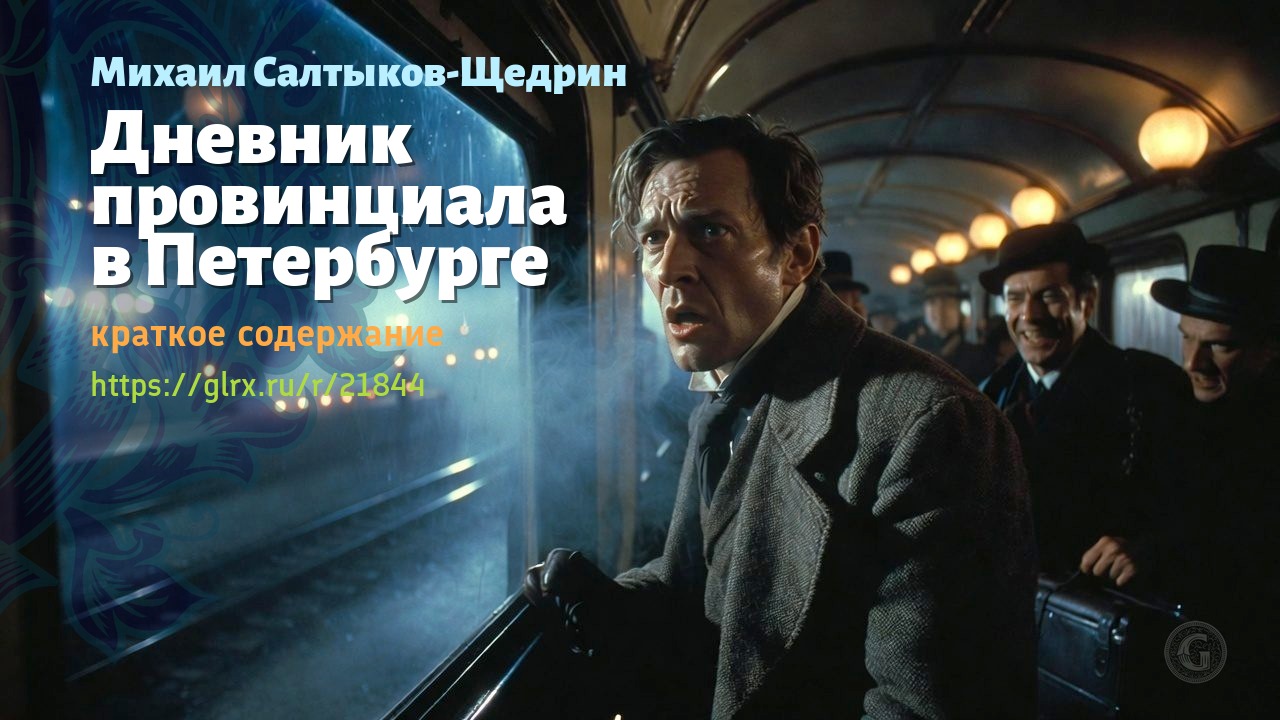
A nameless provincial hero flees a loathsome provincial town for St. Petersburg. He hopes to find meaning in his life, far from the vulgar conversations and narrow interests of his native land. On board the train, he discovers to his horror that almost his entire native province is traveling with him. Landowners he knows are traveling to negotiate lucrative railway concessions. Among his fellow travelers, the insolent and unscrupulous Prokop stands out. The capital greets the newcomers with bustle. The provincial fraternity settles together in the Grand Hotel.
The hero finds himself caught up in the whirlwind of meaningless metropolitan activity. His fellow countrymen spend their days knocking on the doors of government ministries. In the evenings, they gather at Eliseev’s restaurant, squandering vast fortunes, drinking champagne, and fawning over the former peasant, now a powerful railroad magnate, Bubnovin. The provincial grows tired of this noisy society. He decides to seek an intellectual life. The hero visits his old school friends, who have risen to high government positions. It turns out that the spiritual life of state councilors boils down to worshiping the operetta singer Schneider. The hero goes to theaters, watches frivolous dances, drinks all night long, and loses his humanity. His morning awakenings are accompanied by a severe hangover and a painful feeling of inner emptiness.
Reactionary projects
Tired of the debauchery, the provincial tries to comprehend what’s happening. Prokop introduces him to new political trends. The provincial nobility, having lost absolute power over the peasants, is en masse concocting absurd plans for social reorganization. These documents terrify the hero with their bloodthirstiness and stupidity. The landowner Poskudnikov demands the total execution of all dissenters. The retired cornet Tolstolobov is writing a lengthy decentralization plan, dreaming of restoring the local landowners’ right to beat people in the teeth with impunity. Titular Councilor Filoveritov proposes a complex system of moral stupefaction, demanding that the youth be forced to read only dream books. Lieutenant Colonel Sdatochny insists on a radical reorganization of the Academy of Sciences. He wants to entrust the ignorant nobles with the task of eradicating harmful knowledge.
The provincial burns these terrifying papers in the fireplace. The hero wants to forget what he’s read. The reality of St. Petersburg frightens him no less. He attends crowded parties hosted by high-ranking dignitaries. There, eminent aristocrats hypocritically sigh over the demise of Russia and listen to the reading of absurd conservative tracts.
Union of Foam Skimmers
Seeking salvation from the reactionaries, the hero turns to the liberal intelligentsia. He meets his old university friend, Menander Prelestnov. Menander now edits the popular newspaper "The Oldest All-Russian Foam Skimmer." He invites the intrigued provincial to join a secret circle of metropolitan skimmers.
The meetings of these figures cause the hero acute disillusionment. The liberals have concocted their own unspoken charter. Their cardinal rules require never drawing clear conclusions, to be fearful, and to skim the cream off safe topics. Journalists Neuvazhai-Koryto and Hemlock spend years producing pseudoscientific proof of the Swabian origins of the folklore hero Churilka. Publicist Neskladin writes empty, endless editorials about precise tax deadlines. These people fear state censorship. They narrow their horizons and drown out vibrant public thought in a powerful torrent of idle talk. The hero understands that cowardly liberals are no better than bloodthirsty conservatives.
In a bold experiment, the provincial begins writing absurd newspaper articles himself. He composes lengthy texts about the possibility of combining gardening with goat breeding. Menander’s newspaper enthusiastically publishes this pseudo-scientific nonsense. The provincial earns enormous amounts of money, but feels utterly spiritually devastated.
Dream of a Million
The hero’s weary, sick consciousness gives rise to nightmarish dreams. He dreams that he was a wealthy tax farmer and died in a furnished room. Prokop, who happened to be nearby at the fateful moment of death, steals a whole million rubles from the deceased’s chest. The provincial man’s soul separates from his body and observes what is happening.
The deceased man’s two greedy sisters from Vetluzha inherit the stolen million. A cynical St. Petersburg lawyer, Khlestakov, arrives to see them. For a paltry handout, he buys the foolish sisters the exclusive right to handle the case. A grandiose, scandalous trial ensues. The self-assured Khlestakov faces the cunning lawyers of the wealthy Prokop.
Prokop bribes the right witnesses. The innkeeper Gavryushka and the resourceful tradesman Strelnikov give false testimony in his favor. The jury completely acquits the brazen Prokop, declaring that the clever embezzlement of someone else’s million is perfectly natural. Having won a difficult trial, Prokop begins his triumphant journey through Russia’s small and large cities. He is greeted everywhere with deep honor. Local authorities flatter the wealthy thief and ask him for money for various city needs. Justice collapses.
Statistical Congress and Court
The hero’s next terrifying nightmare is closely connected to the International Statistical Congress. The provincial becomes an official delegate to this lavish scientific gathering. The congress is held in a St. Petersburg tavern. Foreign scientists Quettle, Levasseur, and Farr demand champagne. They make lengthy toasts and devour Russian pies with gusto. Famous literary figures are present at the congress. The hero encounters the aged Rudin, Kirsanov, and Lavretsky of Turgenev, and Goncharova’s radical Mark Volokhov.
The scientific meetings devolve into utter farce. The stern Englishman Farr proposes adding a separate line item for spies to the official statistics. The cunning Frenchman Levasseur delivers a fiery, persuasive speech in defense of the institution of espionage. The congress participants applaud the speaker.
Suddenly, the police burst into the hall. It turns out the entire congress was an elaborate trap. The foreign guests remove their masks. The liberal Levasseur reveals himself to be the retired Cornet Shaloputov. The police accuse the bewildered provincial and his friends of a dangerous state conspiracy.
An absurd, closed trial begins. Young, unyielding judges interrogate the arrested men. They force the frightened hero to confess to sympathizing with absurd, destructive ideas. The judges attempt to accuse the provincial of determinedly intending to destroy the state by forcibly introducing mandatory smallpox vaccinations. The hero is willing to confess to any monstrous crime, just to avoid Siberian hard labor. He gives securities to a corrupt official as a large bribe. It soon becomes clear that the entire horrific trial was a cruel, pointless prank. Idle metropolitan pranksters decided to mock the foolish, gullible provincials.
Hospital for the insane
A series of real-life shocks and terrifying, debilitating dreams shatters the hero’s sanity. A provincial man wakes up in a gloomy mental hospital.
In complete isolation, he draws a bitter, disappointing conclusion to his recent observations in the capital. He divides modern public figures into two main types. He calls the first type the predator. The predator is brazen, cynical, and obsessed with easy money. This is the new man, who retains the crude manners of the old serf-owner. He elbows everyone aside and robs his defenseless neighbors. But even the successful predator feels a deep inner emptiness and suffers from the utter meaninglessness of his active existence.
The second type is the so-called "skimmer." The skimmer is cowardly and pathetic. They fear open struggle and prefer to beg for small handouts. This type of person thrives on petty, harmless problems, avoiding the harsh truth of life. The skimmer coos about the general good of society, but in reality, they only lull and soothe others’ consciences.
The hero admits his powerlessness in the face of this grim, stifling reality. Society has reached a dead end. Old, lofty ideals have been destroyed, and new ones have never been created. Life has become an ominous mirage, where deep despondency and a ringing emptiness reign.
You cannot comment Why?