Charles Bukowski’s "Post Office" Summary
 Automatic translate
The novel was created in 1970 and published in 1971. Charles Bukowski wrote this debut in three weeks, immediately after leaving the military at the age of forty-nine, accepting publisher John Martin’s offer of a hundred dollars a month for life. The book is the first in a series about Henry Chinaski, which also includes the novels "Factotum," "Women," "Ham on Rye," and "Hollywood."
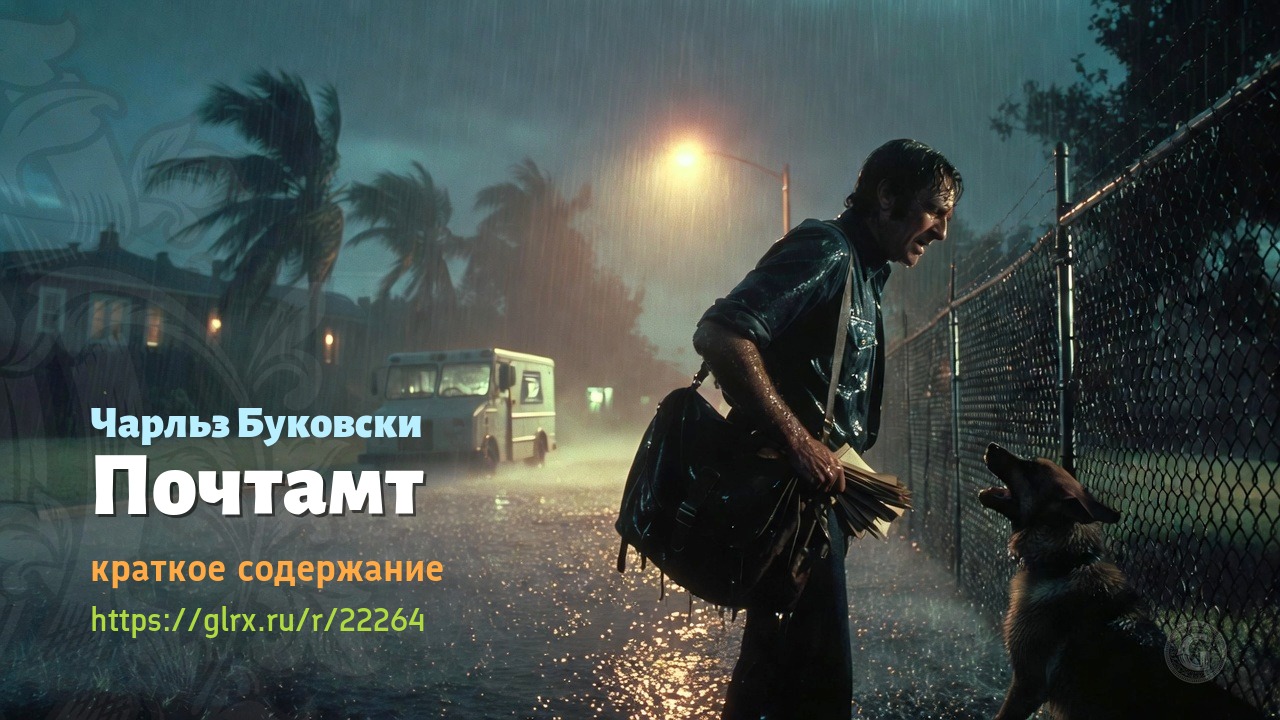
On Christmas Eve, Henry Chinaski takes a temporary job as a substitute letter carrier. After passing an exam and a medical examination, he is assigned to the Oakford station. The sorting hall is run by the despotic Chief Johnston, nicknamed "Stone." This man wears blood-red shirts and systematically torments the new recruits with grueling tasks. Chinaski is assigned the most neglected route, with steep hills, dark front doors, and broken mailboxes.
A heavy leather bag weighs down my shoulder. I have to fend off angry German shepherds, endure the nitpicking of tenants, and get drenched in a five-day California downpour. During Sunday mail collection, the water rises two feet, flooding the cab of the company truck, washing the address pad into a muddy puddle, and forcing the postman to abandon his stalled car on someone else’s lawn.
A report against Stone’s arbitrary behavior yields no results. Officials in the Federal Building defend their boss. Soon, model employee Matthew Battles is arrested for systematically stealing money from a religious cult’s mailing list. Another veteran of the precinct, old Dae-Ge, collapses under the weight of unscheduled advertising leaflets and runs off to the locker room, crying loudly.
The service lasts three years. Management forbids leaving uniform caps on desks. Stone scribbles endless reports about rule violations. Chinaski methodically throws these forms in the trash and resigns.
Texas Marriage and Return to Service
Betting on the horse races brings in a steady income. Betty’s partner finds a job as a typist and reproaches Henry for his idleness. The couple quickly breaks up. A trip to Las Vegas ends in a hasty wedding to a twenty-three-year-old wealthy heiress, Joyce, after which the newlyweds move to a tiny Texas town of two thousand.
The local relatives greet the stranger with undisguised anger. Grandfather Joyce takes his son-in-law out to pasture and sets a herd of bison on him. Henry escapes the enraged animals with a desperate leap into a roadside ditch.
The couple returns to California. Joyce buys a house on a hill and demands immediate employment. Chinaski works briefly as a packer in an art store, then retakes the state exam and returns to the department as a letter sorter. The oath of office turns into hard labor. The first day of work devolves into a twelve-hour night shift without the right to leave the footrest, and the instructors instill in their classes the idea of defeating geopolitical rivals through sheer hard work.
Everyday life turns into a nightmare. The backyard is swarming with flies, the puppy Picasso his wife brought home is soiling the rooms, and the pots of geraniums hanging over the bed fall on their backs during sex. To top it all off, Joyce buys noisy parrots. Chinaski opens the cage door and releases the birds. Soon, the woman becomes infatuated with a coworker with a purple tie pin and files for divorce.
Losses and Mnemonic Cards
Chinaski is alone again. A chance encounter with the dejected Betty develops into a brief attempt to reconnect. The woman drinks heavily in a cheap room and is admitted to the county hospital with profuse bleeding.
The ward is filled with complete indifference. Henry moistens his dying friend’s parched lips with a napkin. The doctors abandon the patient without assistance, and she dies. The funeral is attended by three people: the deceased’s son, the mute landlady, and Chinaski. The priest cuts the ceremony short, and the ordered rose wreath wilts in the heat and falls into the dry grass.
The racetrack helps him cope with his dark thoughts. In the stands, Henry meets a black post office clerk named Vi, calculates the victories of forgotten underdogs, and takes home substantial winnings.
Postal authorities require mandatory passing of a highly challenging exam to map out hundreds of city streets, so Chinaski develops his own system for memorizing cards using obscene associations with female names and the ages of fictional characters. He distributes a hundred test forms in five minutes with 100% accuracy and is promoted to permanent staff on an eight-hour shift. The seat next to him in the hall is occupied by the braggart Dave Jenko, who torments his colleagues every night with his mediocre manuscripts and cries about fictional novels.
Vacation on the coast and the birth of a daughter
A successful bet brings in three thousand dollars in six weeks. Demanding a three-month vacation at his own expense, Chinaski heads to the coast 160 kilometers south of the city. Days are spent in expensive restaurants and beachfront hotels. He meets Mary-Lou at a racetrack bar. While packing for the hotel, her ex-boyfriend lunges at her with a knife, receiving a crushing blow to the jaw from a beer bottle.
Money is melting away rapidly.
Henry returns to the night shift and takes up with the gray-haired anti-war activist Faye. His body begins to malfunction. He experiences sudden dizziness at work, and his weight skyrockets to 100 pounds. In the hospital, Faye gives birth to a daughter, Marina-Louise. Riots break out in the city, the postmaster declares a curfew, after which Faye takes the baby and leaves for a hippie commune in New Mexico.
Bureaucratic persecution and final departure
Administration plied Chinaski with warnings for missing shifts, issuing him a three-day suspension without pay. Controllers with stopwatches monitor his every move. A five-minute delay in sorting a sixty-centimeter tray results in a forced lecture from a supervisor nicknamed Skinny Beaver. A stray cigar ash ignites a cart of third-class advertising wastepaper, after which Chinaski desperately smothers the flames with heavy catalogs, tramples the smoldering, charred stacks with his boots, and is sent to the infirmary with severe burns on both palms.
Management dismantles drinking fountains to save on lawsuits. Old comrade Moto transfers to the guards’ camp and wears a badge.
Chinaski crosses the threshold of the Federal Building and demands his paycheck. He calmly tells the personnel officer a tall tale about hunting nutria and muskrat on a boat in the Louisiana swamps.
His release turns into a two-week bender. A visiting medical student leaves a jar containing the preserved heart of a dead woman named Frances on the coffee table. His friends take Henry to a strip club, after which he returns to his ransacked apartment and collapses on his bed. Waking up in the morning, he resolves to write a novel — and he does.
- For the anniversary of the Kursk region in the exhibition hall "Star" exhibition opened
- Exhibition "Children’s WORLD (Museum of the History of Russian) postcards"
- Pushkin State Museum of Fine Arts A.S. Pushkin will hold exhibitions at the sites of the Russian Post
- "Stronger Than Fear" by Marc Levy, summary
- Charles Bukowski’s "Women," Summary
- What can you give a guy for his birthday: popular gift ideas
You cannot comment Why?