A summary of "Maturity" by Jean-Paul Sartre
 Automatic translate
Paris stands still in the summer of 1938. Thirty-four-year-old philosophy professor Mathieu Delarue suddenly learns that his longtime lover, Marcelle Duffet, is pregnant. His freedom is shattered. Instead of coming clean and starting a family, he frantically seeks money for a clandestine surgical procedure, hoping to maintain his bachelor lifestyle among books, lectures at the Buffon boys’ school, and casual get-togethers with friends. The author conceived the idea for this book in July 1938, and he completed the final manuscript in Paris in the summer of 1941.
This novel opens the "Roads of Freedom" cycle. It was followed by "Delay" and "Death in the Soul." The fourth part of the series, tentatively titled "The Last Chance," remained unfinished, and its surviving fragments later appeared in print under the separate title "Strange Friendship" in the literary journal "Tan Modern."
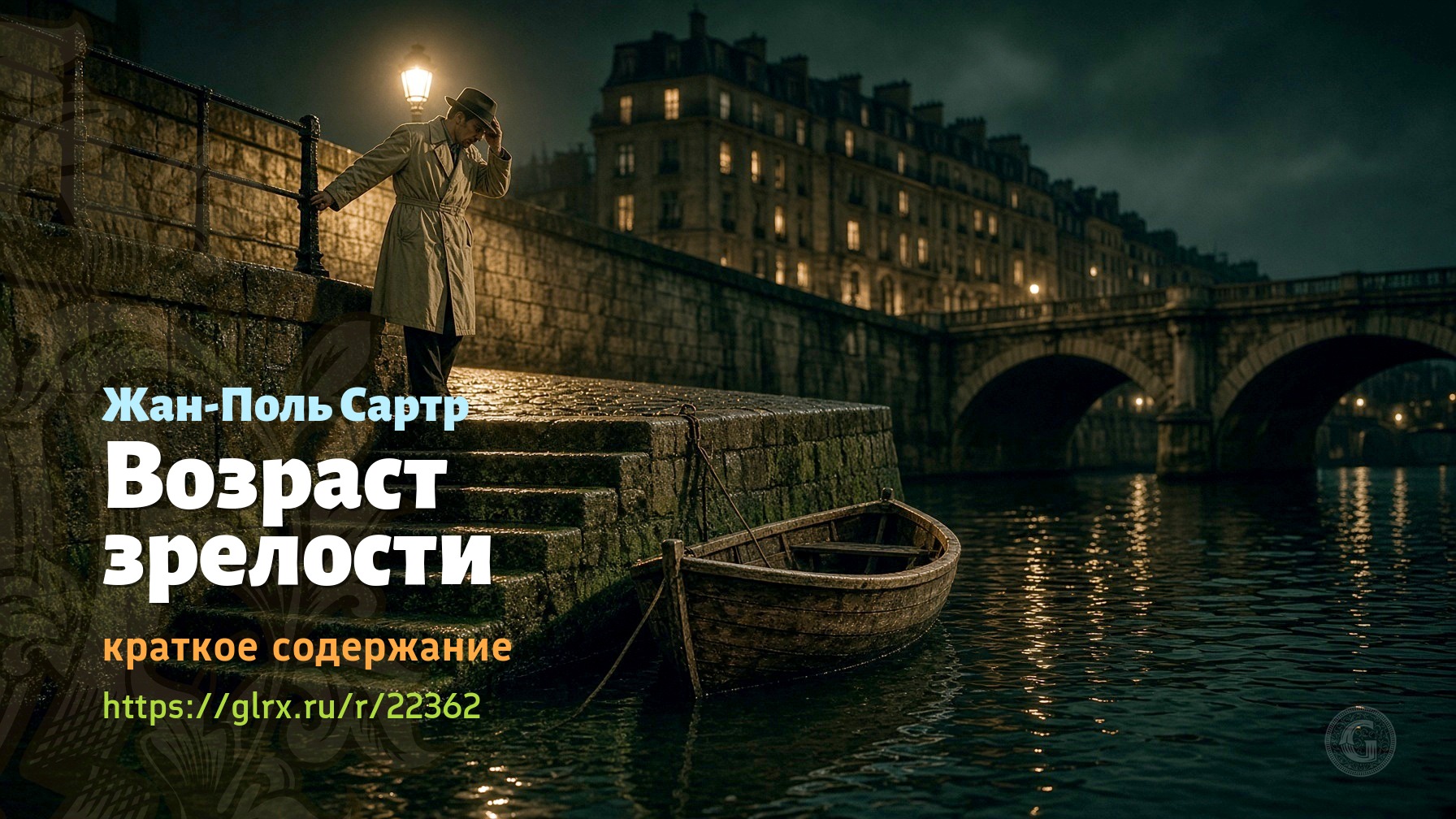
The Pink Room and the Old Debt
On Rue Vercingetorix, a drunken hunk handed Mathieu a postcard postmarked from Madrid. He hurried to the blue house. In the stuffy pink attic, Marcelle lay on the bed in a green nightgown. Seven years of secret meetings had culminated in a two-month delay. Mathieu immediately began talking about getting rid of the burden. The woman gave the suspicious address of a midwife on Rue Maurer, who paid four hundred francs. Mathieu set out to investigate at night. His hostess met him in men’s pants, her hands smeared with the dirt of a strangler. Looking at the broken dishes and empty bottles of rum, the guest categorically forbade his friend from going under the knife of this madwoman.
In the morning, the philosopher arrived at the workshop on Rue Delambre. Sarah Gomez was sitting in a yellow kimono among vials of acid. The communist Brunet also appeared. Upon learning of the plight, the workshop owner remembered a refugee from Vienna named Waldmann. The doctor asked for four thousand francs in cash before sailing for the United States.
Mathieu ran to the Café Dupont Latin. Sorbonne student Iviš Sergina was drinking green mint. She was afraid of failing her botany exam. In a taxi on the way to the Gauguin exhibition, Mathieu awkwardly pulled the girl toward him and kissed her cold, pursed lips.
Basket by the muddy water
Daniel Sereno shaved in front of the mirror. This wealthy, handsome man used a razor to cut off a ripe pimple on his chin. Three cats — Scipio, Malvina, and the wild Poppea — were thrown into a wicker basket. Daniel loaded the basket onto bus route 72 and drove to Charenton to drown his pets in the Seine.
The shore smelled of tar. The man cut a skein of twine, tied a heavy boulder to the wicker handle, and peered into the dark, oily water, streaked purple with factory smokestacks. His claws scraped along the bars. A sudden wave of nausea compelled him to cut the rope with a penknife.
Daniel brought the captives back to Rue Montmartre. There, Mathieu was waiting for him, asking for five thousand francs. The landlord lied about his losses on the stock exchange and sarcastically advised his guest to get married.
Visiting relatives
Lawyer Jacques Delarue received his younger brother in a spacious office on the third floor of Rue Réaumur. The elder brother sported an impeccable English flannel suit and drank whiskey. Mathieu bluntly admitted to Marcelle’s pregnancy. The lawyer launched into a lecture about the prude bourgeois hiding behind the mask of an irresponsible student.
Abortion was called metaphysical murder. Jacques offered ten thousand francs exclusively for a legal marriage.
Mathieu rushed out into the scorching sun, bought a fresh copy of the Excelsior newspaper with front-line reports on the bombing of Valencia, and felt ashamed of his own petty egotism. At home, he was intercepted by the communist Brunet. The activist persistently urged his old comrade to join the party in anticipation of the approaching war. Mathieu declined, citing a lack of blind faith.
Night Lights of Cabaret
The daytime heat had subsided. The basement lounge of the Sumatra nightclub smelled sultry and thick with powder. Former student Boris sat next to Sister Ivich. Singer Lola Montero took to the microphone to sing a sailor’s ballad about Johnny Palmer.
Ivich was drunk on vodka. She snatched her brother’s Basque folding knife from the tablecloth and slashed her left palm to spite the prim lady sitting next to her. Scarlet blood spurted. Mathieu drew the blade and slammed the steel blade into his own hand. The waiter led the wounded to the restroom. The gray-mustached attendant bandaged their palms with stinking iodine.
Letters under lock and key
In the morning, a trembling Boris came running into the Dom café. He screamed about Lola’s death from a heroin overdose. The young man’s love notes, containing dangerous references to drug dealers, were left in the hotel room on Rue Navarin.
Mathieu rushed to rescue the frightened boy. In room twenty-one, behind the half-open door, lay the singer’s motionless, pale body, her gaze frozen. The man knelt before a chest by the window, found a bundle of papers with a yellow ribbon, and noticed wads of thousand-ruble bills. Fear prevented him from taking the money. Lola suddenly stirred and spoke in a hoarse, weak voice. It turned out to be a deep faint. The singer was asking for her lover to be returned.
Ivich waited for news on a stone bench near the Santé prison. Her sister rolled dice to see if she would win the university entrance exam. She’d failed. A note with the words "Unconscious" sent Mathieu searching for the young lady in the stuffy pubs of the Latin Quarter.
Meeting in the basement
Students were dancing under the paper lampshades at the Tarantula. Mathieu dragged a staggering girl out onto Rue Jugens. On the sofa, the guest drank Ceylon tea and grimaced in disgust.
Sarah arrived out of breath, refusing to treat him without an advance payment. Mathieu announced his decision to marry Marcelle. Ivich flushed with contempt for the other woman’s family life and ran out onto the stairs.
In desperation, the philosopher ran to Lola’s empty hotel, opened someone else’s chest, and stole five thousand francs. On the Rue Vercingetorique, Marcelle was waiting for her lover, wearing a white dressing gown and a flower in her hair. She already knew about Daniel’s secret visits. Mathieu placed the stolen bills by the bed. Marcelle, furious, threw the bills back in his face after hearing his icy confession of fading passion.
Final settlement
Meanwhile, Daniel paced his room with a straight razor in his hand. He wanted to castrate himself to rid himself of a carnal vice, but he cowardly threw the blade on the table and fled to a Norwegian bar.
At midnight, Daniel knocked on Mathieu’s door. Lola was sitting on the sofa, demanding the return of the stolen wad of cash or face imprisonment. The guest took the bills from his pocket, which Marcel had discarded on the rug, and handed them to the singer. Lola silently took the cash.
Daniel announced to his stunned friend his engagement to the pregnant Marcelle to save someone else’s child. He then confessed his homosexuality. Mathieu locked the front door behind him, sat on the arm of an empty leather chair, and began to pull off his shoes in complete silence. Freedom had turned into a deafening emptiness. The time of youth was finally over.
- Three new exhibitions at the Museum of Modern Art in Porto
- "Crimea. Return" - a personal exhibition of Alexei Burtashenkov following the results of the autumn plein air in Crimea
- In the Nizhny Novgorod Theater. Gorky held a press conference on the new work of director Rodion Ovchinnikov
- Exhibition by Ekaterina Belyavskaya "Checkmate and You"
- Our wives (16+)
- Our wives (16+)
You cannot comment Why?