"Nausea" by Jean-Paul Sartre, summary
 Automatic translate
The novel is written in the form of a diary by the thirty-year-old historian Antoine Roquentin, who found refuge in provincial Bouville. This book is a manifesto of early French existentialism, in which the abstract metaphysical category of being is transformed into the physical unease of things. The author worked on the manuscript from 1932 to 1936 in Le Havre, which provided the topographical features of the fictional Bouville, and the first edition was published in 1938 under the title suggested by publisher Gaston Gallimard instead of the author’s original "Mélancholia."
Other people’s things
The notebooks open with a brief introduction from the fictional publishers about Roquentin’s papers. The hero himself settled in the seaside town of Bouville to conduct archival research on the life of the Marquis de Rollebon, a French adventurer of the late 18th century. Several years ago, Antoine had abruptly abandoned his colonial service in Indochina after suddenly becoming transfixed by a Khmer statue.
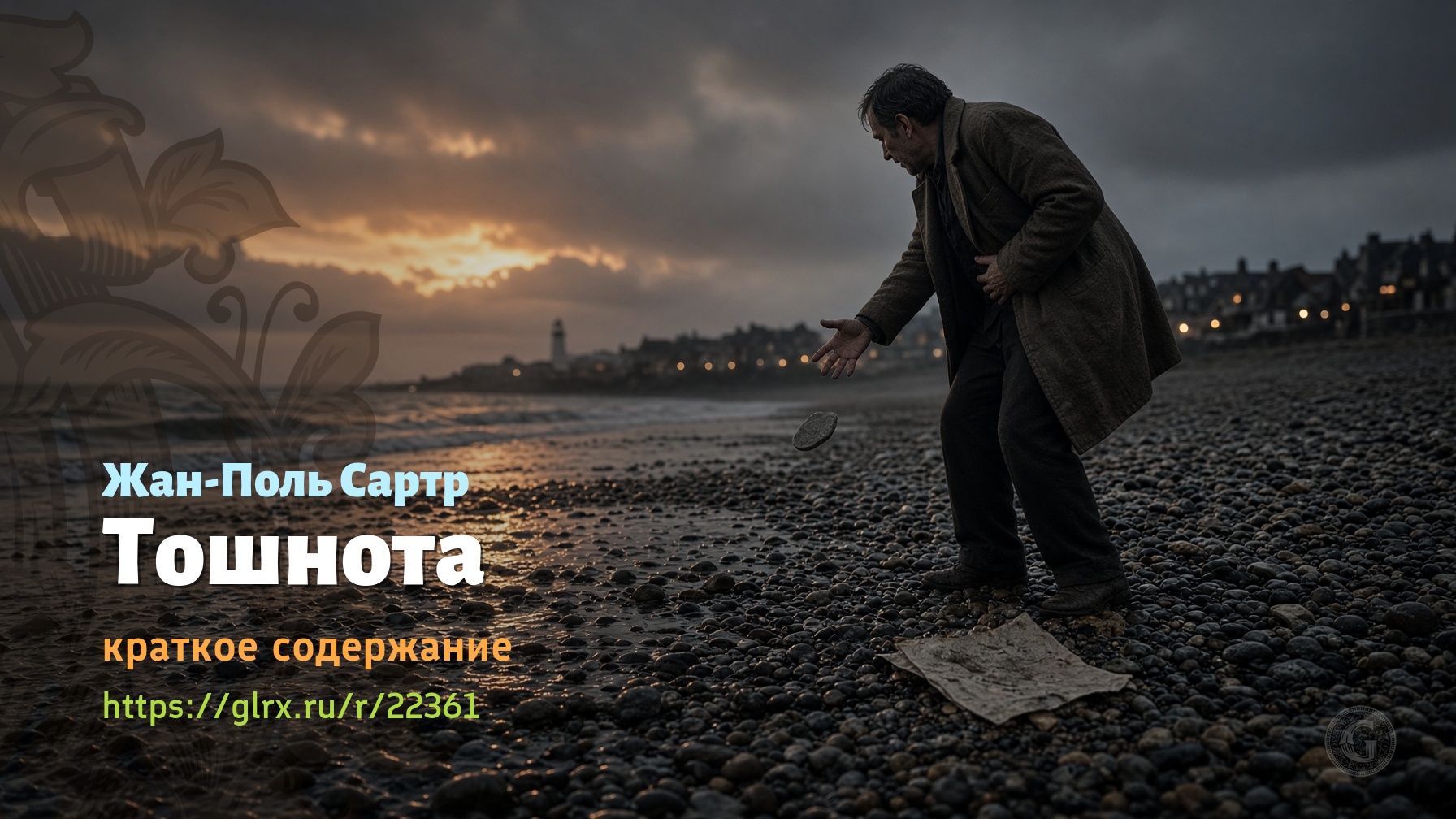
Now familiar objects lose their neutrality. On the seashore, my fingers drop flat pebbles from an inexplicable attack of sweetish pain in my stomach. The doorknob feels like a cold, living thing. A wet school sheet of paper with the words "Dictation. White Owl" is stained on the pavement. My hand freezes over the paper, paralyzed. Free will breaks on the pavement.
Loneliness narrows the horizon. Antoine avoids conversations with people, meeting Françoise, the owner of the "Rest of the Railwaymen" café, for a quick sexual encounter on the second floor among the creaking floorboards.
Bouville’s Habits
In the reading room of the municipal library, Roquentin encounters a small clerk nicknamed the Autodidact. He methodically pores over the bookshelves, alphabetically sorting by author, having worked his way from the letter "A" to the letter "L" in seven years. This awkward reader munches on bread and chocolate between Catholic pamphlets and treatises on peat.
On Thursday, a green statue of the academy’s inspector, Gustave Empetraz, stands tall in the Place du Mortgage Bank. The bronze idol guards the peace of the ladies in black walking their lapdogs. People on these streets seem to sense the immutability of a routine. The locals string their days together on a thread of empty tasks.
On Sunday, a bourgeois crowd spills out of the Church of Sainte-Cécile-de-Marine onto the Rue Tournebride. The townspeople ceremoniously raise their black bowler hats, revealing their shiny, pink bald heads to passersby. Antoine watches this parade of false smiles in the Vézelize brasserie, leafing through Balzac’s Eugénie Grandet. In the evening, the crowd on the pier disperses in the cold wind. The lighthouse of Caillebotte Island lights up in the gathering darkness.
The Marquis’s Ghost and the Mirror
Historical research begins to stall. Rolbon was present at the palace coup in St. Petersburg and the death of Paul I, changed camps, plotted, and traded arms in Asia. Police reports and letters fade. The nobleman’s true appearance is finally lost in the biographer’s conjectures.
A white hole in a mirror gleams in the hotel room. Roquentin leans over the porcelain frame, peering into the reflection of his own face. His gaze registers the fish-scales of his pupils, the ridges of his skin, the grayish fuzz of his cheeks. A shapeless mass of plant matter sways in the glass, at the level of his polyps. His face loses its human structure.
At the "Priyut Trektcikov" (Travelers’ Shelter) café, waitress Madeleine puts on an old Pathé record featuring the song "Some of These Days." A sharp, syncopated rhythm plays. A black voice cuts through the viscous air of the pub. The melody hardens into a steel band, momentarily dispelling the nausea.
Museum scum
A letter from Annie’s former lover appears among the old papers. Five years of separation are broken by a dry note in pencil inviting him to come to a Parisian hotel for a few days. While waiting for the appointed date, Antoine wanders around gray Bouville, engulfed in sticky fog.
The city museum greets visitors with the silence of its halls. The walls of the Bordurin and Renaud gallery are adorned with formal portraits of the city’s fathers. Pacôme merchants, court presidents, and the director of the board, Jean Parrottin, gaze from their canvases with absolute confidence in their right to rule the world. The artist disguised the meager stature of Olivier Blévigne, a member of parliament at 1.53 centimeters, with miniature furniture. Antoine casts a curse on the complacent portraits into the darkness of the hall.
Chestnut root
Work on Rollebon’s biography finally ceases. The historian realizes the impossibility of justifying his own present by resurrecting someone else’s ashes. In anguish, Antoine slashes his palm with a penknife, watching the drops of blood on the drafts.
Wednesday arrives. The Autodidact invites Roquentin to lunch at Bottanet’s restaurant for purple coupons. The clerk enthusiastically professes the socialist humanism he acquired in a German prisoner-of-war camp. Antoine feels an overwhelming revulsion at the abstract love of humanity. His escape from the restaurant leads him onto a tram, where the plush seat turns out to be the carcass of a dead donkey.
A revelation occurs in the city park. Near a wooden bench, a thick chestnut root protrudes from the ground. The word "root" falls away, revealing a black, knotted mass. The existence of things is revealed as absolute chance, without purpose, reason, or necessity. The entire landscape of Bouville — the rocks, the trees, and Antoine himself — appears nauseatingly excessive. To exist is simply to be here, without any justification.
Paris meeting
On February 20th, Roquentin crossed the threshold of his Parisian hotel room. Annie greeted him in a tight black dress, devoid of the oriental shawls hanging on the walls. Her figure had grown heavy, her cheeks paler.
Annie used to fanatically construct "perfect moments" and seek out "winning situations." Now this passion has faded. She lives off the support of a wealthy companion, mechanically travels around Europe, and calls herself a living corpse. Antoine confesses to the collapse of his illusions. The unity of lost time separates them forever. At the Saint-Lazare station, Annie leaves for Dieppe with a silent foreigner.
Scandal in the library
Returning to Bouville to collect his luggage, Antoine climbs the Green Hill. Below, figures scurry about, confident in the eternity of the brick walls. The forest creeps down onto the city from the hills.
At two o’clock in the afternoon, Roquentin comes in to return his books. Two high school students are sitting in the hall. The autodidact starts a quiet conversation with the dark-haired teenager, timidly touching the child’s hand on the tablecloth. A Corsican warden bursts out from behind a bookcase. The enraged officer showers the reader with obscenities and punches him in the face. Antoine intercedes for the unfortunate man, grabs the brawler by the collar, and allows the bloodied clerk to leave. The disgraced humanist wanders through the streets, forever banished from his only refuge.
Farewell saxophone
Forty minutes remain before the Paris train departs. Antoine sits at a table in the "Rental of the Railwaymen," listening to the rattling of the streetcars. Françoise bids farewell to her former guest, accepting compliments from her new lover. An old melody plays as a final farewell. A saxophone carries the tune through the scratches of the shellac.
Suddenly, the thought of the creators of music comes to mind. In a stuffy room on the twenty-first floor of a New York skyscraper, a Jewish composer traced a pencil across music paper, sweating profusely from the monstrous heat. Somewhere, an unnamed Black woman sang. These two had escaped the stickiness of chance by creating a work of immutable form.
Antoine decides to write a book. The fictional story will cleanse the years he’s lived through. It will give him a chance to remember the Bouville station without disgust. The construction site smells strongly of damp wood. It will rain here tomorrow.
- Charles Bukowski’s "Stories of Ordinary Madness," Summary
- Tatyana Korsakova’s "Deadly Tango," a summary
- Charles Bukowski’s "Post Office" Summary
- "Life in the world", an anniversary exhibition of Nikolai Chibisov in the Russian Academy of Arts
- "Napoleon: Life After Death" by Edward Radzinsky, summary
- A summary of Max Fry’s "Complaint Book"
You cannot comment Why?