Milan Kundera’s "Broken Testaments," a summary
 Automatic translate
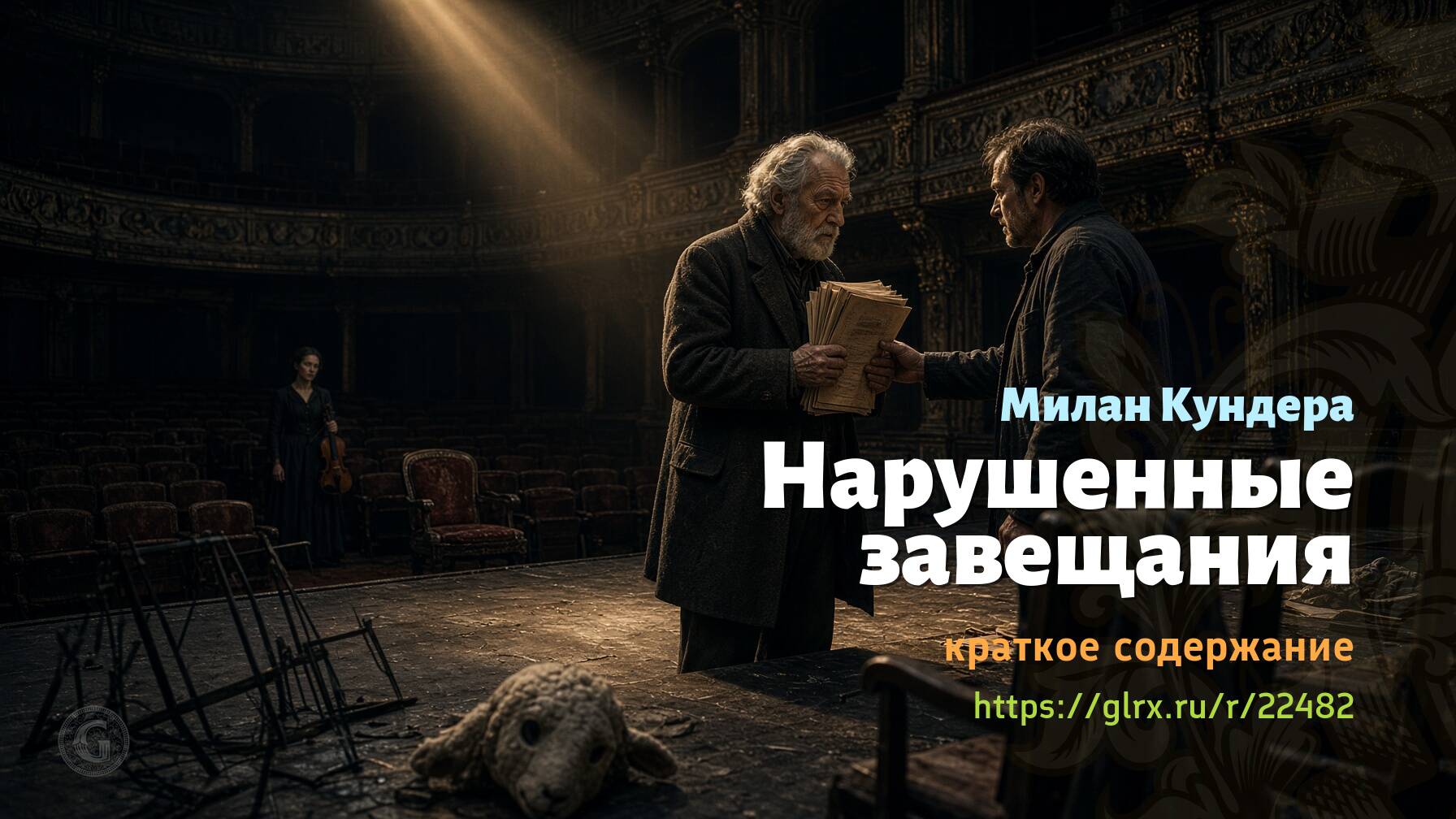
Nine interconnected essays on the history of the European novel and music, from François Rabelais and Johann Sebastian Bach to Salman Rushdie and Igor Stravinsky. The text is structured according to the musical principles of polyphony and variation, where the fates of Franz Kafka, Leoš Janáček, and Ernest Hemingway intertwine around a single issue: the posthumous distortion of the author’s will by friends, translators, biographers, and censors. Milan Kundera wrote the book in French ("Les Testaments Trahis") in France in 1992–1993, bringing together reflections on the kinship between the novel and music that had been building in him since his emigration from Czechoslovakia in 1975.
In 1993, the French Academy awarded the book the Aujourd’hui prize for the best non-fiction work on contemporary issues.
The book continues Milan Kundera’s cycle of French-language essays on the aesthetics of prose, being the second volume after The Art of the Novel (1986); this line was later supplemented by the collections Curtain (2005) and Meeting (2009).
The day when Panurge won’t be able to make you laugh
Madame Grandgousier ate too much tripe during pregnancy, took an astringent, and the baby Gargantua emerged from his mother’s left ear. In Salman Rushdie’s The Satanic Verses, Gibreel Farishta and Saladin Chamcha fall from a bombed airplane, singing and butterflying through the air among armchairs and cardboard cups. Both openings make an unspoken pact with the reader: here, literal facts are not presented; here, humor takes over, which, in the words of Octavio Paz, ambiguizes everything it touches. In the fourth book of Pantagruel, Panurge takes revenge on a merchant by throwing a ram he bought overboard; the flock follows, dragging the owners along with them, clinging to its wool and horns. Panurge pushes away drowning men with an oar and eloquently describes to them the bliss of the afterlife. Brother Jean praises him, reproaching him only for wasting his money.
A Parisian medical professor invited Kundera to a symposium on artificial insemination, taking the visionary Dr. Shkreta from "The Farewell Waltz" for a prophetic image, and then seriously reproached the writer for not sufficiently extolling the moral beauty of the gratuitous gift of sperm. The professor didn’t hear the laughter. The novel is a territory where moral judgment is suspended, and it was precisely thanks to this discovery that Europeans learned to see others as unique individuals.
The modern era brought a desacralization of the world, removing sacred texts from the temple and into the realm of the novel. In the tetralogy Joseph and His Brothers (1926–1942), Thomas Mann ironically transforms the biblical God into a fiction of Abraham, and turns the scene with Potiphar’s wife, who childishly coos "come with me" while the chaste Joseph’s flesh rises, into high comedy. Man, however, reveals himself not to be a self-contained being: from the "well of the past," he is guided by the mythical schemes of his ancestors, and the weeping Jacob merely repeats the ancient words of Noah. Kundera also discovered this need to bring different centuries together in a single book in his "The Joke" and "Immortality," in Carlos Fuentes’s "Terra Nostra," and in Rushdie. Twentieth-century novelists combined the freedom of Rabelaisian improvisation with musical architecture: the third part of Hermann Broch’s The Sleepwalkers alternates five independent lines in 88 chapters, and The Satanic Verses is structured as a rondo A-B-A-C-A-B-A-C-A.
When Imam Khomeini sentenced Rushdie to death in 1989 for his 1988 book, newspapers printed excerpts taken out of context before the novel itself was translated, turning literary text into a crime. Intellectuals signed petitions in salons, snobbishly remarking, "His book? No, I haven’t read it."
Theocracy attacked the very art of the European novel, its ontology of relativity, while Europe, forgetting the example of King Francis I and Cardinal du Bellay, who defended Rabelais against the theologians of the Sorbonne, betrayed its own creation. At 20, in a workers’ dormitory, Kundera read to his fellow workers the scene in which Panurge showers an unapproachable lady in church with powder made from the secretions of a bitch in heat, causing 600,014 dogs to urinate on her dress. The workers laughed without a hint of condemnation and nicknamed their most shy comrade, who was afraid to shower naked, "Panurke."
The Castrating Shadow of Saint Gartha
In 1926, Max Brod published the cryptic novel "The Enchanted Kingdom of Love," in which he posed as himself under the name of the Prague writer Nový and as the sinless, silent Garta, the late Franz Kafka. Garta is portrayed here as a religious prophet on par with Buddha and Lao Tzu, who bequeaths his sketches to the flames because he failed to live according to his own faith.
With four monographs (1937, 1946, 1951, 1959) and numerous introductions, Brod laid the foundation for "Kafka studies." Kafka scholars have separated the writer from the history of the novel and modernism of the years 1880–1883 (Igor Stravinsky, Robert Musil, James Joyce, Pablo Picasso), confined him to the micro-context of letters to Felice and his father, elevated diary aphorisms above prose, and transformed his books into religious or political allegories. Roman Karst, at a conference in Liblitz in 1963, exclaimed pathetically: "Franz Kafka lived and suffered for us!" Brod even erased from his friend’s diaries a 1910 entry about a brothel and all mentions of prostitutes, although it was Kafka who discovered in 20th-century prose an anti-romantic sexuality inextricably fused with dirt and comedy.
Poor flesh! In "Amerika," a maid clumsily squeezes young Karl Rossmann in his featherbeds and pushes him with her belly, making him his father and the cause of her own exile overseas. Later, he sees the monstrously obese singer Brunelda, suffering from gout, dragged down the stairs for two hours and wheeled in a chair under a blanket, so that a policeman mistakes her for sacks of potatoes. In the third chapter of "The Castle," land surveyor K. embraces the inconspicuous Frieda right on the floor, amid puddles of beer and garbage, while two annoying assistants watch from the bar above. Later, in Chapter Twelve, they will set up a bedroom behind blankets on the gymnastics bars in the middle of the schoolroom, in full view of the children. André Breton, in his "Surrealist Manifesto," dreamed of a fusion of dream and reality, failing to notice that Kafka had achieved this a decade earlier by breaching the wall of plausibility.
Improvisation in Honor of Stravinsky
The history of European music (approximately a thousand years old) and the history of the novel (four centuries) developed in two halves, with a discrepant caesura in the 18th century. The first period of music concluded with Bach’s "Art of Fugue," while the second began with Classicism and Romanticism, which subordinated polyphony to the dictates of short, expressive melody and sonata form. Jean-Jacques Rousseau, followed by the Soviet ideologist Andrei Zhdanov, Ernest Ansermet, and Theodor Adorno in "The Philosophy of New Music" (1949), demanded of composers a "trial of the senses" and heartfelt confession. When Igor Stravinsky, in "Chronicle of My Life" (1935), denied music the ability to express emotion, Ansermet accused his old friend of "poverty of heart," and Adorno denounced the dissonances in his neoclassical transcriptions of Pergolesi ("Pulcinella") as violence and a precursor to fascism.
In fact, 20th-century modernism became a “third half,” rehabilitating the forgotten objectivity of the first half: the 16th-century polyphonist Clément Jeannequin introduced bird calls and street noise into choral singing, anticipating Stravinsky’s Les Noces (four pianos and percussion), Janáček’s Seventy Thousand Choir, and the frog voices in Béla Bartók’s En Plein Air suite. Having lost Russia after 1917, having lived 27 years in his homeland, 29 years in France and Switzerland, and 32 years in the United States, Stravinsky avoided the alienation of exile (as experienced by Joseph Conrad, Witold Gombrowicz, Vladimir Nabokov, and Bohuslav Martinů, whose remains were stolen from a Swiss grave by the Czechoslovak authorities in 1979), because he found the only home in the entire thousand-year history of music – from Perotin and Gesualdo to the ragtime and dodecaphony of Arnold Schoenberg.
In "The Rite of Spring," he created an Apollonian portrait of Dionysian barbarism, contrasting blind collective ecstasy (akin to the roar of modern rock stadiums and the childish piano thrashing of Kundera himself in B minor) with an ironic smile of contemplation — the very happiness of Picasso’s painting of a man eating a watermelon with his feet raised to the sky. Similarly, in "Amerika," Kafka playfully rewrote Charles Dickens’s "David Copperfield," revealing "the callousness of heart hidden behind a style replete with sentimentality" in the scenes where Karl weeps over the hand of a barely known stoker.
Phrase
In the third chapter of "The Castle," the intercourse between K. and Frida is rendered in a single, long German sentence without a single semicolon: the word "Stunden" (clock) is repeated three times, "gemeinsamen" (common) twice, "die Fremde" (foreign world) twice, "die Fremdheit" (strangeness) once, and the verb "sich verirren" (to go astray) twice. The French translators — Alexandre Vialatt (1938), Claude David (1976), who edited it for the "Pléiade" series, and Bernard Lortholari (1984) — succumbed to the schoolboy reflex of synonymization and a fear of the simple verbs "to be" and "to have."
They replaced the lagol "to be" with the visual "to delve deeper" or "to advance," "to go" with the grotesque "to stride," reduced the triple repetition of "foreign world" to "exile" or touristic "foreign lands," and replaced Frida’s name, in its triple repetition, with the words "servant" and "companion." Meanwhile, Kafka’s metaphor is phenomenological, not pictorial (as in the second love scene in Chapter Four, where bodies burrow into each other like dogs in the earth, and David attributes claws and nails to them), and his deliberately sparse vocabulary with insistent repetitions gives rise to a nostalgic melody of prose — akin to the woman’s internal monologue about her husband’s venereal disease in Hemingway’s two-page story "A Reader Writes."
Contrary to the will of Kafka, who wrote in one breath and divided the third chapter in the manuscript into just two gigantic paragraphs with one semicolon, Vialatt divided the text into 90 paragraphs and introduced 31 semicolons (Lortholari - 95 paragraphs and 28 semicolons), and German pocket editions squeezed his lines into small font and supplied forty pages of drafts crossed out by the author.
In search of the lost present
At a Spanish railway station between Barcelona and Madrid, an American and a girl named Jig are drinking beer while waiting for a train. In Ernest Hemingway’s short story "Hills Like White Elephants," the word "abortion" doesn’t appear once for five pages. The characters’ pasts are hidden, their motives and intonations are unspecified, and behind the banal dialogue, with its fourfold cry of "please, please, please, please, shut up" and gaze at the white hills, a dozen opposing psychological narratives could lie. In 1985, American biographer Jeffrey Meyers reduced this mystery to a trivial moralizing piece of gossip about Hemingway himself and his wife Hadley’s second pregnancy, dubbing the young girl "woman" and "wife," attributing to her the Shakespearean despair of King Lear and Psalm 121, and portraying the man as a heartless egocentric.
Similar kitsch was indulged in by the Prague Opera conductor Karel Kovařovics, who in 1916 embellished the quiet finale of Leoš Janáček’s Jenůfa with triumphant trumpets in the spirit of a love apotheosis. And by the composer’s student, who, after his teacher’s death, added a joyful coda with the words "Freedom! Freedom!" to his opera From the House of the Dead (1928), even though Janáček’s version ended with the commandant’s cry "Get to work!" and the clanking of shackles. The true purpose of the novel, since the time of Gustave Flaubert and James Joyce, and in opera thanks to Janáček’s efforts to jot down street intonations (for example, the conversation between two frozen girls near the train station on February 15th at six in the evening), has been something else: to capture the elusive prose of the concrete present moment, where sublime sadness coexists with empty chatter.
Creations and spiders
During World War II in Prague, Kundera’s father, as a sign of solidarity, hired a composition teacher for his thirteen-year-old son — a Jewish man with a yellow star. He had moved the piano from one cramped apartment to another before he was sent to the Terezín concentration camp. Saying goodbye at the door, the teacher told the boy: Ludwig van Beethoven has many weak passages that serve as a lawn around the beautiful tree of strong passages.
Friedrich Nietzsche, beginning with "Dawn," wrote each chapter in a single paragraph, rejecting philosophical systems in which hundreds of toiling spiders must web the voids between the flights of eagle-like thought (as in Georg Wilhelm Friedrich Hegel’s "Aesthetics"). The same structural dichotomy between inspired theme and artisanal "filler" (like the "bridges" in a sonata or the descriptions of furniture and passports in a 19th-century novel, ridiculed by Breton) plagued the music and literature of the second half of the twentieth century.
Frédéric Chopin overcame this by abandoning large-scale forms in favor of mazurkas and nocturnes, while Beethoven, in his final two-movement sonata, Opus 111 (8 minutes 14 seconds of dramatic allegro and 17 minutes 42 seconds of variations, as recorded by Artur Schnabel), destroyed the very constraints of the prescribed compositional matrix. Having been inoculated for life against the "lyricization of terror" after the communist coup of 1948 and the suicide of the poet Konstantin Biebl, Kundera transferred the strategies of Chopin and Beethoven to The Book of Laughter and Forgetting, constructing a novel from seven independent sections, held together only by recurring themes (history, border, angels, memory).
Following Robert Musil, who in The Man Without Qualities abolished the descriptive background of Austria-Hungary (Kakania) for the sake of continuous existential reflection (in contrast to Thomas Mann’s polyhistorical The Magic Mountain with its disputes between Settembrini and Naphta), novelists of the third half returned to the characters conventional names-signs without civil passports: Ulrich, Esch, Joseph K.
The unloved child in the family
On February 15, 1992, in the French FNAC store, Kundera is sorting through Leoš Janáček’s CDs: Taras Bulba, Sinfonietta, two string quartets, the piano cycles Along an Overgrown Path and In the Fog (where the pianists forever smooth over the split between elegy and the sharp forte in the fourth bar of the 1905 Sonata), operas cleared of other people’s edits by the conductor Sir Charles Mackeras in 1980 and 1982, and an ADDA disc, on which the "scavengers" squeezed in 6 minutes and 30 seconds of music for ladies’ gymnastics, while the four great male choirs of 1906-1922 disappeared from the shelves.
Born in 1854, before Giacomo Puccini and Gustav Mahler, this old innovator became a victim of his own "small nation" – the stifling Czech family (in Icelandic, family is fjölskylda, "many obligations"), where the Prague musicologist and Stalinist minister Zdeněk Nejedlý idolized Bedřich Smetana and hounded the provincial from Brno until, in the summer of 1928, at the age of 75, he caught a cold in the forest while searching for the lost child of his young lover and died in the hospital (rumor has it, right during lovemaking in his hospital bed).
Roads in the fog
In The Book of Laughter and Forgetting, the writer Banac and his philosopher friend utter fashionable sophistries about the death of the novel; a French author later used their words as an epigraph, and a Prague critic praised them for their profundity, failing to notice the novel’s hidden irony. Similarly, Orson Welles, in his film adaptation of The Trial, mistook Joseph K. for a crusader against violence, whereas in Kafka, the arrested K. capitulates from the very first moment, allows himself to be eaten, and runs to interrogation on Sunday at the appointed hour, refusing to board a tram solely out of ridiculous pride.
Kafka scholars — Brod, Eduard Goldshtücker (1964), who served four years in a Stalinist prison, and Vialatt (1947) — staged a second trial for K., accusing him of an inability to love, the mechanization of life, or the breaking off of his engagement to Felice. Kafka, however, was the first in literature to describe the mechanism of guilt-infliction (culpabilization), right down to self-criticism and the victim’s desire to plunge the executioner’s knife into themselves. For Kafka, a trial is any force that reduces a person’s biography to criminography, and the entire 20th century was marked by such trials of Vladimir Mayakovsky, Martin Heidegger, Louis-Ferdinand Céline, Ezra Pound, and modernism itself, condemned three times: by the Nazis, the Communists, and victorious capitalism.
Unlike the airless political propaganda of George Orwell’s 1984, The Trial opens poetic "windows" (a sickly girl with a jug at a pump) into the world of Leo Tolstoy, where Andrei Bolkonsky and Pierre Bezukhov (who calculates the number 666 from the words "l’Russe Besuhof") are transformed by a random "conspiracy of details" and wander through history in a fog that today’s judges of the past and the mindless dancers of the rock era refuse to notice.
My dear, you are not at home here.
In October 1937, Igor Stravinsky broke off a twenty-three-year correspondence with Ernest Ansermet, forbidding the conductor to cut 13 bars from a march in the ballet "The Card Game": "My dear fellow, you are not at home." The composer himself recorded all his works, saving them from the arbitrary whims of performers (like Leonard Bernstein’s rubato in "The Rite of Spring"), just like Samuel Beckett, who controlled every pause in his plays, or Witold Gombrowicz, who defended the global context of his novel "Ferdydurke" (1938) in his Argentine "Diary" (since 1953).
Max Brod, on the contrary, immured Janáček in a provincial Czech context with his naive monograph of 1924, and from two unsent notes from Kafka (in which he recognized his completed books, including The Judgment, The Metamorphosis, The Penal Colony, The Country Doctor, and The Hunger Artist, who ruled from his deathbed, as worthy of publication) he created a noisy myth about a saintly madman who wanted to burn everything he had written.
Saving three unfinished Kafka novels could be justified as a personal moral risk for a friend, but Brod published intimate diaries and an unsent letter to his father, violating the basic human shame (die Scham — the last word in The Trial) that makes the man in the window across the street draw the curtains, and the Icelander Elvar D. in the cemetery in Reykjavik keep the secrets of a dead comrade from his own wife.
Totalitarian surveillance with radio-feuilleton recordings of Jan Prochazka’s conversations in Prague in 1970, paparazzi outside the hospital of Jacques Brel, dying of cancer, in France, biographers-informers like the Hemingway researcher in the spirit of the method of Charles-Augustin de Sainte-Beuve (crushed by Marcel Proust), French publishers who dissolved three of Kafka’s collections of short stories in a chronological stream of drafts, and Polish patriots who cut the heart out of Chopin’s corpse — all of them destroy the copyright born of the individualism of the New Age.
True love for the deceased is tested only by fidelity to his last will - like that of a peasant’s son who does not chop down the old pear tree under the window as long as he remembers his father’s will.
You cannot comment Why?