A summary of "A Holiday Dream - Before Lunch" by Alexander Ostrovsky
 Automatic translate
The comedy "A Holiday Dream — Before Dinner," written in 1857, is the first part of a trilogy about the adventures of the minor official Balzaminov. This book is a vivid satire illustrating the clash of two worlds: the pragmatic patriarchal merchant class and the bourgeoisie, whose representatives dream of easy enrichment through a profitable marriage, while being unwilling to put in any effort into honest work. In 1964, based on this play, as well as the other two works in the trilogy, the popular Soviet feature film "The Marriage of Balzaminov" was made, starring Georgy Vitsin. A television ballet of the same name was created in 1989.
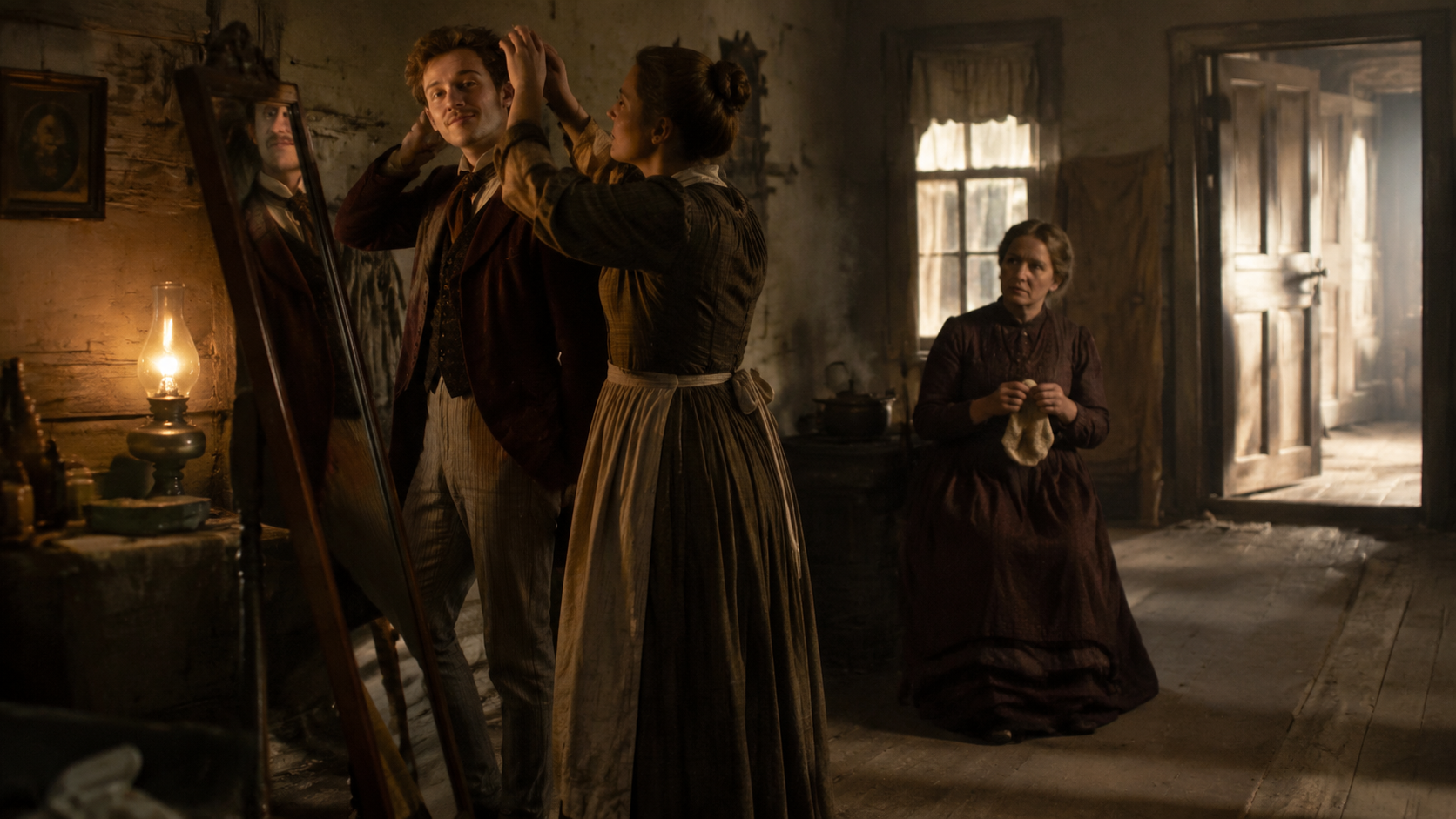
Scene One unfolds in the modest room of twenty-five-year-old civil servant Mikhail Dmitrich Balzaminov and his mother, the widow Pavla Petrovna Balzaminova. From the very first minutes, the viewer watches Mikhail Dmitrich twirling in front of the dressing mirror while the cook, Matryona, helps him curl his hair. His mother, holding a stocking, laments her son’s over-indulgence in his appearance and his constant dream of a rich bride, completely neglecting his official duties. Balzaminov, however, is sincerely convinced that official service is not his path, as he has neither the aptitude nor the desire for it. His main goal is to find a wealthy wife and live in idleness. He enthusiastically recounts to his mother a recent dream in which he imagined himself in a luxurious house, surrounded by servants, with his beautiful and wealthy wife at his side. Mikhail Dmitrich interprets this dream as a sure sign of future wealth and an imminent wedding.
Soon, matchmaker Akulina Gavrilovna Krasavina drops by their modest home. The Balzaminovs greet her with great anticipation, hoping for good news. Krasavina informs them of a very promising bride: seventeen-year-old Kapochka (Kapitoline), the daughter of the wealthy merchant widow Cleopatra Ivanovna Nichkina. According to the matchmaker, Nichkina’s late husband left the family a substantial fortune of approximately three hundred thousand. Cleopatra Ivanovna herself, a member of the merchant class, passionately desires her daughter’s marriage to a nobleman, preferably a civil servant, to join the gentry. Balzaminov is overjoyed by this news, his imagination already conjuring up images of a comfortable life. The matchmaker vividly describes the luxury of the Nichkin household and the size of the dowry, further fueling the young man’s greed. Pavla Petrovna, although she shows some caution, gives her son instructions on how to behave with rich merchant women in order to make a favorable impression on them.
The action of the second scene shifts to the lush garden of Nichkina’s house. Kapochka and her twenty-year-old friend Ustinka, a merchant’s daughter, appear on stage. The girls engage in a frank conversation about suitors and marriage. Kapochka shares a secret with her friend: she has taken a liking to a young official she recently saw on the street, and she dreams of marrying him. This official turns out to be none other than Balzaminov. Ustinka, being more experienced and feisty, advises Kapochka to be firm and insist on her choice to her mother.
Soon, Mikhail Dmitrich Balzaminov himself appears in the garden. A comical scene of acquaintance and courtship begins. Balzaminov, trying to portray himself as a socialite and gallant cavalier, speaks in absurd, high-flown phrases, learned from books, which the naive Kapochka accepts at face value. He tells her of his tender feelings, hints at a quick wedding, and vows eternal love. Charmed by his demeanor and the very fact that he is a civil servant, Kapochka reciprocates his feelings.
Then the mistress of the house, Cleopatra Ivanovna Nichkina, comes out into the garden. She receives Balzaminov very favorably, seeing in him the noble son-in-law she’s long dreamed of. They engage in conversation, during which Mikhailo Dmitrich tries his best to demonstrate his education and respectability. However, his natural limitations and lack of upbringing continually reveal themselves through his feigned self-importance. Nichkina, not known for her insight, is oblivious to these shortcomings and seems ready to consent to her daughter’s marriage to this young man. The conversation briefly mentions Nichkina’s brother, the forty-year-old merchant Nil Borisych Neuedenov, whose opinion Cleopatra Ivanovna greatly fears and with whom she usually consults on important matters.
Scene three unfolds in Nichkina’s richly furnished living room. Balzaminov and his mother, Pavla Petrovna, arrive, expecting the final wedding decision to be made today. Nichkina hosts a sumptuous tea party for them. Kapochka and Mikhailo Dmitrich exchange meaningful glances, completely confident in their bright future together.
However, their idyll is suddenly shattered by the arrival of Nil Borisych Neuedenov. His thirteen-year-old son, Yusha (Efim), arrives with him. Neuedenov is a straightforward, blunt, and exceptionally practical man, a true representative of the businesslike merchant class. He immediately takes control of the situation and begins interrogating Balzaminov. Nil Borisych asks him specific questions about his service, salary, capital, and future plans. Balzaminov, not expecting such pressure, becomes flustered, hesitates, and gives inappropriate answers. Neuedenov quickly realizes who he is dealing with and mercilessly exposes Mikhailo Dmitrich as a penniless philanderer seeking easy money, penniless, without the ability or desire to work.
The merchant sternly reprimands his sister, Cleopatra Ivanovna, for her utter stupidity and gullibility. He explains to her in simple terms that a merchant’s capital is not a toy; it must be put to use and be of use, not left to scoundrels and idlers. Balzaminov makes timid attempts to justify himself, citing his lofty dreams and inability to work hard, but Neuedenov remains adamant. He bluntly declares that they have absolutely no need for such a suitor and literally throws Mikhailo Dmitrich out the door.
Balzaminov and his mother leave their wealthy home in disgrace. Pavla Petrovna, trying to somehow console her distraught son, utters the phrase that becomes the title of the entire play: "I told you, Misha, that a holiday dream is before lunch." To this, Mikhail Dmitrich replies with annoyance that if he had had this dream on a weekday, everything would have turned out completely differently.
After her would-be relatives leave, Kapochka resorts to feminine wiles and, attempting to soften her stern uncle’s heart, dramatically faints. Ustinka quietly advises her to pretend to faint. However, Neuedenov, fully aware of the artificiality of this scene, orders the maid Malanya to bring a full bucket of cold water. Hearing this, Kapochka instantly "comes to life" and leaps from the bench, declaring that she will not tolerate such treatment. Nil Borisych announces to his niece and sister that he has already found a truly worthy suitor for Kapochka — a young, healthy, and resourceful Russian merchant, a man of action and with substantial capital. Upon learning that her new suitor is young and rich, and that his small beard will eventually grow, something she’ll get used to, Kapochka instantly forgets about the official Balzaminov and, looking down, agrees to the match. The play ends with Neuedenov’s words: "That’s better. Now we’ve agreed."
- Bear in Rus’: a symbol in art and crafts
- "Madame" by Alexander Bessonov, summary
- The festival "The Future of Theater Russia" opened in Yaroslavl, bringing together theater graduates
- "Time of Results" by Sergei Voronin, summary
- "Catacombs" by Valentin Kataev, summary
- A summary of "Matryona’s House" by Alexander Solzhenitsyn
You cannot comment Why?