A summary of Alexei Tolstoy’s "The Eighteenth Year"
 Automatic translate
Alexei Tolstoy’s novel, written in 1928, describes the painful division of society in the flames of the Civil War. Former officers, peasants, and thinking people seek the truth under fire, choosing sides in the bloody confrontation between the Reds and the Whites. The trilogy was awarded the First Class Stalin Prize in 1943. The work has been successfully adapted into films three times by Russian directors — in 1957, 1977, and 2017.
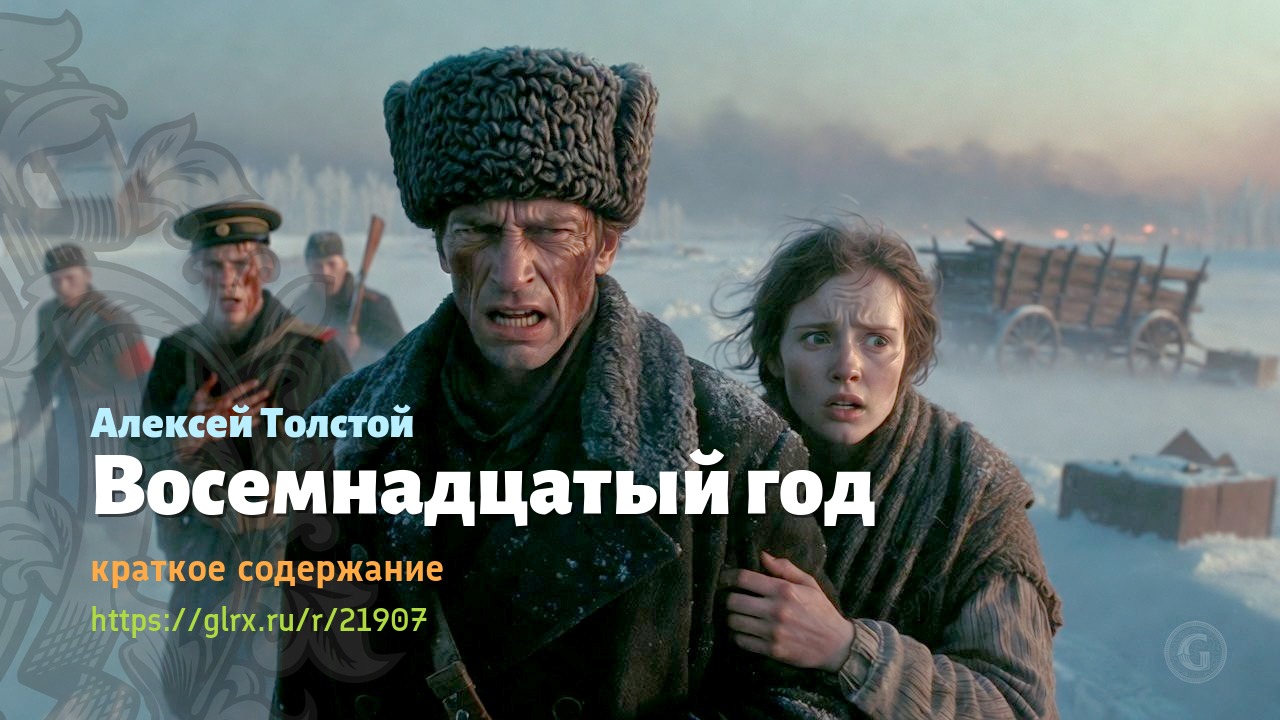
The book is part of the extensive historical series "The Road to Calvary." The novel is the second part of the cycle. It is preceded by the first book, "Sisters," and concludes with the third novel, "Gloomy Morning."
Winter in Petrograd and Samara
In the winter of 1917, Petrograd freezes over. Ivan Ilyich Telegin is deeply distressed by his wife’s estrangement. Dasha has lost her child and now spends her days in a cold room, immersed in apathy. Telegin accidentally encounters an old friend, the Bolshevik Vasily Rublev, on the street. A heated exchange forces Ivan Ilyich to consider the need for action. He soon decides to join the Red Army. Dasha asks him to leave her, and Telegin leaves for the southern front.
In Samara, Vadim Petrovich Roshchin and his wife Katya are staying with Dr. Dmitry Stepanovich Bulavin. Roshchin is morally crushed, fiercely hating the new government and thirsting for revenge for the destruction of his homeland. Bulavin cynically discusses the imminent arrival of the Germans and the benefits of occupation. Roshchin persuades Katya to move south, closer to the nascent White forces. They reach icy Rostov, where they temporarily stay with army Lieutenant Colonel Tetkin.
An ideological dispute erupts in Tetkin’s apartment. The lieutenant colonel sympathizes with the common people, while Roshchin demands a merciless struggle. Katya begs her husband not to kill his compatriots, not to stain his hands with blood. In a fit of rage, Roshchin insults his wife and immediately leaves the house. He enlists as a private in the Red Varnavsky Regiment using false documents. His secret goal is to reach the front lines and defect to the volunteers at the first opportunity.
The Ice March and Battles in Kuban
The Volunteer Army retreats from the Don to the Kuban steppes. The arduous Ice March begins. The small White forces fight their way through the Red Guard lines. Roshchin marches in a Red echelon alongside the suspicious fighter Kvashin. During a nighttime river crossing, Roshchin throws Kvashin off a cliff. Vadim Petrovich defects to the Whites and meets General Markov.
Roshchin, along with Kornilov’s men, takes part in the multi-day assault on Yekaterinodar. General Lavr Kornilov categorically refuses to lift the siege. The Whites suffer colossal losses, throwing their last reserves into the attack. An artillery shell hits the farmhouse headquarters. The commander-in-chief is killed instantly. Anton Denikin assumes command. The depleted White Army secretly withdraws from its positions and retreats north.
The fate of the Krasilnikov brothers
Sailor Semyon Krasilnikov is shot in the chest during a battle with the Kornilovites. His brother, Alexei, takes him to his native village of Vladimirskoye to be with his young wife, Matryona. Semyon recovers his health, but the prosperous peasant life leaves him deeply irritated. Soon, German occupation forces enter Vladimirskoye. The occupiers restore power to Mil, the former prince’s steward.
The Germans brutally rob the peasants, taking away grain and purebred cattle en masse. Alexei is enraged by the destruction of his property. A German soldier, a boarder, brazenly accosts Matryona in the courtyard. Semyon kills the rapist with a single blow of an axe. Afterwards, he hides in the reeds at night and joins the underground rebels of the anarchist Kozhin. The peasants begin to prepare for mass armed resistance to the invaders.
Katya’s Wanderings
Katya receives false news of Roshchin’s death. Officer Valerian Onoli gleefully takes revenge on Vadim Petrovich by deceiving his wife. The grief-stricken woman boards a train and travels to Yekaterinoslav. On the way, the German officer discourses at length on the decline of civilization. At night, the train is stopped by armed men belonging to Batko Makhno. They drive the passengers out into the bare steppe and loot the carriages. Katya wanders through the darkness with the Red Army deserter Mishka Solomin.
The bandits bring their captives to the wealthy village of Gulyai-Pole. Here, Katya unexpectedly encounters Alexei Krasilnikov. He drives a machine-gun cart in Makhno’s bandit army. Wounded in the head, Mishka Solomin begs Alexei to spare Katya. Krasilnikov promises to protect the weak woman and find her a safe place. Nestor Makhno enters the village triumphantly, demanding more bloody reprisals.
Dasha’s Moscow trials
In the summer of 1918, Denikin’s spy Kulichok appears in Petrograd. He brings Dasha a letter from her sister. In it, Katya recounts the Yaroslavl uprising, the execution of Commissar Nakhimson, and the long flight through the woods. Kulichok draws Dasha into the underground "Union for the Defense of the Motherland and Freedom." On his instructions, she travels to Moscow, attends a factory rally, and listens to Lenin’s speech on bread. The harsh truth of class struggle astounds her. Dasha begins to doubt the righteousness of the White underground.
Chance brings Dasha together with a fellow poet, Zhirov, and a group of anarchists. She ends up at a drinking party at the hotel of the famous tragedian Mamont Dalsky. The actor rudely offers her wild, unfettered freedom. Breaking away from him, Dasha runs along the dark Moscow boulevards. Before her eyes, Mamont Dalsky is run over by a heavy tram. Miraculously, Dasha manages to keep his crocodile-skin suitcase, filled with someone else’s diamonds, in her hands.
The destruction of the Black Sea Fleet
In the summer, German troops issued an ultimatum: transfer the Black Sea Fleet from Novorossiysk to occupied Sevastopol. The Soviet government secretly ordered the warships to be scuttled to prevent them from falling into enemy hands. Thousands of sailors’ rallies erupted on the embankments. Crews were split in two. Some decided to save their lives. Destroyers and the enormous dreadnought Volya shamefully surrendered to the Germans.
The sailors, remaining faithful to their revolutionary duty, prepare for a terrible end. Semyon Krasilnikov is among them. A signal is hoisted from the masts: "I’m dying, but I won’t surrender." The destroyer Kerch fires torpedoes at the abandoned ships. The dreadnought Svobodnaya Rossiya suffers fatal holes and slowly sinks to the seabed in clouds of steam. The crew then scuttles the Kerch itself, escaping in lifeboats.
Meetings and partings on the Volga
A military mutiny by the Czechoslovak Corps breaks out in the Volga region. Anti-Bolshevik forces seize Samara. Dr. Bulavin is delighted and quickly receives a ministerial post in the KOMUCH government. At a lavish banquet, he delivers flattering speeches to French and Italian diplomats. Bulavin asks the allies for gold and calls for the merciless destruction of the Red Army units.
Roshchin is recovering from another concussion at the garrison. By chance, he sits on the same bench as Telegin at the Rostov train station. Ivan Ilyich is wearing the uniform of a Red Army commander. Vadim Petrovich recognizes his old friend but doesn’t betray him to the patrols. Telegin quietly leaves. Later, Ivan Ilyich is sent on a secret mission along the Volga. He participates in the capture of the city of Khvalynsk alongside local peasant partisans.
Telegin secretly enters Samara. He arrives at Bulavin’s office, hoping to learn news about his wife. Ivan Ilyich reads Dasha’s despairing letter. Suddenly, Govyadin, the assistant to the head of counterintelligence, appears. Telegin snatches a hand grenade. At that moment, the door flies open and a terrified Dasha runs in. She takes Ivan Ilyich to her room and begs him to hide immediately. Telegin jumps out the window. Bulavin demands that Govyadin find and execute his son-in-law, but in the morning the counterintelligence officer is found dead on the riverbank.
The defeat of Sorokin’s army
The Red Army, under the command of Ivan Sorokin, is waging bloody battles in the North Caucasus. The commander-in-chief loses his grip on reality, drinks alcohol, and arbitrarily executes popular commanders. His exhausted troops are defeated at Tikhoretskaya Station. In a fit of lust for power, Sorokin orders the assassination of five republican leaders in Pyatigorsk.
News of the night’s crime reaches the regiments. The Front Congress outlaws the dictator. The cut-off Taman Army fights its way through heavy fighting to Stavropol. Sorokin attempts to regain power, but the Taman army arrests him. In prison, the outraged Red commander Vislenko kills the former commander-in-chief with point-blank shots.
The autumn of 1918 brings a turning point on the Eastern Front. Telegin valiantly commands an advancing rifle regiment. His soldiers are the first to break into Samara, driving out the White Guard units. Ivan Ilyich gallops through the dusty streets of the liberated city. He goes up to Dr. Bulavin’s devastated apartment. The premises are empty, the windows shattered. Dasha is not there, and no one can say where the inexorable tide of historical events has cast her.
You cannot comment Why?