A summary of "The Road to Calvary" by Alexei Tolstoy
 Automatic translate
This book is a monumental historical epic about the intelligentsia against the backdrop of the collapse of the Russian Empire and fratricidal war. The trilogy was written from 1919 to 1941. The lives of two sisters are inextricably intertwined with global social upheavals, forcing the characters to navigate opposing political camps in order to regain their lost homeland. For the trilogy, the author received the first-degree Stalin Prize in 1943. The work has been successfully adapted for the screen three times: in 1957–1959 by director Grigory Roshal, in 1977 by Vasily Ordynsky, and in 2017 by Konstantin Khudyakov.
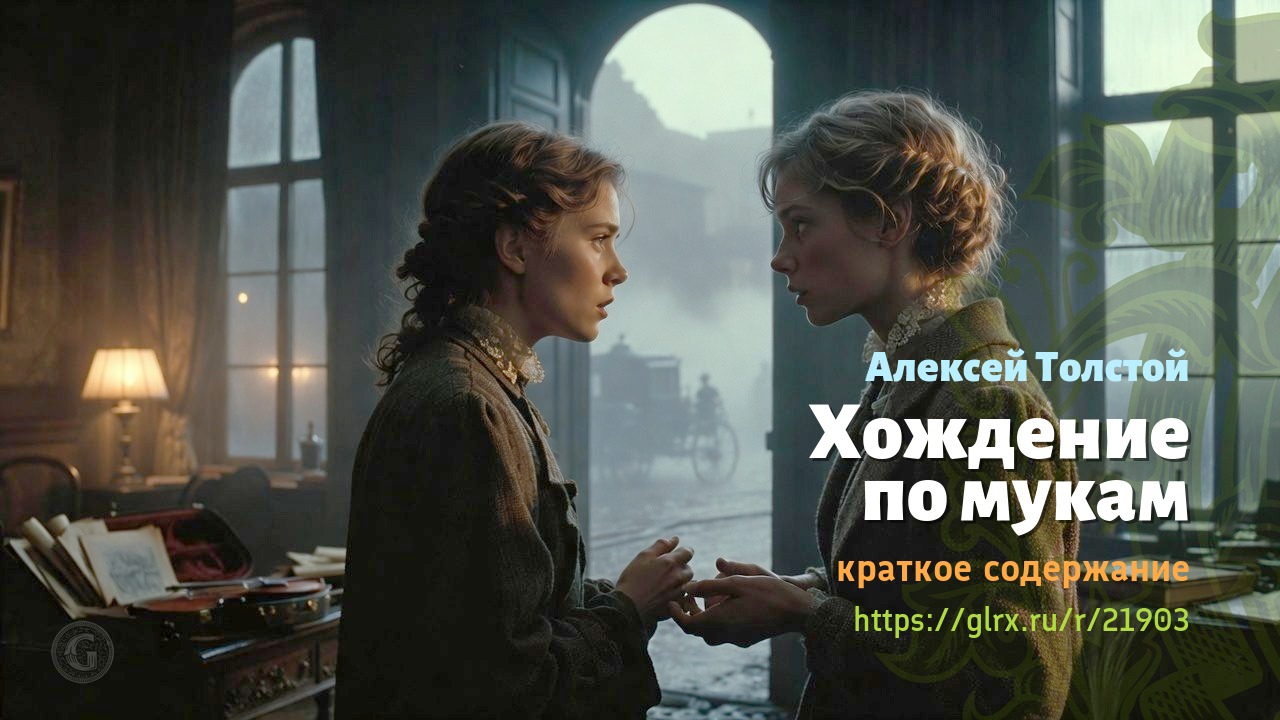
The book opens a novel series of the same name. The series includes "Sisters" (the first book in the series), "The Eighteenth Year" (the second book in the series), and "Gloomy Morning" (the third book in the series).
Pre-revolutionary Petersburg and the First World War
The action begins in 1914. The capital is gripped by a premonition of disaster. In St. Petersburg, the intelligentsia attends philosophical soirées and debates the fate of art. The crisis of the old way of life is clearly felt here. At the center of events are two sisters — Katya Smokovnikova and Dasha Bulavina. Katya is married to the liberal lawyer Nikolai Ivanovich. She is bored in the empty bustle of society. This melancholy drives her to cheat on her husband with the fashionable poet Alexei Bessonov. Dasha condemns her sister for her fall from grace. She herself feels a strange attraction to the poet.
Dasha meets Ivan Ilyich Telegin, an engineer at the Baltic Shipyard. She visits his apartment, where futurists and artists gather. Telegin is enchanted by Dasha but conceals his feelings. World War II begins. Ivan Ilyich is sent to the front. Bessonov also ends up in the active army and dies ingloriously. Telegin is captured by the Austrians and suffers in a concentration camp. Together with Colonel Melshin and Staff Captain Zhukov, he kills the sadistic commandant. The officers seize a car and stage a daring escape.
Ivan Ilyich returns to Russia. Katya, after separating from her husband, works as a nurse. She meets officer Vadim Petrovich Roshchin. Roshchin’s stern character attracts Katya, and a deep connection blossoms between them. The country experiences the historical upheavals of 1917. Dasha and Telegin marry, hoping for a quiet happiness. The civil war mercilessly ruins their plans. Nikolai Ivanovich is sent to the front and dies during a soldiers’ mutiny. Roshchin leaves for the Don to join the White Guards.
Separation of families in the flames of civil war
Telegin joins the Red Army. Commissar Gymza instructs Ivan Ilyich to deliver a letter to Moscow demanding the removal of the rebel Sorokin. Ivan Ilyich successfully commands a regiment and, together with Ivan Gora, defends Tsaritsyn from General Krasnov’s troops. Telegin is assisted by brave soldiers — sailors Latugin and Zaduyviter, as well as the defrocked priest Kuzma Kuzmich. Former Futurist Sergei Sapozhkov becomes a reliable commander in the Red Army units. Dasha loses her newborn son. The tragedy deprives her of peace of mind, and the couple’s relationship begins to crumble. Dasha leaves for her father in Samara. The city is captured by the Czechoslovaks. Doctor Bulavin becomes a minister in the White government. Dasha quarrels with her father and flees.
In Moscow, Dasha falls into a White Guard conspiracy led by Savinkov. Emissary Kulichek draws her into a dangerous game. In Yaroslavl, Dasha witnesses the White Terror and the executions of Bolsheviks. The horror of this experience forever turns her away from the forces of counterrevolution. She narrowly avoids arrest and goes into hiding. Katya loses contact with Roshchin. Officer Valerian Onoli falsely informs her of Vadim Petrovich’s death. In despair, Katya leaves Rostov. On the train, she is captured by Makhno’s anarchists. Roshchin’s former orderly, peasant Alexei Krasilnikov, takes Katya under his protection.
Krasilnikov brings Katya to his village. He intends to force her into his marriage. She resists Alexei’s brutal advances. While defending herself from bandits, she works as a village teacher. Krasilnikov soon flees the village, escaping the Red Army food detachments. Katya is given the opportunity to leave the village.
A turning point in the consciousness of a white officer
Roshchin fights in the ranks of General Denikin’s Volunteer Army. He takes part in General Kornilov’s famous Ice March. During the assault on Yekaterinodar, Kornilov is killed by an artillery shell. Denikin leads the White Army. Roshchin experiences a difficult path of disillusionment. He sees the White officers as an embittered and blind force. Vadim Petrovich understands the righteousness of the people defending their land. In Rostov, Roshchin accidentally meets Telegin at the train station, but hides his identity, tormented by shame. Upon learning that Katya is alive, he deserts the White Army. Roshchin sets off to Yekaterinoslav in search of the woman he loves.
Vadim Petrovich ends up at Batko Makhno’s headquarters. Makhno’s army astonishes Roshchin with its savagery. Together with the executioner Lev Zadov, he heads to the city occupied by Petliura’s forces. Roshchin helps the underground Bolshevik Revolutionary Committee and the sailor Chugai organize an uprising. During street fighting, he is seriously wounded. After recovering in the hospital, Vadim Petrovich finally defects to the Soviets.
The Red Army retreats under the onslaught of Denikin’s hordes. Commander-in-Chief Sorokin mutinies, assassinates his commanders, and dies himself. Telegin and his regiment break out of encirclement in the North Caucasus. Commissar Ivan Gora dies heroically in battle. His wife, Agrippina, continues to fight among the Red Army soldiers. Dasha, along with Kuzma Kuzmich, makes her way through the front. Kuzma Kuzmich rescues the weakened Dasha. They live secretly in Kostroma.
Meetings and victorious battles
Roshchin travels to Kyiv. Together with the sailor Chugai, he participates in the defeat of Ataman Zeleny’s gang. Vadim Petrovich ends up in the village of Krasilnikova, where he finds Katya’s abandoned school diary. Roshchin pursues Alexei’s detachment and kills the former orderly in a brief shootout.
Katya escapes persecution and leaves for Moscow. There, she again works at a school with children. She endures hardships and starves, but finds true solace in the peaceful work of teaching. Life in the ruined city is harsh. Dasha arrives in Moscow with Kuzma Kuzmich and settles with her sister on Arbat Street. Dasha resumes her correspondence with Ivan Ilyich. Telegin receives a short leave and comes to Moscow for a visit. The couple reconcile, forgetting past grievances and misunderstandings.
Soon, Roshchin arrives in the capital. A chance encounter with Katya revives him. He swears his allegiance to the revolutionary cause. Telegin and Roshchin return to the Southern Front together. They participate in the legendary battles of Semyon Budyonny’s cavalry near Voronezh and Kastorna. Together with the brave Serb Dundich and the fighter Latugin, they make their way into White-occupied Voronezh. There, they boldly present Budyonny’s ultimatum to General Shkuro. The Red Cavalry crushes General Mamontov’s corps. Denikin’s armies retreat south.
In the epic finale, the civil war is drawing to a close. All four main characters meet in the cool hall of the Bolshoi Theater in Moscow. They listen to engineer Gleb Krzhizhanovsky’s historic report on the electrification of the devastated country. Telegin, Dasha, Roshchin, and Katya feel like builders of a new, bright world, ready to work for the ultimate happiness of all humanity.
You cannot comment Why?