"Shadows in Paradise" by Erich Maria Remarque, summary
 Automatic translate
This book is the German author’s final novel, first published posthumously in 1971. The narrative centers on the story of journalist Robert Ross, who fled Nazi persecution to the United States at the end of World War II. The work’s greatest value lies in its profound understanding of the fate of European emigration, where escape from physical death offers no relief from emotional trauma, and the comfortable American life only serves to underscore the foreignness of the surviving wanderers.
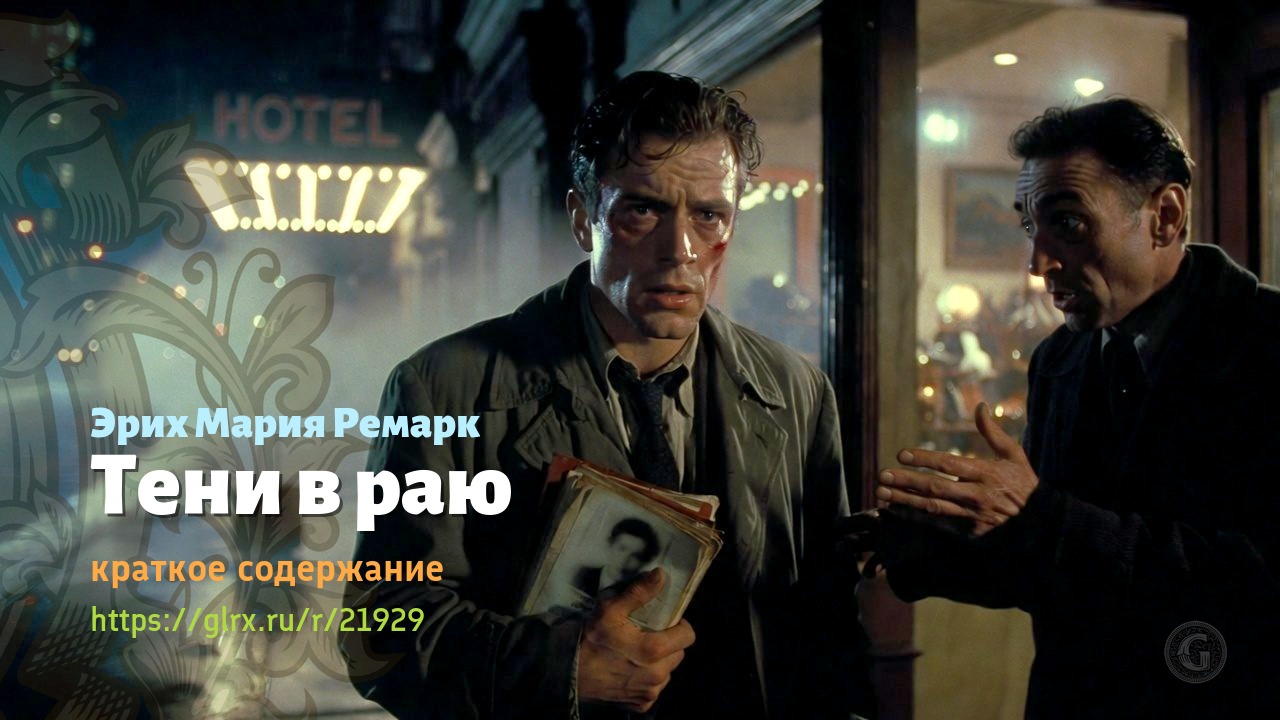
Arrival in New York and the first steps of a refugee
Robert Ross arrives in New York on a cargo ship from Lisbon, using the passport of a man who died in Frankfurt. After six weeks on Ellis Island, immigration officials grant him a temporary residence permit valid for three months. On the advice of a casual acquaintance, he goes to see Vladimir Melikov, a Russian émigré. He works as a doorman at the shabby Reuben Hotel near Broadway and gives the refugee a bed in his room.
Legal work is impossible without an immigration quota, so Ross is forced to find unregistered work. In a conversation with Melikov, he recalls hiding from the Gestapo for two years in the basement of a Brussels museum. There, in pitch darkness, he examined the exhibits by touch, developing a keen sense of touch for ancient objects. Ross’s savior, the museum director, was sent to a concentration camp, and the journalist himself managed to escape.
In the hotel lobby, the hero meets a fellow refugee, Kurt Lachmann, who has changed his last name to Merton. Lachmann limps due to old injuries sustained in a stormtrooper attack and is unsuccessfully courting a Puerto Rican woman with a missing leg. Soon, the slender model Natasha Petrova arrives at the hotel.
In the world of antiques and art
While strolling through the city, Ross stops into the Low brothers’ shop on Third Avenue. He recognizes among the merchandise a genuine ancient Chinese bronze from the Zhou period, which experts had mistakenly considered a copy. The eldest brother, Raoul Low, hires him to clear out the warehouse stock in the basement for ten dollars a day.
Lowe later recommends Ross to the art dealer Silvers. He hires the refugee as an assistant for eight dollars a day. Silvers teaches him the tricks of the trade when selling paintings by Degas, Cézanne, Monet, and Renoir. Ross puts on stage performances for wealthy buyers like Mr. Cooper, Mrs. Whymper, and the Laskeys, artificially inflating the prices of the works.
The hero meets Harry Kahn, who saved dozens of people in France using a fake Spanish diplomatic passport. Kahn introduces Ross to Betty Stein. This kind woman is a gathering place for German refugees, actors, and writers seeking refuge from reality with memories of pre-Hitler Berlin. To pay for a lawyer’s fees for a visa extension, Ross borrows from Frieslander.
Love and inner breakdowns
Ross attends a reception hosted by a prosperous merchant, Frieslander, who changed his surname to Warwick after receiving American citizenship. At the party, he meets Carmen, a dazzlingly beautiful but utterly naive girl from Pomerania, with whom Kahn is in love.
A torrid, passionate affair develops between Ross and Natasha Petrova. They spend evenings in restaurants, stroll through snowy streets, and use the luxurious Rolls-Royce of Natasha’s wealthy suitor, Fraser. However, both avoid discussing the future. Ross continues to be tormented by agonizing nightmares of his torture in a German concentration camp and the executioner Egon Merz.
Berlin gynecologist Greffenheim reveals that the émigré Hirsch has fraudulently appropriated his valuable stamp collection. Kahn and Ross visit Hirsch and, threatening to hand over the information to immigration authorities, force him to return a thousand dollars. The funds are then used to pay for Greffenheim’s medical exams in the United States.
Working in Hollywood
Silvers takes Ross on a trip to California. In Hollywood, director Joe Holt offers him a consulting position on the set of an anti-fascist film. Ross agrees for a fee of $1,500 and $300 a week, allowing him to fully pay off his lawyer’s debt for renewing his residency.
On the studio’s soundstages, the hero sees cardboard sets and actors in SS uniforms, among whom the actor Tannenbaum stands out. His duties as a consultant bring Ross a bitter sobering realization: filmmakers refuse to depict the true cruelty of Nazism, claiming that American audiences will not believe the true scale of the crimes.
In California, Ross visits Carmen. She lives in Westwood, tends chickens, and doesn’t miss Kahn at all. Soon, she marries a local farmer. Tragically, news arrives from New York: Dr. Grafenheim took a lethal dose of sleeping pills after learning of his wife’s death in the bombing of Berlin.
The final and return to Europe
Having earned money selling drawings by Renoir and Degas, Ross returns to New York. The Reuben Hotel greets him with disaster: the police arrest Melikov on drug charges, and the doorman is sentenced to a year in prison. The gravely ill Betty Stein dies of cancer.
Soon, another tragedy occurred: Harry Kahn shot himself in his room above the radio shop. He realized that after the coming of peace, he would be useless to society and unable to find a new meaning in his existence.
In May 1945, Germany capitulated. A turning point began among the refugees: the illusion of a common home was shattered. Some refugees decided to remain in the United States, while others prepared to leave, realizing that their former homeland was no more.
Ross and Natasha’s relationship is deteriorating. Wanting to avoid a drawn-out goodbye, Ross announces his impending departure only at the last minute. A quarrel ensues, and Natasha leaves, forbidding Ross to seek her out. They never see each other again.
In the summer of 1945, Robert Ross, having borrowed from Frieslander, sets sail for Europe. Upon his return, he encounters a strange and indifferent world. The director of the Brussels Museum perished in a concentration camp, and the search for his father’s killers leads to a wall of cowardice and denial. The Germans justify their actions as blind obedience to orders. Years later, Ross realizes that his relationship with Natasha was the most important event in his life, and the memory of the past turns into a quiet, peaceful sadness.
You cannot comment Why?