"First Man in Rome" by Colleen McCullough, summary
 Automatic translate
This is a historical novel about the decline of the Roman Republic, where the central plot thread is the rise of two implacable generals: the wealthy Gaius Marius and the impoverished patrician Lucius Cornelius Sulla. Colin drew on the accounts of Plutarch, Appian, and Sallust, and drew her own maps of ancient districts and character portraits. The book was published in 1990 after thirteen years of research.
The Australian author’s work opens the "Lords of Rome" series with the first volume. It is followed by the novels "The Herbal Crown," "Fortune’s Favorites," "Caesar’s Women," "By the Will of Fate," "The October Horse," and the final installment, "Anthony and Cleopatra."
Alliance with the impoverished patricians
The year was 110 BC. Senator Gaius Julius Caesar lived modestly on the Hermale Hill, owning five hundred iugera of land near Bovilla. The ancient patrician family traced its lineage to the goddess Venus, having squandered its ancestors’ gold over centuries of carelessness. There was insufficient money to promote the sons of Sextus and Gaius to the praetorship.
A solution was found on the steps of the Temple of Jupiter. The landowner Gaius Marius of Arpinum owned silver mines in distant Spain, amassing ten million sesterces. The noble clans of the Caecili Metelli despised the nouveau riche, calling him an uneducated bumpkin. Marius sent his barren wife, Grania, to Cumae with a dog, gave Caesar a million denarii to purchase land, and married the sensible Julia the Elder.
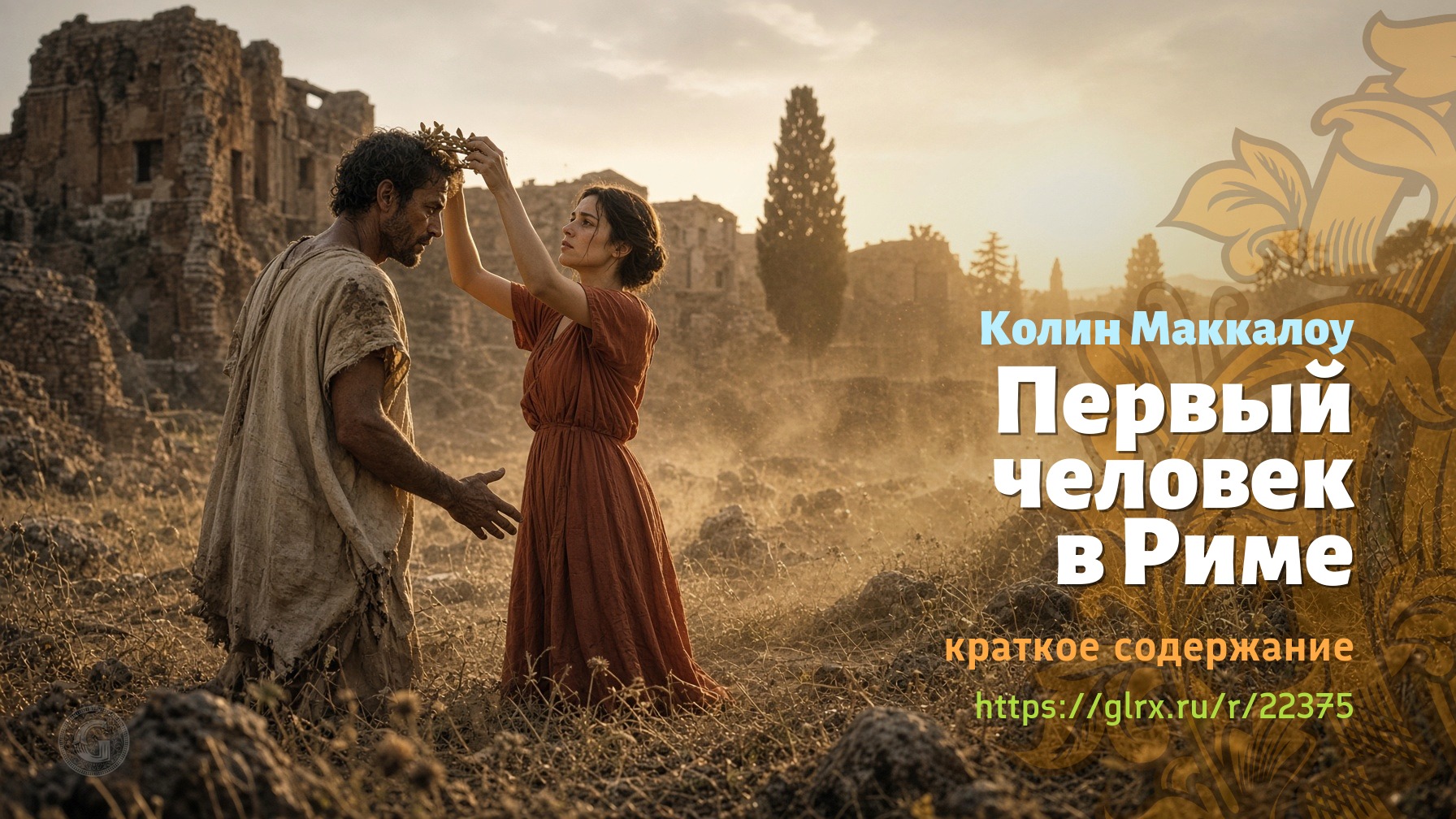
Patrician Lucius Cornelius Sulla was destitute. The thirty-year-old descendant of dictators lived in an insula on the Esquiline, hauling sacks of wheat at the port, and sharing a bed with his aging stepmother, Clitumna, and the Greek hetaera, Nicopolis. Sulla adored the theater, mimes, and the young actor Metrobius. Sixteen-year-old Julius Caesaris spotted the handsome beggar in a vacant lot and placed a woven wreath of dried grass on his head. Sulla took the wreath as a sign of fortune.
The desire for the consulship required a senatorial census. Sulla methodically removed obstacles to the wealth of others. First, he fed his greedy nephew Stichus poisoned candied figs. Then he presented Nicopolis with deadly pale mushrooms in a forest clearing near Tibur. Sulla broke his stepmother Clitumna’s neck on a moonlit night at a seaside villa in Circeii, throwing her body off a cliff into the sea foam. Having inherited millions from both women, Sulla married the amorous Iulilla.
War in the Sands of Numidia
In Africa, the rebellion of King Jugurtha raged. The king slaughtered his brother heirs, massacred Italian merchants in Cirta, and openly bribed Roman ambassadors. Visiting Rome, Jugurtha described the Eternal City as a commodity awaiting a rich buyer. The Numidian prince hired Lucius Decumius, the head of the Suburian brotherhood, to slaughter his rival Massiva right outside the Temple of Castor.
Consul Quintus Caecilius Metellus commanded the war, taking Marius as legate. The campaign dragged on. The Syrian prophetess Martha prophesied seven consulships for Marius. With the support of the plebeian tribune Mancinus, the commander succeeded in recalling Metellus.
The comitia elected Marius consul for the year 107. The consul broke with centuries-old conventions by opening recruitment to the legions to indigent citizens, counted head by head. The state treasury paid for the volunteers’ equipment.
A disgruntled Metellus took the old army to Italy. After training the penniless new recruits, Marius, with lightning speed, crossed the desert and burned the impregnable Capsa. Later, the army approached the basalt mountain on the Mulukha River, where the royal treasury was kept.
The Ligurian cavalryman Vagennius was searching the cliffs for giant, palm-sized snails for garlic sauce. Crawling into crevices to retrieve the gastropods, the soldier discovered a secret path to the rear of the fortress. Engineers constructed a wooden ladder. The citadel fell.
Sulla carried out a diplomatic mission. Sneaking through the Gaetulian patrols at night, the quaestor convinced the Mauretanian king Bocchus to betray his son-in-law. Bocchus lured his relative to a secret meeting. Sulla personally chained Jugurtha and delivered the captive to Utica.
The Massacre of Aravsion
The northern borders were rocked by an unprecedented barbarian invasion. The Germanic tribes of the Cimbri and Teutones defeated the consul Silanus, crossed the Rhone River, and united with the Celtic Tolosates.
The consul of 106, Quintus Servilius Caepio, advanced to meet the horde. A noble patrician, he despised the mob. Having occupied Tolosa without a fight, the proconsul scooped up fifty thousand ingots of molten Delphic gold from the sacred lakes of the Celtic temples. The convoy moved toward Narbonne under the protection of a single cohort. On a forest road near Carcassonne, bandits slaughtered the Roman guards. Fifteen thousand talents of gold vanished without a trace on the way to Smyrna.
In 105, the plebeian consul Gnaeus Mallius Maximus led reinforcements to the banks of the Rhone. Caepio refused to form a fortified camp with the upstart. The arrogant patrician pitched his tents twenty miles north, seeking to claim the victory for himself.
On October 6, the Germans attacked the scattered Roman forces at Arabium. The Cimbri overran Caepio’s isolated camp, driving the retreating soldiers into the raging river. The arrogant commander abandoned his soldiers, crossing the Rhone River in a prepared boat. The barbarians then utterly routed Mallius Maximus’ legions.
Eighty thousand Roman soldiers perished on the battlefield. Senator Marcus Aurelius Cotta found the wounded tribunes Drusus, Sertorius, and Sextus Caesar among the piles of corpses. Having escaped, Cotta chartered a fast vessel in Massilia and sailed to Ostia with news of the disaster. Panic gripped Rome. The popular assembly violated the Lex Villia by electing Gaius Marius consul in absentia for the year 104.
Reforms and the Battle of Aquae Sextiae
Marius trained soldiers in southern Gaul. Each soldier carried a saw, a sickle, a ration pack, a cooking pot, and a palisade stake on his shoulder. Nicknamed "Marius’ mules," the legionaries dug a canal from the sea to Arelate and paved the broken Via Domitia with stone.
Standards were replaced by silver eagles. The consul replaced the iron pin in the pilum’s shaft with a fragile wooden wedge. When it struck an enemy shield, the spearhead bent, preventing the barbarians from throwing it back.
Sulla grew his hair, dyed it henna, and infiltrated the Cimbri disguised as a Gallic bard from the Carnuti tribe. The tribune Sertorius gathered intelligence among the Celtiberians. Sulla married the widow Germana, fathered twins, became a leader at the Cimbri council, and learned the plans of their leader, Boiorix. The barbarians split: the Teutones took a detour through Provence, while the Cimbri planned to invade Italy through the Brenna Pass in the Alps.
In 102, the consul awaited the enemy at Aquae Sextiae. On the first day, the Romans destroyed thirty thousand Ambrones at the crossing, building a rampart along the Arsus River from the enemy’s bodies. On the second day, the Teutonic leader Teutobod led the main forces to storm the hill. The legionaries held their formation, raining pilum upon the Germans. Legate Manius Aquilius attacked the barbarians from the rear with three thousand elite fighters. One hundred thousand Teutons perished in the massacre or surrendered to the slave traders.
The fall of the Cimbri and the revolt in the Forum
The Cimbri descended like an avalanche down the valley of the River Ates. Marius’ appointed partner, proconsul Quintus Lutatius Catulus Caesar, panicked. The commander abandoned the forward fortifications at Tridentum. Legate Sulla rescued the Samnite legion under centurion Petreius, led the soldiers across the bridge, and blew up the supports, delaying the savages.
In 101, the consul Marius united the veterans with Catulus’s legions. The battle broke out on July 30th on the Raudian Fields near Vercellae. The midday sun blinded the Cimbri, and choking dust clogged the giants’ throats. Sulla routed the enemy infantry, and Marius scattered Boiorix’s cavalry. The Germanic tribe ceased to exist.
The victory was marred by a crisis in the capital. Plebeian tribune Saturninus and praetor Glaucia formed gangs of gladiators, demanding that Marius’ veterans be given lands in Africa and the price of bread be reduced to one sestertius.
The censor Metellus of Numidia refused to swear to uphold Saturninus’s agrarian law, opting for voluntary exile to the island of Rhodes. Julius Caesaris saw her husband in the arms of the actor Metrobius and, in despair, stabbed herself with Sulla’s sword in the storeroom.
During the elections, Saturninus’ supporters beat the consular candidate Gaius Memmius to death with sticks. The Senate issued a decree defending the Republic. Six-time consul Marius armed the citizens with clubs, cut off the water supply to the Capitol, and locked the surrendered rebels in the Senate building for trial.
A crowd of young aristocrats, led by Caepio the Younger, climbed onto the roof of the Curia Hostilia. Tearing off the clay tiles, the youths pelted Saturninus, Equitius, and Saufeius with heavy debris, killing them.
Marius paid for the distribution of cheap bread from his own share of the German spoils. The six-time consul’s rule endured, sparing Rome from lynching. An uneasy silence reigned in the Forum. Sulla left to prepare for new elections, and the aging triumphant emperor remained alone on the steps of the deserted Curia.
You cannot comment Why?