"Dream No. 9" by David Mitchell, summary
 Automatic translate
Twenty-year-old Eiji Miyake leaves the remote island of Yakushima and comes to Tokyo to search for his unknown father. The young man’s inner world is fused with feverish visions, where fiction supplants reality. The author wrote this book between 1999 and 2001 in Hiroshima, while working as an English teacher at a technical institute. In 2001, the novel was nominated for the Booker Prize and was also shortlisted for the James Tait Black Memorial Prize.
Pan-opticon
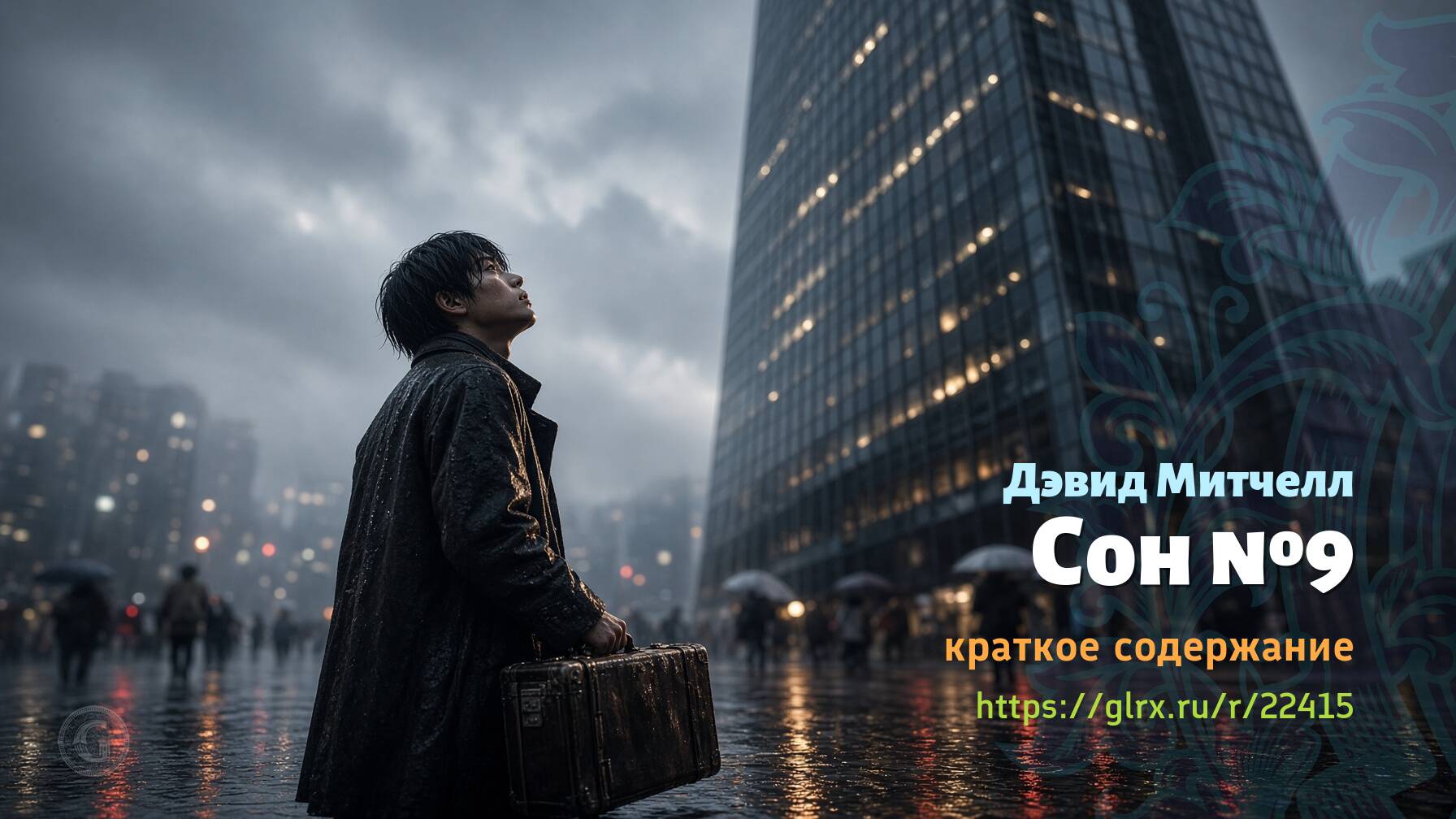
Eiji spends hours in the Jupiter coffee shop. The colossal Pan-Opticon office complex looms before his eyes. He tracks down the influential lawyer Akiko Kato, the keeper of information about his secret parent. The fugitive’s mind spawns a series of cinematic hallucinations. He imagines storming a skyscraper with a tranquilizer in his suitcase, shootouts with bioborgs, a flood, and a duel with a giant alligator on a flooded Shinjuku street.
Reality turns out to be more prosaic. Kato emerges from the hall, crosses the intersection, and leads his pursuer into the dimly lit Ganymede Cinema. They’re showing an arthouse film about the prisoner Voorman, who wiped Belgium off the map with his own mind. Eiji sits in the back and overhears the lawyer’s conversation with her companion. A monstrous revelation emerges: the politician has long been paying lawyers to conceal his illegitimate offspring. The young man rises to his full height, attempting to claim recognition. Faces turn without a hint of recognition. A genuine attempt to enter the corporate citadel ends in disaster: a Cerberus at the gate shows the provincial out.
Lost and Found
An unemployed young man rents a tiny living capsule above the Shooting Star video rental store in the Kita-Senju district. The owner, Buntaro Ogiso, finds him a temporary job. At Ueno Station, suitcases, umbrellas, and gloves are being searched for. His partner, Suga, dreams of a career as a world-class hacker, and his boss, Sasaki, demands meticulous accuracy when inventorying lost items.
Memories flash suddenly. Nine years ago, Anju’s twin sister died in a whirlpool near Whale Rock while Eiji was playing soccer at a school tournament in Kagoshima. Before the match, the boy ran up to an ancient shrine and promised the thunder god all his possessions for victory. Returning home with the trophy, he found his relatives weeping. Now the ghosts demand retribution.
A letter from the Miyazaki Mountain Clinic arrives in the capsule. Mariko’s mother confesses to her son the sins of her youth. On the eve of her escape from the capital, a drunk woman threw her three-year-old son from the ninth-floor landing. That same week, the deputy stationmaster, Aoyama, corners the inspector in his office, aims a hunting crossbow at him, and finally throws himself out the window in front of reporters.
Video games
The Shibuya district deafens with the roar of slot machines in the evening. At a pool table, fate brings Miyake together with student Yuzu Daimon. The new acquaintance spouts cynical aphorisms, pays with General Douglas MacArthur’s platinum lighter, and leads the group to the exclusive "Queen of Spades" salon. There, hostess Miriam pours guests expensive champagne.
The morning brings a sobering awakening. Daimon vanishes from the love motel, abandoning his friend with a fifty-five thousand yen bill. Escaping from the manager, Eiji slips through the cook Bonki’s kitchen. At the Jupiter Café, he knocks down a rude man with a headbutt who was insulting the waitress, Ai Imajo, with her amazingly beautiful neck. The girl advises him to place a personal ad in the press.
While strolling by Shinobazu Pond, Eiji runs into Miriam. She mistakes him for a Daimon spy, delivers a well-aimed kick to the groin, and drops the library reference book. With Suga’s help, Eiji hacks the library card. He finds her in the slums of Funabashi. The hostess begs him to stay away from the seedy areas.
Reclaimed land
Street ATMs suddenly transmit strange messages. The digital display flashes the words: "Father awaits your answer." Outside a noodle shop, a guy is bundled into a spacious black Cadillac by gangsters Frankenstein and the Lizard. The unfinished entertainment complex "Valhalla" is ruled by the ruthless mafioso Ryutaro Morino.
The crime boss suspects the outsider of secret ties to a rival Nagasaki gang. Daimon is already lying drained of blood in the hallway, punished for his illicit affair with Miriam. Morino forces his unwilling captive down to the dark alleys of the bowling alley. There, the living heads of traitors are sealed in concrete nests. The leader forces the young man to launch a heavy ball at the living targets under threat of reprisal against Buntaro’s pregnant wife.
Midnight approaches. The Nagasaki convoy converges on the flat embankments of the bay. Morino detonates Israeli explosives in the Kevlar helmets of the attackers via a cellular transmitter. The explosion tears the attackers to shreds. Bodyguard Sukhbaatar shoots the cartridge, fulfilling the secret orders of his former boss, Tsuru, blows up cars containing incriminating evidence, spares the young man frozen on the bridge, and orders him to forget the nightmare.
The Abode of Fairy Tales
Sasaki’s boss is hiding a fugitive in an empty suburb. The owners of the house have left to lecture in Europe.
The attic is crammed with books. On the oak bureau lies a draft of a fairy tale about the Goat-Writer, Lady Crested, and the hairy Pithecanthropus. The animals rescue a stolen fountain pen from Queen Erichnida, journey through a wilderness of forgotten meanings, and perish in the waters of a mysterious sacred lake.
Daimon finds refuge before fleeing to America. The student managed to secretly marry Miriam, whose real name is Min. The guest returns his friend’s guitar and leaves MacArthur’s lighter. A certain Takara Tsukiyama, claiming to be his paternal grandfather, responds to the newspaper. He arranges to meet his grandson at the hotel restaurant.
Kaiten
A bitter veteran, introducing himself as Admiral Raizo, sits in the Amadeus room. The envoy hands the visitor a yellowed notebook. It’s the war diary of Subaru Tsukiyama, pilot of the deadly Kaiten torpedo.
The notebook bears pencil marks. In the fall of 1944, a young soldier trained at the Otsushima Island base, preparing to launch an explosive-laden projectile directly into the hull of an American battleship. The document chronicles the submariners’ daily life, disputes over military duty, the bitterness of the senseless deaths of their comrades, and the final swim into the black depths of the Palau lagoon, where an unexploded metal coffin became an eternal mass grave.
A return visit brings a bitter truth. The stepmother and haughty stepsister are sitting at the table. It turns out the grandfather died three days ago, and the old admiral was Takara himself, who decided to look at his relative under a false name. The relatives send the visitor away. The father is ashamed of his illegitimate offspring and demands that he forget the address forever.
Cards
Miyake works the night shift at the Pizza Nero bakery with Ai’s friend Sachiko and the magician Doi. The heat from the oven is brain-melting.
The post office delivers a package. The deceased detective, Kozue Yamaya, sent a compact disc containing evidence of organ trafficking by the yakuza clan’s top brass. She begs for the evidence to be made public. Later, Eiji is lured to an empty cosmetic clinic, where mafia henchmen force debtors to play cards. The terms are simple: the queen of spades promises death on the operating table for the harvesting of kidneys. Miraculously, the young man draws the club, and the aging leader, Tsuru, suddenly falls dead face-down on the hot stove grate.
Dawn puts an end to the situation. A favorite dish of the company’s boss, Daisuke Tsukiyama, is ordered to the Pan-Opticon office. Eiji personally delivers the box to the ninth floor. The father, reclining languidly in his robe, scolds his wife on the phone, praises the hot sauce, and doesn’t recognize his own blood. The son takes the money and silently slams the door.
The mountains speak the language of rain
A young man travels south in the cabs of passing trucks. The road winds past bridges and gas stations.
The mother greets the guest at the Miyazaki asylum. The woman, having shed her haughty mask, pours the wanderer a barley drink and informs him of her wedding plans with the innkeeper. The mutual recriminations fade away.
The elements overtake the fugitive in Kagoshima. A fierce typhoon shatters the seaside fences, forcing the traveler to seek shelter in a garden shed among boxes and earth. In the morning, a ferry cuts through the calm surface of the strait, returning the wanderer to his native island of Yakushima. The young man places three flat pebbles on his sister’s grave, lights incense, and walks to his grandmother’s empty house.
The silence of the room is shattered by a breaking news broadcast. The radio announcer reports a monstrous magnitude 7.5 tremor right beneath the foundations of Tokyo. The capital lies in ruins. Aya’s phone line is silent. Eiji rushes outside and runs toward the storm. Chapter Nine remains a blank page.
- Антонио Гауди: каталонский архитектор
- Дэвид Хокни
- Дэвид Уилки: шотландский портретист
- Сон — Анри Руссо
- Дэвид Нолан, ирландский художник-портретист
- Дэвид Войнарович: коллажист и уличный художник
- Дэвид Бейли: портретный фотограф знаменитостей
- Дэвид Смит: американский скульптор-абстракционист
- Дэвид Сигер, художник по керамике, скульптор: биография
You cannot comment Why?