A Summary of "The Thousand Autumns of Jacob de Zoet" by David Mitchell
 Automatic translate
David Mitchell’s historical novel takes readers to the closed feudal Japan of the Edo period at the turn of the 18th and 19th centuries. Europeans are forbidden from entering the islands. The only window to the outside world is the tiny man-made island of Dejima in Nagasaki Bay, where a handful of Dutch East India Company employees live behind wooden walls under the constant surveillance of shogunate officials. The idea was born during a trip. The author worked on the text for four years, completing the historical book in 2010.
In 2011, the novel won an award. It won the Commonwealth Regional Prize for Best Novel of the Year and was shortlisted for the prestigious Booker Prize. Formally, the novel remains a standalone work, separate from the series, but shares recurring characters with the author’s later books, The Bone Clocks and The Hungry House.
Arriving at Dejima Island
In the summer of 1799, the Dutch ship Shenandoah anchored in Nagasaki. A young, pious clerk, Jacob de Zoet, arrived at the trading post to earn money, hoping to save a dowry for his wedding to his Rotterdam bride, Anna, after five years of service. The former manager was arrested. At customs, the newcomer’s belongings were inspected by a young Japanese translator, Ogawa Uzaemon, who noticed Adam Smith’s Wealth of Nations among the Dutch tomes. The two officials quickly found common ground. Vorstenbosch demanded that the authorities triple the copper quota, forcing the clerk to forge the Governor-General’s signature on a bold diplomatic ultimatum.
An unexpected encounter occurs in the warehouse. Orito Aibagawa retrieves a sailor’s amputated limb stolen from a hospital from a pet macaque, striking the Dutchman with her composure, calm gaze, and the dark mark of an old burn on her cheek. She takes lessons in European medicine from Dr. Lucas Marinus. The resulting passion compels the Dutchman to secretly imprint his beloved’s face on the slats of a forgotten fan and, through a translator, pass her a dictionary containing a marriage proposal.
A sudden earthquake destroys the warehouses. The abbot of the mountain monastery, Enomoto, visits the trading post, demonstrating the deadly power of internal energy and buying crates of healing mercury at an incredible price. The trading season ends in deception. Vorstenbosch decides to conceal seven thousand piculs of state-issued metal for personal gain, ordering his secretary to sign a false declaration.
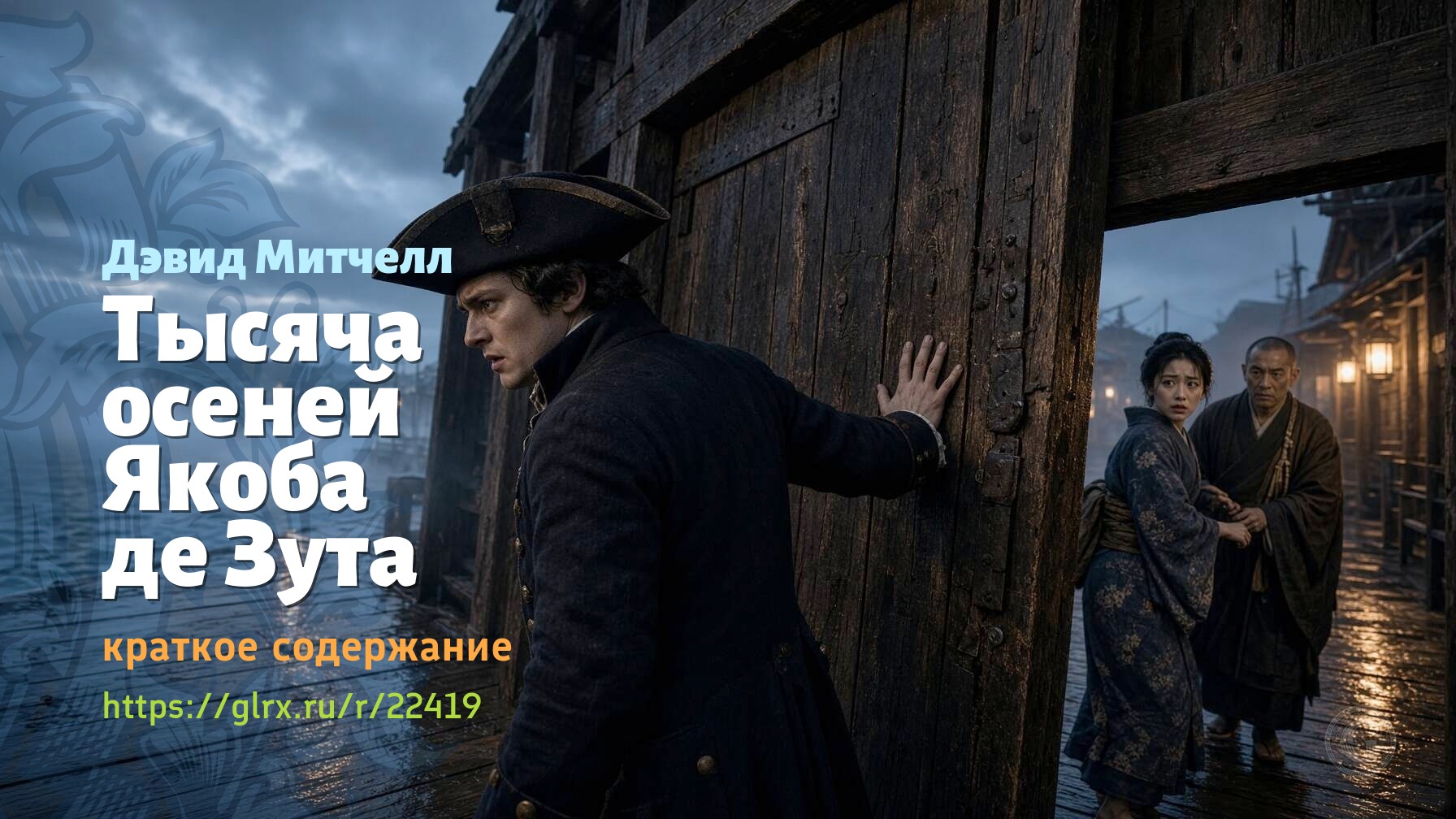
Without hesitation, the clerk tears up the forged document. The enraged boss deprives his subordinate of the promised promotion, hands over the assistant manager’s position to the arrogant Prussian Peter Fischer, and sails to Java, leaving the recalcitrant man penniless on the island. Orito’s father dies in debt. To pay the bills, her stepmother sells her stepdaughter to Abbot Enomoto to settle the debts, and the girl’s belated attempt to seek refuge on Dejima ends with the gates slamming shut before the helpless Jacob.
The Mystery of the Monastery on Mount Shiranui
Orito finds herself locked in a remote mountain sanctuary. Behind the high walls of the Sisterhood, crippled women are kept under the strict supervision of monks, taking a daily intoxicating potion. The midwife secretly pours the poison down her sleeve. Before his painful death, the fugitive novice Jiritsu manages to pass a scroll containing the order’s secret tenets to the village Christian herbalist Otane, revealing the horrific truth about the regular murder of infants born to nuns for the sake of an elixir of eternal youth. The old woman finds the monk dead.
In Nagasaki, a herbalist brings a dangerous document to the translator Ogawa Uzaemon, whose heart is torn by remorse and guilt over his lost fiancée. The young official entrusts the scroll to de Zoet for safekeeping. Together with the fencing instructor Shuzai and mercenary samurai, the Japanese man sets off into the mountains to storm the monastery. The master betrays his student. Enomoto personally shoots the captive in the forehead with a European pistol purchased from the former Dutch director.
In the monastery, the captive discovers a secret underground passage. After making her way through hidden rooms containing a stone statue of the goddess, the fugitive finds an archive of forged New Year’s messages and descends along bound silk cords beyond the monastery wall. An alarm bell rings on the suspension bridge. Remembering her friend Yayoi, who is having a difficult labor, the noble midwife voluntarily returns to captivity to save another’s life, safely delivering twins. The infants are taken away to be slaughtered.
The siege of the trading post and the duel of wills
In October 1800, the British warship Phoebus, commanded by Captain John Penhaligon, unexpectedly entered Nagasaki harbor. The ship was sailing under a deceptive Dutch tricolor. In a cunning trap, the foreigners took Melchior van Cleef and Peter Fischer, the new manager of the trading post, hostage, forcing the Europeans to surrender the trading outpost. The Prussian defected to the enemy. The captured van Cleef threw the traitor Snitker overboard, refusing to commit a shameful betrayal of his homeland.
The defector is sent ashore with an English ultimatum. Jacob declares a temporary independent republic of Dejima, rallies the remaining seven workers, and categorically rejects capitulation. Fearful, the carpenter Tumi hides from imminent reprisal. At a meeting at the town hall, de Zoet reveals the British’s treacherous plans to the mayor, Shiroyama, and proposes blocking the bay with a pontoon bridge made of hundreds of fishing boats tied together to allow for a massive bombardment of the frigate with incendiary arrows. Penhaligon orders the bombardment.
British guns smash warehouses and batter the stone embankment, showering rooftops with cannonballs. Jacob and Doctor Marinus stand fearlessly atop the Watchtower beneath the fluttering Dutch flag, reciting the Psalms of David as they await the deadly grapeshot. With a sudden order, the captain calls off the salvo. Seeing the red hair of a young foreigner through his telescope, the captain, tormented by an attack of gout, remembers his dead son and steers the frigate out to sea.
The military threat has passed.
After the enemy’s departure, de Zoet hands Shiroyama the dogwood case. Shocked by the revealed treachery, the dignitary summons Abbot Enomoto to the palace under the pretext of finishing an interrupted game of Go. The host mixes the deadly venom of a Siamese snake into the sake cups. By partaking of the poison along with the condemned villain, a loyal chamberlain, and a young novice, the dying city governor washes away the shame of the breaches in the coastal defenses and saves his ancient samurai line from certain execution. The mountain monastery is dissolved forever.
Farewell at Nagasaki Bay
Eleven long years of forced isolation for the trading post from a Europe devastated by the Napoleonic Wars pass. Doctor Marinus dies of a sudden cerebral hemorrhage, having written a will and predicted his death down to the hour. At the funeral of his old mentor, Jacob unexpectedly encounters Orito. Freed from her secret monastery, she has become a respected midwife in the imperial capital of Miyako, opening her own school for female students. The two speak frankly. Orito warmly lifts Jacob’s burden of guilt, calling the suffering they endured a shared instrument of higher justice, ridding the world of a cruel cult. The lovers part forever on the bridge.
In the autumn of 1817, fifty-year-old de Zoet boards the ship "The Oracle," leaving Japan after two decades of service. His ten-year-old son, Yuan, remains ashore. The laws of the shogunate mercilessly forbid the children of local women from leaving the closed empire. In Zealand, the aging traveler finds peace. The former merchant marries a young compatriot, is elected to the city council of Middelburg, and raises his heirs in the family home. Before his last breath, the old man sees a vision of Orito. The beloved image silently touches the cool spot between the graying eyebrows of the fading patriarch.
- Крестовые походы: мотивы и последствия для Востока и Запада
- Как нарисовать красками рисунок и картину “Осень”?
- Дэвид Нолан, ирландский художник-портретист
- Дэвид Хокни
- Дэвид Уилки: шотландский портретист
- “Амурская осень” в Благовещенске
- Дэвид Сигер, художник по керамике, скульптор: биография
- Дэвид Войнарович: коллажист и уличный художник
- Дэвид Бейли: портретный фотограф знаменитостей
You cannot comment Why?