"We’ll Live Until Monday" by Georgy Polonsky, summary
 Automatic translate
Written between 1966 and 1968, the text reveals with ruthless sincerity the hidden conflicts of Soviet schools, where human dramas rage behind the facade of polite speech. The work is devoid of the didactic pathos typical of the era, depicting teachers as vulnerable individuals who doubt, make mistakes, and painfully search for the meaning of their work. In 1968, the story was adapted for the screen by director Stanislav Rostotsky. The film of the same name won the Grand Prize at the Moscow International Film Festival (1969) and the USSR State Prize (1970).
Thursday
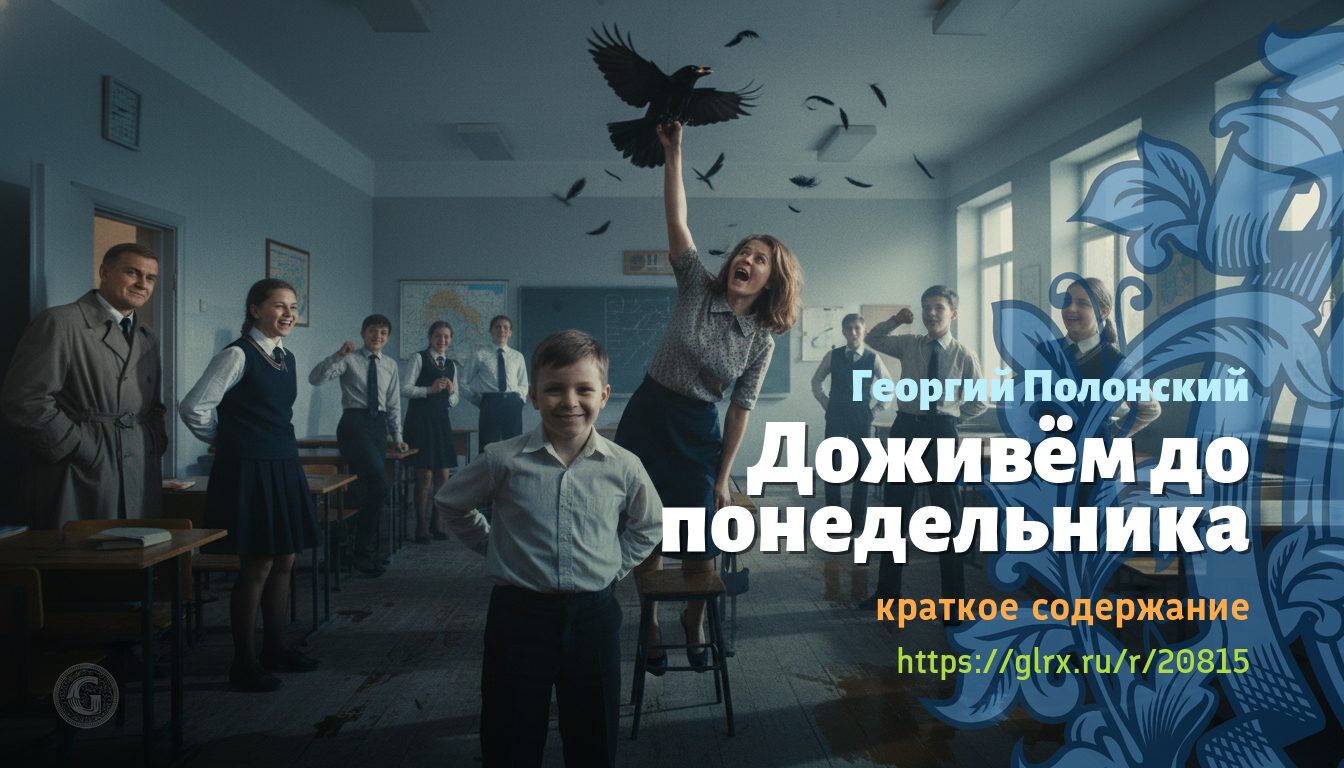
On a rainy autumn morning, students rush into the gray school building. Ninth-grade "B" is disrupting a lesson taught by Natalya Sergeyevna Gorelova, a young English teacher. Someone has brought a live crow into the classroom. The bird flutters around the ceiling, the children burst into laughter, and the inexperienced teacher climbs onto a chair in horror.
Ilya Semenovich Melnikov, a historian, former front-line soldier, and Natalia’s mentor, passes by. He peers into the classroom, assesses the chaos, and ironically declares that he won’t interfere since the teacher has such excellent rapport with the class. Insulted, Natalia Sergeyevna catches the bird and throws it out the window. The class leaves the classroom in protest against the cruelty.
After class, Ilya Semenovich plays the piano in the empty assembly hall. His literature teacher, Svetlana Mikhailovna, tries to engage him in a frank conversation. She hints at a spiritual connection, but Melnikov responds coldly. He tests her knowledge of Yevgeny Baratynsky’s poetry and abruptly leaves, leaving his colleague alone.
On the street, the historian is hailed by a former student, Borya Rudnitsky. He gives the teacher a ride in his official Volga and comments on how Melnikov is wasting his potential at school. Borya also complains about his fiancée, who ran away from the altar and caused his father to have a heart attack and cost him a year-long assignment to England. From the context, it becomes clear that this woman was Natalya.
Melnikov’s elderly mother, Polina Andreyevna, is waiting for him at home. She tries to get her son to talk, recalling Gorelova, but the historian locks himself in his room. Tormented by his conscience, he calls Natalya to apologize for his morning taunt, but the conversation doesn’t go well.
Friday
The morning bustle in the teachers’ lounge is interrupted by Melnikov’s anger. He scolds the elementary school teacher, Taisiya Nikolaevna, for using a vulgar word. Ilya Semenovich demands that the teacher’s authority be protected, driving the woman to tears.
It soon becomes clear that Class 9B is boycotting English class. Melnikov finds the rebels in the schoolyard near the workshops under construction. Class leader Kostya Batishchev condescendingly explains the motives for the strike. The historian tries to reassure the students, comparing their actions to real historical strikes, but senses the falseness of his own words. The conflict is resolved abruptly: Natalya Sergeyevna runs in without her coat and apologizes to the students. A short student, Genka Shestopal, admits that he brought the crow.
Later, Ilya Semenovich sits in the history room, berating himself for his rudeness to Taisiya Nikolaevna. He draws caricatures of himself on the board, depicting himself as a parrot and then a camel.
Meanwhile, the ninth "B" class is writing an essay on literature. Svetlana Mikhailovna suggests topics about Bazarov, Katerina, or "My Idea of Happiness." The modest Nadya Ogarysheva writes that she wants to get married and have two boys and two girls, so that there will never be loneliness in the house. An indignant Svetlana Mikhailovna scolds the girl for her inappropriate frankness. Nadya stubbornly reads the text aloud, defending her right to ordinary love. The class sides with her, demanding to know what’s wrong with this. The writer loses control of the situation.
The mother of Vova Levikov, a failing student, comes to Melnikov. She begs him not to give her son a "F," citing the boy’s severe childhood illnesses. The historian relents and gives him a "C," disgusted by his own lies.
Driven to despair, Melnikov bursts into Principal Nikolai Borisovich’s office. He demands immediate leave or dismissal. The principal, an old friend of the historian, refuses to lose his best teacher. After a heated argument, Nikolai Borisovich relents.
Ilya Semyonovich leaves school with Natalya. They take a long stroll through the autumn streets, eating pies in the courtyard of an old, abandoned church, from where watchful old women chase them away. Then the couple enters a semi-basement second-hand bookstore. The elderly salesman, Yakov Davydovich, resembling a sad bird, sells them a rare book through an acquaintance — Johann Peter Eckermann’s "Conversations with Goethe." Near the operetta theater, Natalya runs into some former classmates. While she chats with them, Melnikov disappears into the crowd.
That evening, in an empty gym, Genka Shestopal reads his own poems to Rita Cherkasova. She rejects his feelings, calling Genka childish. The hurt young man lies that he loves someone else and writes poetry only to sustain his inner state of infatuation. After Rita leaves, he makes his way to the empty teachers’ lounge. A heretical idea burns in his eyes.
At home, Melnikov drinks vodka and reads aloud a letter from Judge Potekhin. He brazenly demands that his daughter Lyuba’s grade be corrected. The historian gloomily recites poetry to the strange, mechanical sound of the television. The phone rings. Natalya’s mother picks it up and, confused, hangs up.
Saturday
The teachers’ lounge is bustling with the usual bustle in the morning. Melnikov arrives and hands Svetlana Mikhailovna a bouquet of fresh chrysanthemums. He’s the only one who remembered that today marks her twentieth anniversary of working at the school. She’s moved to tears. The historian and Natalya’s eyes meet, and they silently forgive each other for yesterday’s offenses.
History class begins in Class 9, "B." The overgrown Syromyatnikov answers at the board, confused and comical. Then Kostya Batishchev stands up. He confidently recounts the mutiny of the cruiser Ochakov, but pragmatically dismisses Lieutenant Schmidt’s actions as a senseless mistake.
Melnikov can’t stand it any longer. He passionately describes Schmidt as a Russian intellectual who couldn’t tolerate the suffering of others. The historian defends the human right to the highest sacrifice, devoid of any guarantee of success. The class listens with bated breath. Rita Cherkasova, stunned by the teacher’s words, moves from Batishchev to another desk.
The lesson is interrupted by the principal and a pale Svetlana Mikhailovna, a soot stain on her forehead. Nikolai Borisovich reports that someone burned all the essays of the ninth grade "B" class overnight. A daring note was left at the site of the ashes. Genka Shestopal stands up and takes the blame. The principal leads him away.
Svetlana Mikhailovna accuses Melnikov of making a laughingstock of her. The historian calmly remarks that it’s their own fault if they can’t prove to their students that they deserve to be teachers.
Returning to class, Ilya Semenovich declares the lesson over. Only he and Natalya remain in the empty room. Melnikov shows her a piece of paper found where his essays were burned. It’s a poem by Shestopal about a white crane that they tried to cage and ring with a grade so it would breathe warm dust and not think of flying. But the bird escaped the fire, leaving the fools in their misery.
Natalya explains that Genka wrote only one sentence in the destroyed essay. It read: "Happiness is when you are understood." Melnikov forcefully throws open the office door. Syromyatnikov, hiding behind it, receives a powerful blow to the forehead and falls to the floor, eliciting a burst of laughter from the others.
- "The Key Without the Right of Transfer" by Georgy Polonsky, summary
- A summary of Georgy Polonsky’s "Cinderella’s Honeymoon"
- "Don’t Leave" by Georgy Polonsky, summary
- A summary of Georgy Polonsky’s "The Tutor"
- St. Petersburg will host the festival "Vivat Cinema of Russia!"
- JAZZ AT THE MUSEUM. ALINA ROSTOTSKAYA QUARTET
You cannot comment Why?