"Formula of Love" by Grigory Gorin, summary
 Automatic translate
This book is a satirical and touching situation comedy, written in 1984. The author took Alexei Tolstoy’s rather dark novella "Count Cagliostro" as a basis and reworked it into a bright philosophical story about the search for the meaning of true feelings. At the center of the plot is a renowned magician who attempts to calculate a mathematically precise pattern for the emergence of emotional attachment.
The work was adapted into a film with exceptional success. Director Mark Zakharov made a feature film of the same name based on the script. The film instantly acquired cult status, and the lines of the eccentric characters quickly became popular.
The action begins on the dusty roads of Russia. The magician Giuseppe Cagliostro, renowned throughout Europe, is riding in a carriage with his companion, Lorenza. They are accompanied by their servant, Margadon, and their coachman, Jacob. The Count teaches the enraged Lorenza Russian using a levitating head resting on a copper tray. Meanwhile, Margadon deftly recites folk proverbs. The strangers pass by the buffoons indifferently, going about their business.
Soon the company arrives in St. Petersburg. At a seance, the Count astounds the capital’s nobility. He dissolves an emerald ring in a glass of foaming liquid. A glowing Roman numeral, nineteen, appears inside the vessel. The magician interprets this phenomenon as a sign of long life for the old landowner. The delighted guests shower the assistant’s tray with jewels. Suddenly, an officer appears with orders to detain the sorcerer on a personal mission from His Serene Highness Prince Potemkin. Cagliostro hides behind a curtain and then escapes through the servants’ quarters. There, Margadon is playing cards, dealing only aces. The host snuffs out the candles with a single puff, and the con artists quickly depart.
Treatment and relocation to the province
Cagliostro continues his journey. Along the way, he undertakes to treat a poor nobleman, Ivan Antonovich Grinevsky. The Magister gathers a cloud of energy above the patient’s head and throws it into a corner. The patient immediately feels better. The Count announces his departure for Warsaw, but promises to continue the treatment indirectly through a relative. He manipulates the emotions of Grinevsky’s wife, and eventually the patient’s daughter, young Maria, agrees to go with the stranger. She takes this step for her father’s sake, harboring no sympathy for the magician.
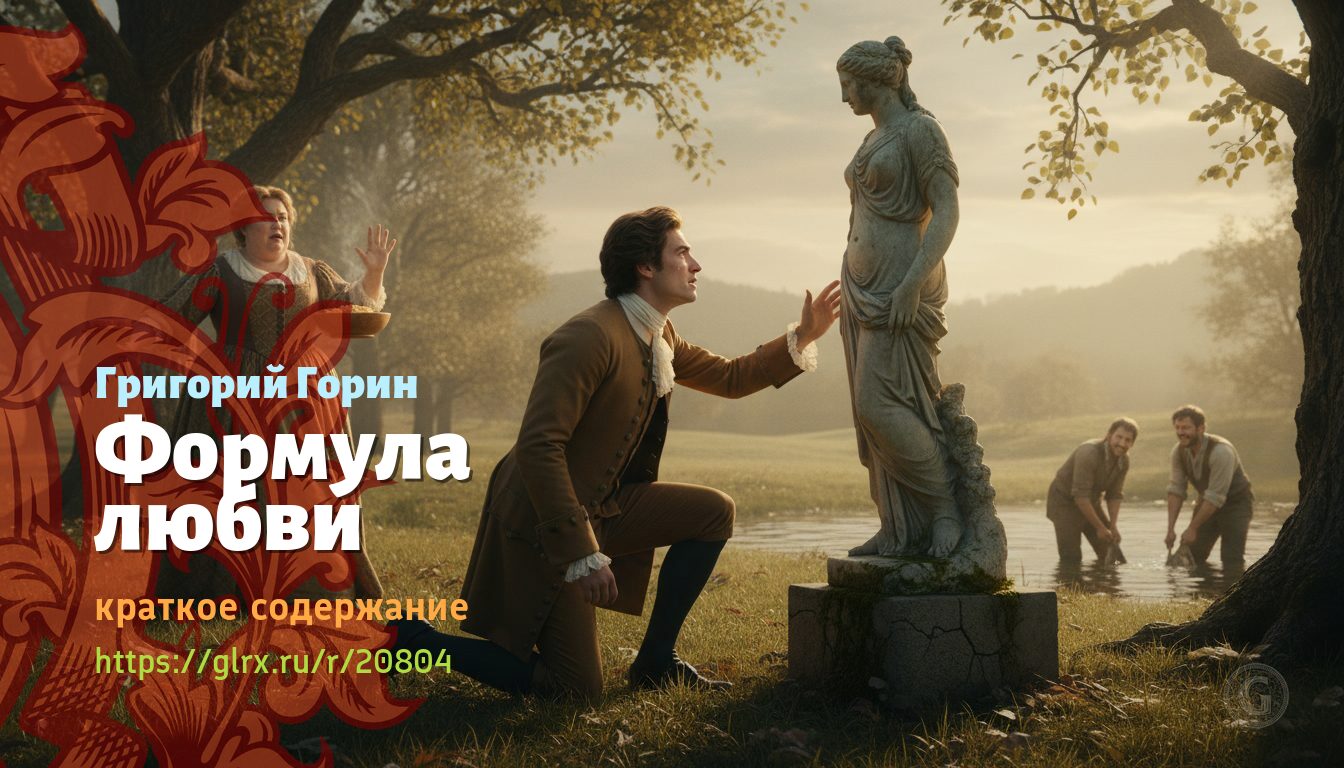
Meanwhile, in the Smolensk district, on the quiet estate of Bely Klyuch, a young landowner named Alexei Fedyashev suffers from hypochondria. He recites poems about the river of life and despises the daily grind. Aunt Fedosya Ivanovna eats noodles with gusto and persuades her nephew to marry one of the neighboring daughters of the Svinin family. Fedyashev rejects the idea with disgust. His heart is lost in a marble statue of a woman in an ancient Greek tunic standing in a neglected park.
The servants, the blacksmith Stepan and the maid Fimka, are fishing for crucian carp in the pond. Stepan is showing off the Latin sayings his former master taught him. Fedyashev orders the blacksmith to move the beloved statue straight to his study. The older servants whisper about the sculpture’s history: whether the model was the courtesan Praskovya Tulupova or the Frenchwoman Jaselle. Alexei attempts to lift the heavy stone himself, falls, and suffers a severe head injury. In the commotion, the marble maiden’s arm falls off.
A rather drunk doctor, arriving from the city, examines the patient. The physician recommends treating hypochondria with ice-holes or conversation. He casually shares a funny piece of news: the famous Cagliostro is currently sitting in the local inn, feeding bedbugs. The Count’s carriage has broken down, and the blacksmith he needs has run away. Hearing this, Fedyashev leaps from the sofa, demands a horse, and races through the pouring rain to the great sorcerer.
Experiments on human nature
At the inn, Margadon and Jacob are miserable. Margadon fears her future rebirth as a mongrel cat, while Jacob meekly awaits his birth as the Prince of Wales. In the next room, Cagliostro is trying his best to artificially rekindle love in Maria’s heart. The girl trembles with fear. The Count demonstrates his power over nature: he makes a white rose turn red and crumble, and then, by sheer force of will, stops his own heartbeat. The servants sing a touching Neapolitan song about the unfortunate girl. Maria begs him to end her torment.
Suddenly, a drenched Fedyashev bursts into the room. He haltingly asks the magician to perform a miracle of materialization and bring a marble statue to life. The young man is ready to give his life for it. Cagliostro initially refuses to expend his magical energy. Seeing Maria’s sincere sympathy for the young man, the magician changes his mind. He moves with his entire strange retinue to the Fedyashev estate.
A strange cortege enters the courtyard of the Bely Klyuch estate. Fedosya Ivanovna greets the guests with bread and salt, and Margadon busily pockets the salt shaker. The local blacksmith, Stepan, agrees to repair the count’s carriage in ten days and asks for help.
At a gala dinner, Cagliostro astonishes those present with his unusual abilities. He claims his birthdate was two thousand years ago, during the eruption of Mount Vesuvius. The doctor calmly compares this to a local scribe who, saving ink, recorded merchants’ birth dates as third years. Angered by his disbelief, the Count draws fire from his little finger, cools it in water with a hissing sound, and calmly eats an iron fork. The doctor finds this circus trick admirable.
After the meal, Cagliostro examines the damaged statue in Alexei’s office. He announces the plan: the ideal will be given the desired contours along the energy channels. The new creation will be named Lorentzia.
The Master’s Secret Plan
Margadon attempts to seduce the rosy-cheeked Fimka. She readily agrees to come to the hayloft that night, but promises to bring Stepan with her for an official blessing. Horrified, Margadon abandons his carnal intentions.
Alexei meets Maria in a gazebo by the pond. He brings her an armful of daisies. The girl tells the young man the harsh truth: the great Petrarch first fell in love with his living neighbor, and only then exalted her to the skies. Fedyashev begins to doubt his worship of cold marble.
One night, in the middle of a moonlit field, the real Lorenza secretly appears in an open carriage. She scandalizes the Count for having to hide. Cagliostro confesses to her his grandiose plans. He has devised a precise mathematical formula for love, taking into account every conceivable stage of attraction and repulsion. The Master wishes to prove to Heaven his ability to create genuine affection with his own hands. Lorenza must pretend to be a materialized statue and drive Fedyashev away from Maria.
One sleepless night, Aunt Fedosya Ivanovna advises her nephew to abandon his empty fantasies. She lets slip about Maria’s nightly tears and her secret trips to the pond. In the morning, Fedyashev sees a girl floating among the water lilies. He dives into the water fully clothed, but falls awkwardly into the thick mud.
Cagliostro intercepts the young man on the shore. Fedyashev declares his refusal to materialize, as he has sincerely fallen in love with a real woman. The enraged Count forcibly drags Alexei to the ritual site. The site is already cordoned off with ropes, the signs of the zodiac are inscribed on the ground, flasks are smoking in the tent, and Margadon and Jacob are busily stirring a whitish mixture in buckets.
The duel and the triumph of life
Alexei grabs a burning log from the fire and rushes to the statue, demanding that the deception be stopped immediately. The silken blanket falls, revealing a terrified, living Lorenza underneath. The young man realizes the fraud and decisively challenges the master to a duel.
The duel takes place in a birch grove. The opponents come face to face. Fedyashev fires into the air, as the rules of hospitality prohibit him from killing a guest. Cagliostro shoots an apple off Margadon’s head and then proposes a draw. Margadon loads only one of his two pistols. Alexei pulls the trigger, aiming for his own heart. There’s a dry click.
The Count’s turn to shoot passes. At that moment, Maria runs into the clearing. With tears in her eyes, she declares her willingness to ride with the unfortunate Master to the ends of the earth out of compassion. Grief-stricken, Alexei snatches the pistol from Cagliostro and shoots himself again. The weapon only hisses pitifully and releases acrid smoke. It turns out the cowardly Margadon had deliberately left neither barrel loaded.
Cagliostro picks up the discarded pistol, points the barrel upward, and suddenly a real shot rings out. The magician decides to tempt fate to the end. He brings the hot barrel to his temple and begins to slowly retreat into the dark forest. His face turns pale and terrifying. Suddenly, a doctor emerges from the bushes with a calm story about a local landowner, Kuzyakin. This Kuzyakin also tried to shoot himself, misfired twice, sold his pistol, got drunk out of grief, and froze to death in a snowdrift. Cagliostro, unable to withstand the psychological strain, pulls the trigger.
Denouement
The master awakens in bed with his head tightly bandaged and wearing a ridiculous nightcap. The bullet only slightly grazed his skin. The blacksmith Stepan regretfully admits to having repaired the carriage prematurely. He had been drinking with his godfather and, drunk, assembled the complex mechanism in just an hour. Cagliostro sees soldiers and an officer approaching the house through the window.
The team hastily prepares for their escape. Jacob bids farewell to the tearful Fimka in the hayloft, firmly promising to return a true prince. Cagliostro jumps out the window. The carriage races through the estate park, but the Count orders them to stop near an abandoned marble sculpture. A small, fair-haired girl approaches him. She introduces herself as Praskovya Tulupova and asks the Count about her grandmother’s revival. Cagliostro shudders, smiles broadly, and picks the child up.
Local artist Zagosin hastily sets up his easel and begins mixing oil paints. He paints a unique group portrait. It depicts the fugitive magician, his servants, the Fedyashevs, Maria, his aunt, Stepan, and Fimka. The arriving officer also peacefully joins the motley group.
The doctor speaks his final words. In 1791, Giuseppe Cagliostro returned to Rome and voluntarily surrendered to justice. The court sentenced him to life imprisonment. Shortly before his death, Lorenza gave him this Russian drawing in prison. The faces gradually acquire graphic clarity, transforming into a conventional antique painting.
You cannot comment Why?