Robert Sheckley’s "White Death" Summary
 Automatic translate
Published in 1963, this thrilling detective story centers on the dismantling of an international drug smuggling network in the Middle East. The story is told from the perspective of Ahmed Abotai al-Din, an educated Iranian translator with Bukharan roots. It is the fourth book in the adventure series about Federal Bureau of Narcotics agent Steven Dane. The series includes the novels Caliber.50 (1961), Running for the Run (1961), Living Gold (1962), White Death (1963), and The Limit of Time (1967).
The meeting in Isfahan and the Mashhad trail
Isfahan police chief Keftia finds former military translator Ahmed Abotai and offers him a lucrative position. At the Shiraz Hotel, the Iranian meets American Steven Dane. Dane is investigating opiate trafficking routes to the United States following the death of a government agent near the border village of Imam Baba. Ahmed agrees to escort the foreigner for a generous reward of three thousand dollars.
The partners fly to Mashhad.
At the city bazaar, the translator unsuccessfully attempts to ferret out rumors under the guise of a merchant selling Isfahan linen embroidery. That evening, in a dark alley in the Old City, six mercenaries attack the companions. The American stuns his opponents with hand-to-hand combat, while Akhmed wields a family blade. Three days later, a nomad named Khitai, from the Turkmen Dushak clan, contacts them. In exchange for silver coins, the man provides crucial information about the smuggling of a prohibited substance across the border, complains of betrayal by fellow tribesmen from the hostile Altai clan, and agrees to lead the agent and translator directly to the secret source of the white powder. He states, "My secret concerns the city of Imam Baba and a certain substance called the White Powder."
Storming a laboratory in the Kopetdag Mountains
Dane rents a car for a dash to the northeastern border. On steep, rocky slopes, the vehicle loses traction and gets stuck at the very edge of a deep cliff. The travelers continue on foot. Soon, they are joined by a detachment of fifteen armed horsemen belonging to Khan Norotai. Khitai contemptuously kicks the abandoned vehicle and declares, "No horse would have slid so far!"
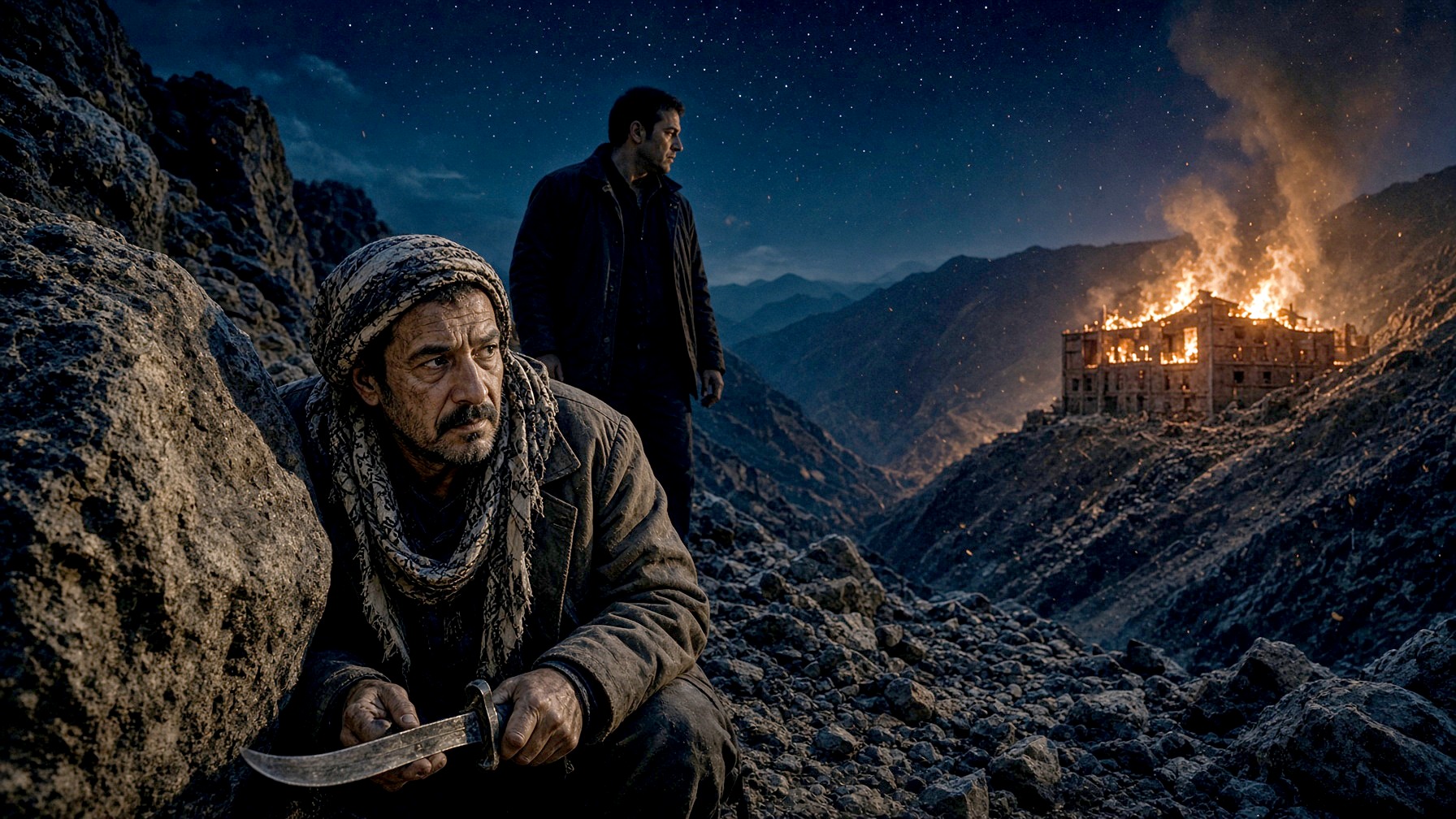
In a deserted gorge in neutral territory between three countries, scouts discover a camouflaged brick factory building with machine gun nests, where workers of Mongolian descent refine opium raw material with alcohol and package the finished heroin into metal boxes. Dane decides to burn down the fortified structure. A nighttime raid is nearly thwarted by a guard dog, which Akhmed manages to feed with chunks of lamb and flatbread. The Dushaks seize the roof, overpowering the guards, and the terrified technicians surrender without resistance. Inside, they discover chests of raw opium from Khorasan, Baluchistan, and Turkey. The factory is destroyed by an alcohol fire.
The detachment pursues the Altai caravan.
In a gorge at night, the Dushaki are ambushed. Crossfire lashes out from above, and four fighters are killed instantly. Dane crawls under fire toward an abandoned machine gun, using the body of a dead enemy as cover. Strapping their heavy weapons with a string of silk sashes, the riflemen unleash a barrage of fire and break through the encirclement. Two more nomads are killed, and the wounded Khitai is temporarily out of action. The surviving participants in the battle reach Imam Baba, where they discover that the mounted group carrying the drug shipment has already departed to the southwest.
Chase through the Dasht-i-Kavir desert
The station commander in the town of Turbat-i-Sheikh commandeers a heavy diesel truck from a Swedish construction company for the chase. The stocky driver, Hansen, takes the wheel. In Sultanabad, it turns out that the Altai sold the saddlebags to five Arab fighters in a special desert all-terrain vehicle. The Bedouins transport the goods through the salt marshes to Tabbas.
The grueling race begins.
In a rocky gorge, the Arabs detonate a dynamite charge. A rockfall blocks the road, but Hansen shouts, "Watch your fingers!" and slams the right side of the vehicle against the cliff at high speed. With a screeching sound, the truck blindly ploughs through a cloud of rock dust over the cliff. On the plain, Dane fends off the all-terrain vehicle’s attacks with well-aimed rifle shots from the roof of the cab.
In the midst of a raging snowstorm, Ahmed crawls out into the sandy darkness on a leash, feels for the cotton rope of a sneaking saboteur, cuts it with a hunting knife, and allows Dane to eliminate the enemy machine gunner with a precise rifle shot by ear. With dawn, the wind dies down. The all-terrain vehicle overtakes a damaged truck on a rocky plateau and disappears in the direction of Yazd. The exhausted pursuers reach Shiraz, where their wrecked vehicle finally comes to a halt near the Omar Mosque.
Searches in the floodplains of southern Iraq
Khitai appears at the public baths in Shiraz. He arrived by plane from Mashhad with new information gleaned from a captive old man. The trail leads to Abadan, to an influential American with red hair known by the alias Mr. Smith. The guide advises contacting the Madan tribe, which inhabits the southern Iraqi marshes.
The group arrives in Basra.
On a hired Sabaean boat, the travelers venture deep into the endless channels of the Shatt al-Arab. They are surrounded by six-meter-high reed beds, fetid fumes, and floating islands of compressed reeds. In a painful stupor, Khitai complains to the translator: "My friend, this stone-faced American wants to destroy us!"
The travelers navigate through a labyrinth of reed beds in a tarred boat, spend the night in huts on shifting floating carpets among the buffalo, and find the one-eyed Sheikh Dakhil, who has agreed to reveal a secret smuggling staging point for the sake of blood feud. The chieftain displays an intercepted bag of white powder. The clan elders fear the arrival of army punitive forces in the floodplains. Dakhil points out the exact meeting place of the dealers on an abandoned Abadan pier. Two local trackers set out to find a buyer.
Interchange at the port of Abadan
In the morning, the detachment lands on the Iranian bank of the river. The trackers identify the contact, Edward Flaherty, deputy manager of the local branch of an American oil company. Sergeants Fahad and Mifleh join in the capture. During the assault on the country cottage, a firefight with hand grenades erupts. Flaherty attempts to escape in a covered van, leaving bags of powder and wads of foreign currency in the rooms.
The chase ends at the docks.
A police car rams a van skidding around a curve. Flaherty’s body is found in the cab, shot in the back of the head by his own accomplices to cover up their connections. At that moment, Sergeant Fahad draws a machine gun, kills his partner, Mifleh, along with a tracker from the floodplains, and, under threat of death, leads the unarmed detectives to an oil tanker moored against the wall.
On board the ship, the captives are met by the syndicate’s leader, Mr. Smith. The criminal cynically laments the loss of their cover and orders the pursuers locked in an empty cargo hold. The sailors start the pumps, and a thick stream of crude oil gushes out of the overhead hatch. Smith orders the crew to "begin immediately, immediately," hoping to attract the attention of the city guards with the suspicious haste on deck.
A surprise attack by an army platoon with armored vehicles saves the captives from death in the reservoir. Driver Hansen raised the alarm in time, and an Arab guide rallied the workers to destroy the syndicate’s port office. Fahad is fished out of the river while attempting to escape, and Smith is sent to prison. The investigation establishes that the underground organization had been transporting tons of pure heroin for years inside hermetically sealed tankers.
Having received the promised monetary reward, Ahmed returns to Isfahan, buys a spacious house with a blooming garden and begins family life.
You cannot comment Why?