Robert Sheckley’s "Man Overboard" Summary
 Automatic translate
The novel was published in 1961. For a science fiction writer, this book is a rare example of a psychological drama about a deadly battle between two sailors on the deck of a two-masted ketch in the open ocean. The entire action centers on the confrontation between a crazed sailor and an unyielding skipper.
St. Thomas Harbor
Dennison wanders the backstreets of Charlotte Amalie’s harbor. The thirty-four-year-old wanderer’s past includes an unfinished bachelor’s degree, front-line service in infantry units on the thirty-eighth parallel, and countless odd jobs at sawmills and on cargo barges. One morning, on a grassy knoll, he shares breadfruit with Australians Tom and Alex. The young giants are en route to Panama. In a hardware store, the bald merchant Heikkla lends a homeless friend a tattered dollar bill.
The owner of an old sloop, Tony Andrews, offers a sailor a job building a dam in distant Nicaragua. New York beckons more strongly. At the bar, Captain Finnerty recounts to the regulars stories of Skipper James’s exploits in the Indonesian jungle: "Nothing can stop Good from triumphing over Evil." The Swedish sailor condemns James’s brutal reprisal against the rebellious workers.
In the morning, James hires Dennison for the ketch Canopus.
Crossing the thirtieth parallel
The Canopus cuts through the ocean swell under four sails. A sailor braces his bare feet against the wooden bulwarks and revels in the oak wheel of the helm. Watches change every four hours. The captain’s pencil plots a course past Bermuda on the chart. Ahead stretch the windless latitudes of the sea.
In the captain’s nightstand drawer, a sailor accidentally finds a bulky leather wallet containing a thick wad of fifty-dollar bills, totaling over two and a half thousand dollars in cash. The thirst for money clouds his judgment: "The biggest difference between rich and poor was whether you owned a yacht." Memory helpfully slips in memories of his arrogant sister Olivia in a respectable mansion.
The ocean seems like the perfect refuge for a criminal. A sudden, fierce squall tears the sails and nearly throws the skipper into the raging waves. Fear of poverty drives the sailor to murder.
Man overboard
The wind finally dies down. The hot tropical sun heats the copper fittings of the deck equipment to the breaking point. Dennison lures James to the very transom with a shout about a twenty-foot shark approaching under the rudder. A furious shove from behind sends the skipper overboard.
Dennison shouts triumphantly to the swimmer, "Choose what you like best — and full speed ahead!" The skipper quickly surfaces. A three-meter boat hook with a cobbler’s knife tied to the tip blocks the path to the lifelines. The blows tear the skin off his shoulder.
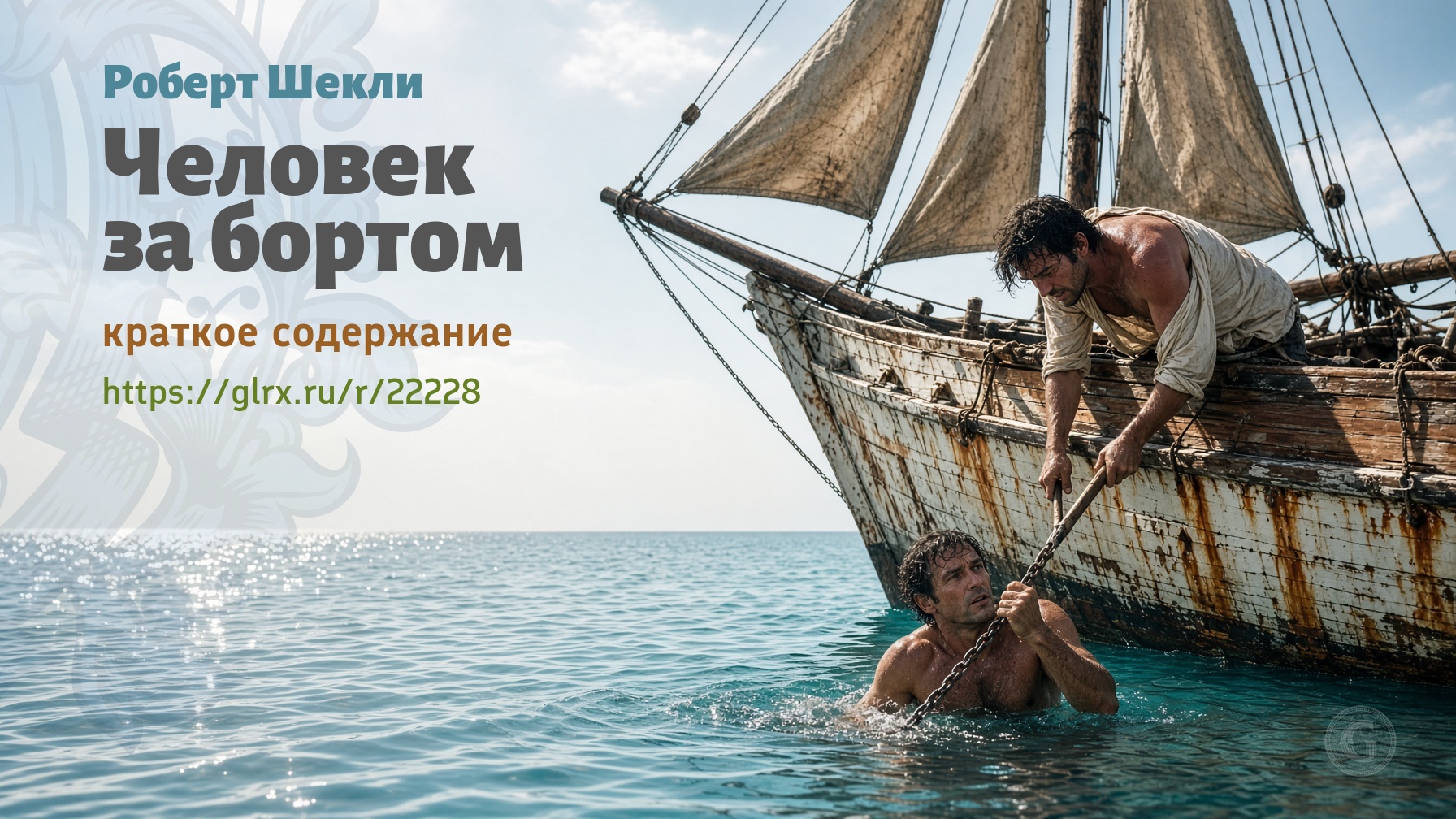
The captain dives under the stem and securely fastens himself in a narrow triangular frame between the water backstays and the bowsprit balance beam.
The steep wooden lines of the ketch’s bow reliably shield the stubborn swimmer from any attacks from above. The sailor, helpless, throws his unloaded rifle into the sea’s depths. Time stands still.
Ghosts and hallucinations
Severe sunburn covers the sailor’s shoulders in a continuous crust of watery blisters. A throbbing thirst mercilessly dries his parched throat on the motionless deck of the wooden ketch, scorched by the midday heat. The engine fails to start. In a feverish delirium, the sailor argues with the skipper: "People aren’t like blocks of dead granite, James."
In a feverish delirium, the frozen Korean camp of the Fox Company near Kaesong comes to life. The brute Herrera draws a knife. Then the memory transports to a Shanghai brothel in 1947, to the young Manchu woman, Janey. The wanderer vowed to return for his beloved.
A fevered mind gives birth to a string of nightmarish visions. The sailor imagines gasoline being pumped out through the ship’s hand pump and the skipper’s horrific death in a blazing sea, followed by a nighttime ramming of a huge cargo ship and an attack by a school of bloodthirsty ocean sharks. The sound of blows thunders beneath the bow.
James methodically performs aquatic exercises to warm up his stiff body before the night attack.
Night skirmish on deck
The moon’s disk sinks into the ocean at half past two in the morning. Pitch darkness descends. The skipper’s wet figure slowly slumps over the bowsprit onto the foredeck. The sailor backs away.
The cornered fugitive delivers a desperate monologue about the true origins of betrayal and the captain’s secret passion for deadly conflict. The skipper coolly closes the distance. A sharp blade rips open his stomach: "James put all his considerable strength into the blow."
The sailor falls and strikes out. The blade severs the tendons in the captain’s arm, cutting right to the bone. The wounded skipper frantically ties a piece of tarred cord above the deep, bleeding cut on his injured right shoulder.
Dennison dies on the blood-stained deck under the cold stars of the Sargasso Sea. It’s impossible for the wounded skipper to steer a heavy sailing ship with one crippled arm in the middle of the endless, windless ocean.
- Роберт Смитсон: американский художник
- Алтарь Мероде — Роберт Кампен
- “Триптих Зайлерна” — Роберт Кампен
- Роберт Капа, военный фотограф
- Человек-лев из Холенштайн Штадель
- Роберт Мэпплеторп: Классик провокационной фотографии
- Роберт Генри: американский художник-реалист
- Роберт Индиана: американский художник
- Роберт Мазервелл: художник-абстракционист
You cannot comment Why?