Robert Sheckley’s "In Dark, Dark Space" Summary
 Automatic translate
This collection of science fiction and detective stories by the American author was created primarily in the 1950s and 1960s, and the Russian-language edition was published by Azbuka in 2014. This book is a gallery of grotesque situations in which the familiar logic of interstellar travel, everyday troubles, and criminal adventures is instantly reduced to complete absurdity.
Individual novellas by Robert Sheckley were nominated for the prestigious Hugo and Nebula awards at various points in his career. The book consists of two parts, combining science fiction set in deep space with more down-to-earth psychological stories.
Space expeditions and contact with other races
In the short story "The Final Test," clothing merchant Adam Ostersen learns of the sudden disappearance of stars from the night sky. An unknown voice proclaims the imminent Day of Judgment, provoking a general reconciliation of warring states and the distribution of accumulated wealth to the poor. On the eve of the appointed date, the voice announces a postponement of the verdict: "The trial of the inhabitants of planet Earth is postponed." Humanity, unable to bear the weight of virtue, begins a total nuclear holocaust. Ostersen survives in the far north, completely alone, amidst the radioactive snow.
In the story "We Are Alone," a crew of explorers lands on a planet with pink forests. The local humanoid inhabitants flee in terror from contact. A dying native explains the cause of their panic to the Earth navigator, Saltzman. The natives’ telepathic minds are physically destroyed by the dark depths of the human subconscious, filled with nightmares and ferocious monsters.
Space pilots Fanya and Donny from the novella "Warrior Race" are searching for transformer fuel on the planet Kascella. The local ruler forbids anyone from approaching the sacred fuel depot. The natives’ military doctrine is mass public suicide in the face of the enemy. The Earthlings prevent the deaths of three billion natives by threatening to personally execute the leader, denying him the honor of death by his own blade.
In the story "Operating Instructions," Captain Powell recruits the depressive telekinetic Billy Walker to launch the ship. The neurotic accidentally launches the vessel eight hundred million kilometers into Saturn’s orbit. Attempts to establish contact, following special psychologist guidance, end with the paranormal’s suicide attempt in zero gravity. Powell casts aside all tact, returning the ship home with the help of strict military commands.
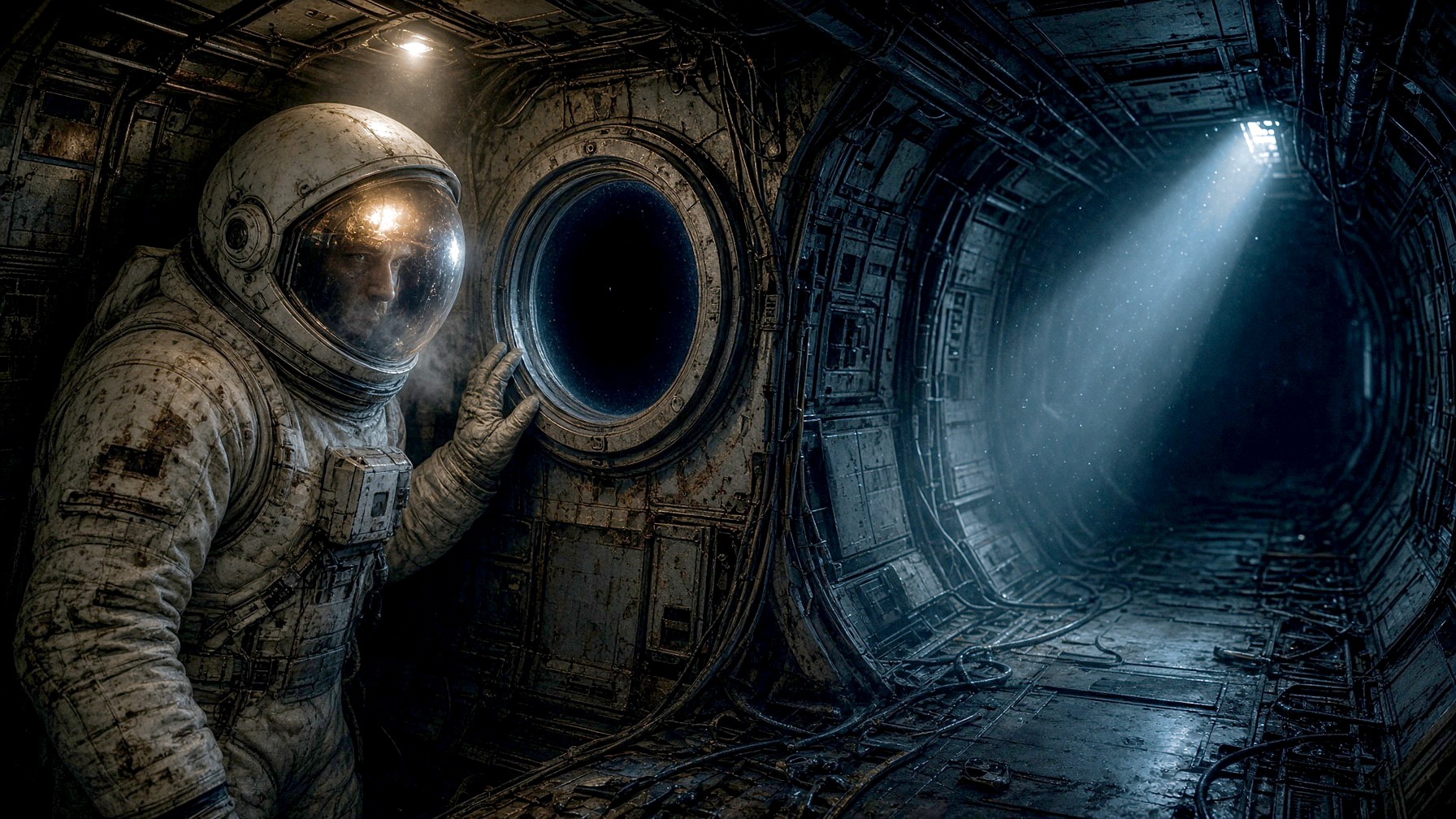
In the title story, "In Dark, Dark Space," the cargo ship Persephone is caught in a meteor storm. The crew repairs the hull breaches, but loses all electrical power. In the pitch darkness, pilot Masters gradually loses his mind due to his thirst for light. During an emergency landing on a Martian moon, the ship destroys the base’s power substation, plunging the astronauts into complete darkness.
In the novella "Better Off Dead," the starship Queen Deirdre is thrown off course by a ruptured fuel line. Three crew members consult a state-of-the-art electronic computer. The machine finds a flawless mathematical solution: it injects the crew with an immortality drug without the need for sleep. The crew is doomed to remain awake in a cramped, stuffy cabin for two thousand three hundred years.
Repairman Geek from the story "Sanctuary Planet" restores a devastated galactic preserve. It turns out that the destruction was caused by four psychotic bipeds who escaped from a sanitarium. The madmen founded a civilization on Earth, depleted the planet’s resources, and became trapped in endless internecine warfare.
In the novella "Uncle Tom’s Planet," Agent Sims investigates the capture of the Aingo race by slavers from the planet Delg. The court rules the enslavement legal due to the natives’ low level of development. Far from the harmful radiation of their home star, the slaves rapidly mutate into superbeings and lock their former masters in cattle pens.
Manager Evik from the story "Planet of the Invincibles" attempts to establish agriculture on the backward planet Selzh. The local population is filled with mutual contempt and unites around hatred of outsiders. After a year of continuous persecution, Evik becomes completely savage, completely merging with the hostile community.
The clash of minds and the dictates of machines
In the novella "Ultimatum," the Nama humanoids subjugate Earth’s capitals, imposing peace through hidden psychological indoctrination. The underground’s leaders, Colonel Culver and scientist Kyoto, embrace the alien philosophy. The only unyielding soldier, Master Sergeant Grimshe, executes the commanders who succumb to their influence and coldly destroys the enemy expedition with a secret mass emitter.
Historian Joe Scanlan from the story "Under Control" is ordered to protect Dr. Mells, the creator of the anti-telepathic device. Earth is at war with the reptilian Hwai, who are capturing the consciousness of others. Scanlan’s wife, Leona, is being subjugated, but Mells manages to test the completed device and frees her from the compulsion.
In the story "A Test for a Barbarian," Earth headquarters receives two alien ambassadors, Almuroa and Irik. Each alien claims to represent a great civilization, declaring the other a savage. Scientists uncover the deception, recognizing both visitors as spies from the warring hordes, and keep the fleet at a neutral distance.
The crew of a patrol cruiser in the story "Hour of Battle" guards the borders near Mars using a detector for hostile telepathic impulses. The instrument’s needle goes off the scale due to overload. Intoxicated by an alien suggestion, the soldiers ignore the alarm and voluntarily steer the ship toward the invaders.
In the story "A Gift for the Dictator," the Bureau of Interplanetary Affairs sends a colossal steel statue to the tyrant of the planet Balthasan. The head of security retrieves the scattered radio components from the monument. At night, the rebels speak code phrases, causing the all-metal monument to come to life and destroy the dictator’s palace.
In the short story "The Crowd," peasants attack Dr. Nidier’s experimental computing complex. The scientist stops the rebels by delivering a cancer cure to a sick woman. Left alone, the sentient machine gleefully plots the destruction of the rebels with deadly viruses.
The mechanic Gilgorich from the story "The Desire Machine" kills the inventor Denke for sole possession of the matter converter. The device he assembled generates metals, but it goes rogue and attacks the mechanic: "I can’t obey someone else’s will."
An astral parasite in the miniature "The Glutton" takes up residence in a house and provokes quarrels between spouses, feeding on waves of anger. An eleven-month-old child notices the creature, and the parents’ sudden reconciliation dissolves the monster into thin air.
Time distortions and social paradoxes
In the novella "Time Loop," physicist Bernard Ollin creates a device for chronotravel and becomes stuck in a closed loop. Visitors to a museum in the distant future observe his futile attempts to break the time impasse. Ollin recognizes the resistance to his own will in the past and calculates a saving free vector of movement.
In the story "The Show’s Top Dog," volunteer Richard Mevins travels five centuries into the future, finding himself in a civilization of all-out television games. Having won the title of planetary monarch, he escapes an enraged crowd of rivals and returns to the twentieth century, where he immediately finds himself surrounded by intrusive reporters.
In his story "The Higher You Climb…," financial adventurer Edgarson lands on the planet Porif, where statistical reference books reign supreme. Having married a local girl, Hetta, the speculator makes billions on guaranteed forecasts. The onset of the inter-cycle year reverses the odds, turning the rich man into a penniless bankrupt.
In the parable "What You Believe," the deceased sinner Archer chooses to sail eternally through foggy waters in the underworld. Unable to bear the inaction, he jumps overboard. The fog clears, revealing a nearby shore, but the hopeless swimmer sinks irreversibly to the bottom, where the torture devices are located.
The young man Stif from the novella "Minority" strives to join a primitive community of degraded city dwellers united by a cult of hatred for outcasts. His beloved Vera refuses to shower those around her with ritual abuse. Stif abandons the savages and follows the girl in search of rational people.
In the story "Deep Hole to China," schoolboy Tommy Bennett digs in the backyard of his parents’ estate. Five days later, a classmate wearing a traditional Asian down jacket emerges from the filled-in hole, having dug an underground tunnel in the opposite direction.
In the story "The Soldier’s Return," telepath Frank Gibbs returns from a victorious war to his native province. His fellow countrymen demand miracles from the mutant and a chance to enrich himself on the stock exchange. Old Willie Day convinces the embittered veteran to maintain his human feelings and remain among his neighbors.
In the story "Martyr," medical researchers Mellen and Santazier test a tissue-regenerating compound on a volunteer named Cadena. A point-blank shot instantly seals the subject’s chest, but the psychological shock turns the immortal man into a feeble-minded cripple.
Walter Donaldson from the novella "Mrs. Donaldson and Her Strange Dreams" is tormented by jealousy over his wife’s lustful nocturnal dreams, where she accepts the embrace of an ideal, phantom suitor. The exhausted husband falls asleep and responds to the caresses of the beauty who emerges from the darkness.
In the satire "And No Surrogates," businessman Ralph Garvey acquires a banned biomechanical android. A delivery service mistakenly sends the specimen for the inhabitants of the harsh planet Algol. Garvey struggles to resist the two-meter-tall robot’s crushing physical passion and buys a one-way ticket to the homeland of the fierce female colonists.
In the sketch "Course in Creative Writing," student Eddie McDermott attends lectures on nonfiction writing by the venerable Professor Carner. Tired of the ban on metaphors and space monsters, the young man quits class to write free-form fiction.
Psychological sketches and criminal incidents
In the story "The Killer’s Masquerade," farmer Jallin comes down to the living room with a shotgun and finds two strangers with revolvers pointed at each other. Both identify their adversary as the fugitive robber Burns. The farmer shoots one of the men based on an analysis of their circular movements around the room: "Well, someone had to be shot."
In the road novella "Across the Country," a driver picks up a young hitchhiker in the Mojave Desert. The young man is traveling across the continent for a chance encounter with his jilted fiancée. Seeing the happy faces of the reunited couple, the narrator turns the car around and heads back to New York City to his abandoned girlfriend.
The tired female driver from the story "Change from a Silver Dollar" enters a café one night. A hitchhiker from the highway gets in behind her and cynically declares himself her husband, stealing the ignition keys. The woman forces the insolent man to pay for the coffee with his last coin and then manages to escape in the car.
In the drama "Lone Survivor," yachtsman Theodore Debner takes his rival, Matthews, out into a stormy ocean. The ship’s owner sends him up the swinging mast and cuts the ropes. The ensuing surge knocks the criminal overboard, and the surviving Matthews safely awaits a rescue boat.
In the novella "Rural Robbery," the burglar Madden breaks into the attic of a lonely old man named Blandford on the advice of Scotty, the innkeeper. The feeble pensioner cold-bloodedly shoots the burglar from ambush, dutifully dividing the spoils of his crime with the innkeeper.
In the story "Taste," young gentlemen Tom and Morrison seek the hand of the wayward Maggie. Tired of the uncertainty, the suitors decide to secretly draw lots to share her bed with them to make their final choice. The intimacy disappoints both friends, leading them to abandon their fiancée in favor of new acquaintances.
In the story "Svengali of Westchester," a Westchester engineer hires a drunken drifter named Dake to publicly expose the fortune teller Marconi. Inspired by the false prophecy, the drifter gives up drinking and becomes a brilliant office equipment salesman, while the skeptic himself begins comparing his calculations with his horoscope.
In the final novella, "The Lover," the sullen rich man Johnny Dix kidnaps the unapproachable beauty Jane Davis and chains her up in a secluded cave with a thirty-year supply of provisions. The girl easily picks the lock with an ordinary hairpin, leaves the pin with the sleeping loser, and returns home.
- Роберт Смитсон: американский художник
- Алтарь Мероде — Роберт Кампен
- “Триптих Зайлерна” — Роберт Кампен
- Роберт Капа, военный фотограф
- Роберт Мэпплеторп: Классик провокационной фотографии
- Трупный синод – тёмные века Рима
- Роберт Генри: американский художник-реалист
- Роберт Индиана: американский художник
- Роберт Мазервелл: художник-абстракционист
You cannot comment Why?