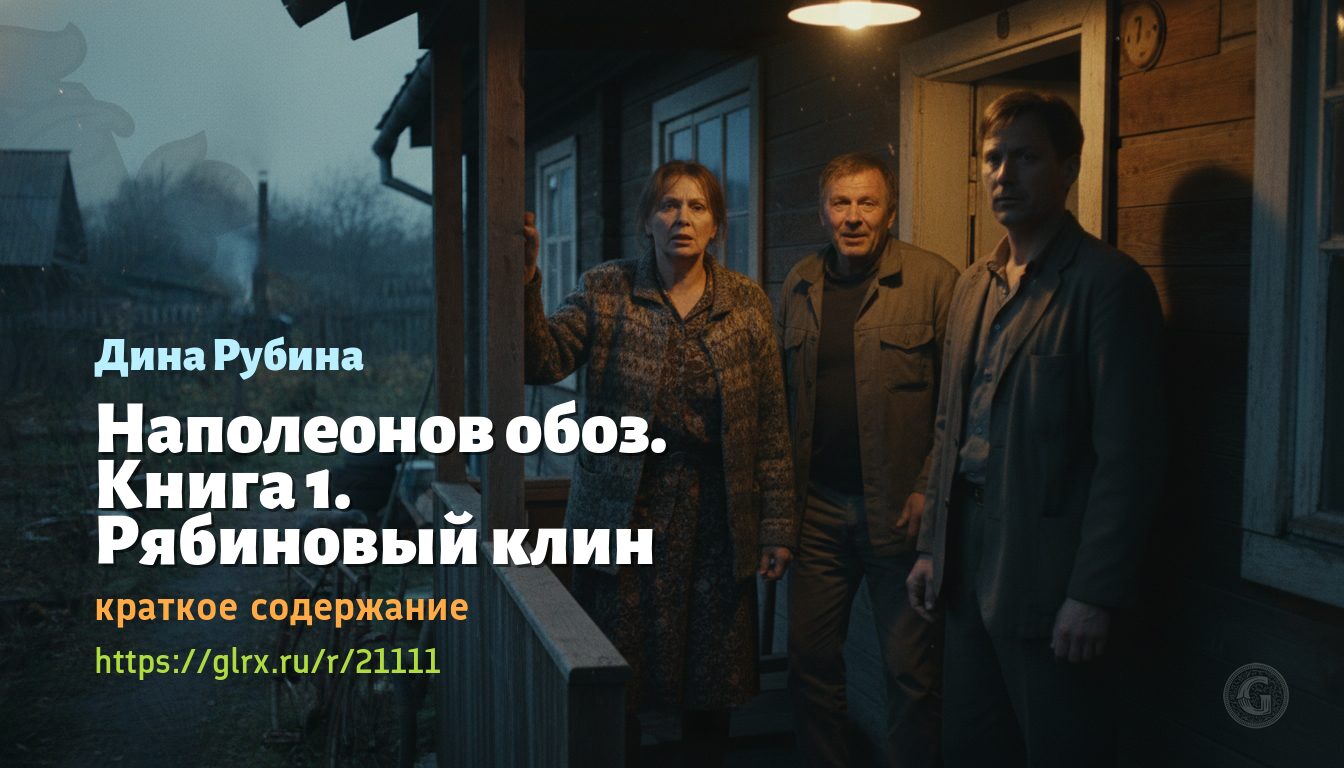
"Napoleon’s Convoy. Book 1. Rowan Wedge" by Dina Rubina, summary
 Automatic translate
This book is the first part of a larger-scale story, published in 2018, that tells the story of the blossoming love between two people separated by harsh circumstances. The action unfolds in the Russian provinces, where the fates of colorful characters, family legends about lost treasures, and the hardships of everyday life intertwine.
Life in Seredinki
Nadezhda Petrovna works as an editor at a major Moscow publishing house, managing manuscripts from draft to printing. She lives in the village of Seredinki near Borovsk. She bought a house quite by chance when she went to buy a Labrador puppy named Lukich from a local resident, Helen Martin. Nadezhda’s quiet village life is constantly interrupted by her neighbor, Izyum Almazovich Davletov. He often drops by, sharing his outlandish invention ideas and telling tales of his wild youth. Izyum is an excellent cook: he makes fish soup, rennet goat cheese, and apple charlotte.
Izyum is a former mayonnaise factory owner who now earns small livings on a construction crew, doing installation and finishing work. In 1989, he was caught with foreign currency at the Belorussky Station. Fleeing prison, he enlisted as a signalman. In the army, Izyum suffered from severe hunger, bartering government-issued diesel fuel with locals for food, and, together with his fellow soldier Sasha, extracted industrial gold from old radio tubes using a complex chemical refining process with sulfuric acid. Their accumulated gold bars were eventually seized by their superior, Warrant Officer Matveyev.
In Seredinki, Izyum clashes with local businessmen: the greedy Gnilukhin and dog breeder Vitka. The latter breeds huskies and uses them to trick children, disguising himself as Father Frost. Izyum demands a share of the profits, as he was the one who came up with the business idea.
Publishing everyday life
At the same time, Nadezhda is engaged in complex work with authors. She travels to Moscow to visit the outstanding but half-mad writer Kaleria Mikhailovna Chesmenova. Kaleria lives in a tiny apartment, makes elaborate hats, and treats her guest to pizza made from old crackers. The writer sings a romance about a poor old woman in a frighteningly high voice, then teases Nadezhda with a pillowcase stuffed with manuscripts of unpublished novels. The editor, on his knees, begs her to submit the texts for publication. Kaleria refuses, declaring that her books will only see the light of day after her death.
Later, Nadezhda is visited by her nephew, Leshik, whom she raised as her own son. The young man dropped out of school, works as a waiter, and plays the saxophone. During a public lecture on music, he throws a wild, avant-garde performance, producing shrill sounds from his saxophone and driving the outraged audience out of the hall. Nadezhda suffers agonizingly from Leshik’s indifference and egotism.
An unexpected meeting
Izyum meets a quiet and reserved employee of Albertik named Sashok. It turns out that Sashok is a qualified doctor. Izyum invites him to stay with him. Wanting to show off his antiques, he takes his new acquaintance to Nadezhda’s house to show him the old tavern orchestrion.
As soon as the guest enters the illuminated veranda, Nadezhda freezes. The man mutters, "Long-legged…" Nadezhda sinks heavily into a chair and responds, "Aristarkh…" A shocked Izyum realizes that these people share a common past, broken many years ago. Sashok disappears that same night, leaving Izyum completely bewildered.
Childhood in Vyazniki
The action shifts back in time to the town of Vyazniki, where Aristarkh Bugrov grew up. Everyone called him Stashek. His father, Semyon Aristarkhovich, was a strict and respected stationmaster. The family lived in a spacious house near the platform. The courtyard was full of colorful inhabitants. Five legless cripples slept under the station and begged for alms. The tramp Rose constantly knitted a stocking and inquired about the Soviet advance on the Germans. His neighbor, Slava, made rockets out of film and later hanged himself in his own dovecote because of his wife’s infidelity.
One day, a traveling circus arrived at the station. While unloading, a huge Indian elephant became enraged and threw a heavy cable spool into a crowd of children. Staszek miraculously survived, managing to hide between the two colliding spools.
In the summer, Stashek and his mother visited relatives in Yuzha. The journey took them on the paddle steamer "Zinaida Robespierre," which regularly ran aground on the Klyazma River, and then on a narrow-gauge train through the marshy swamps. A noisy and hospitable family gathered in Yuzha. There, Grandmother Valya secretly baptized Stashek in the Trinity Church in the village of Kholuy.
Staszek was friends with a Korean named Volodya Pu-Yi. He taught him calligraphy and self-defense techniques. One day, in a rowan grove, Staszek met a tall, red-haired girl, Nadya, who fearlessly teased him with a live snake. They later met at the birthday party of a mutual friend, Zina Petrenko. Staszek played a melody from the opera "Orpheus and Eurydice" for Nadya. The music became their declaration of love. The boy promised to marry her, and Nadya accepted.
Music and history lessons
Staszek was taught music by Vera Samoilovna Badaat, a former prisoner of Stalin’s camps and historian. She organized the school brass band. She gave the boy an ebony English horn, which she kept in memory of her late lover, Igor Danilovich.
Music lessons were accompanied by lengthy historical lectures. Vera Samoilovna recounted Napoleon’s retreat from Moscow in detail, analyzing troop dispositions and strategic maneuvers. She mentioned the Golden Caravan — three hundred and fifty carts carrying the Kremlin’s treasures, lost on the snowy Russian roads. Staszek was reluctant to listen to these lectures, considering them useless for a future surgeon.
Family secret
In the summer, Stashek and his father would travel to Gorokhovets to visit the Matveyev relatives, who had raised the orphaned Semyon Aristarkhovich. Stashek detested these visits because of Uncle Viktor’s constant drinking and the anger of his cousin, Pashka. The Matveyevs stored supplies in a huge earthen icehouse, where river ice lay year-round. At Uncle Nazar’s wake, a drunken Pashka began insulting Stashek’s father, reminding him of the orphan’s bread he had eaten as a child. Unable to bear it, the young man brutally beat his brother until he bled.
Staszek’s father led him away from the wake. On a bench at the station, he told his son the story of their family. Semyon Aristarkhovich’s great-grandfather was a mysterious foreigner who settled in Russia. Staszek’s grandfather, the brilliant gambler Simon, before his death went to Zurich, to the bank Dreyfus and Sons, where he had deposited some wealth. The key to the Swiss safe was passed down through the generations until it came into the possession of Staszek’s father. The key disappeared in a bathhouse, stolen by Uncle Nazar.
The father admitted that the key was merely a symbol of his lost family. Recovering the inheritance from abroad was impossible. After a frank conversation, they boarded the commuter train. Arriving at his home station, the father stepped onto the platform, waved to his son, and collapsed dead on the pavement.
- Mikhail Sholokhov’s "The Impudent One," a summary
- "The Flying Ship" by Andrei Belyanin, summary
- "Tomorrow Was the War…" by Boris Vasiliev, summary
- "The Key of the Yellow Metal" by Max Fry, summary
- Summary of "The Pirate Queen on the Planet of Fairy Tales" by Kir Bulychev
- "Alice and the Dragon (Scary, Green, Prickly)" by Kir Bulychev, summary
You cannot comment Why?