"Kuban Fire" by Nikolai Svechin, summary
 Automatic translate
"Kuban Fire" is a detective novel by Nikolai Svechin from the series about detective Alexei Lykov, set in 1911. The book combines criminal investigation with the historical backdrop of the Kuban oil rush and pre-war military-technical developments.
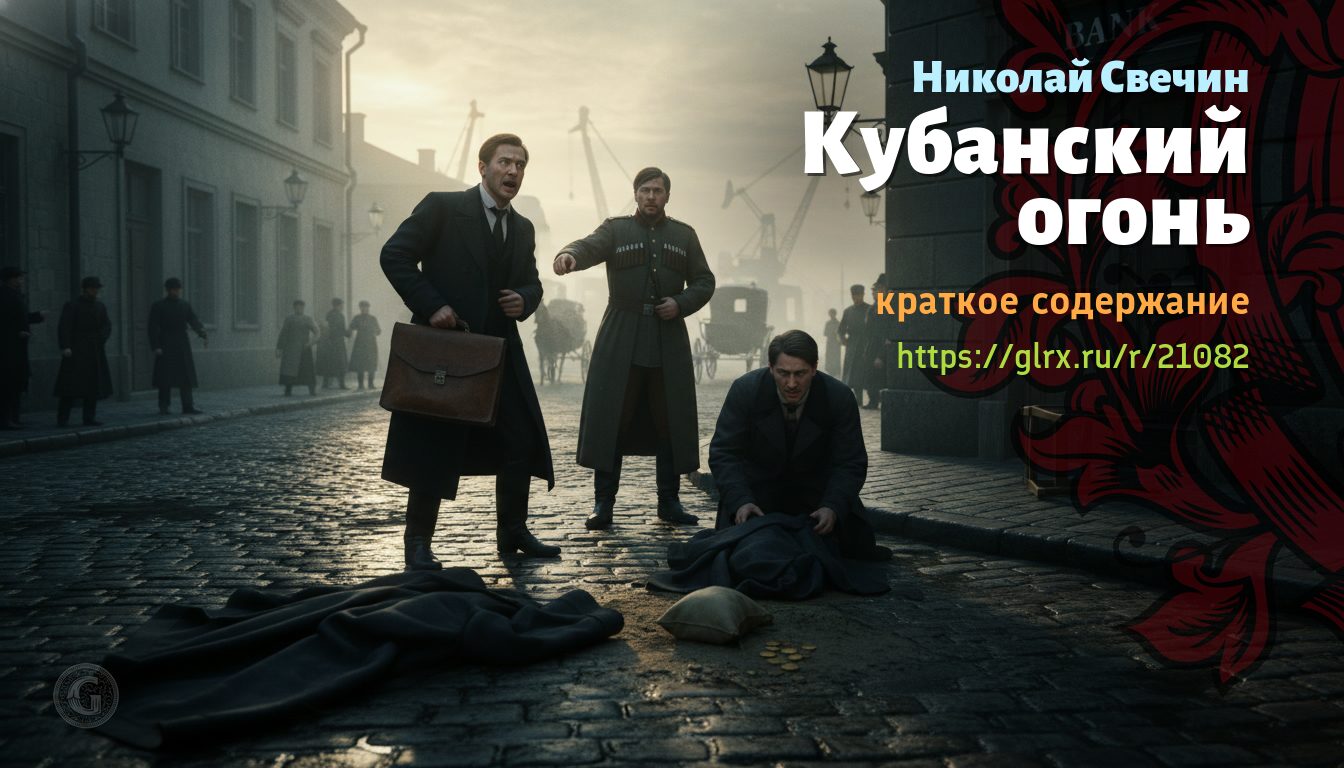
Robbery in Novorossiysk
On January 30, 1911, a group of about fourteen armed men wearing black robes concealing carbines burst into the Novorossiysk branch of the Russian Bank for Foreign Trade. At the entrance, they killed policeman Dimitryuk, mortally wounded the branch manager, and made off with forty-five thousand rubles. The attackers retreated through the city, exchanging fire, leaving behind only their abandoned robes and a bag of change on Mount Markotkh. Everyone fled.
The investigation initially hits a dead end. Thanks to an informant from the Kuban Regional Gendarme Department, the head of the Yekaterinodar detective department, Collegiate Assessor Prisheltsev, tracks down a Circassian named Tsuk Kaitlesov, who’s been carousing with the proceeds from a robbery at the Aquarium Garden. The arrest is carried out skillfully: Prisheltsev, along with guards Korzh and Zhukovsky, surround Kaitlesov right at the restaurant table. Banknotes with numbers written on them are found on him — incontrovertible evidence.
Varivoda and the threat to Ekaterinodar
Kaitlesov, eager to avoid the gallows, gives extensive testimony. He names the gang’s members: five Georgians, five Armenians, three residents of the same village from Bzhegokay, and a certain Russian chieftain nicknamed Varivoda. It was Varivoda who killed the policeman and the bank manager. He had previously been the captain of the dreaded Polyundra gang, which terrorized Kuban in 1910: over four months, the gang carried out twenty-one attacks, killing and wounding twenty-five people, including the entire family of the Armenian merchant Sarkisov, including a five-year-old child. The leader, Polyundra, was eventually caught and hanged along with seven accomplices, but Varivoda escaped.
The prisoner reports something even more alarming: a major act of sabotage — an explosion or fire — is being planned in Yekaterinodar. A month ago, Kaitlesov personally accompanied Varivoda to the oil rigs near Maykop, where he set fire to one of the wells using a heavy object wrapped in felt. Lieutenant General Babych, the head of the Kuban region, urgently reports this to Count Vorontsov-Dashkov, the Viceroy of the Caucasus, who then telegraphs directly to Emperor Nicholas II, requesting that the experienced detective Lykov from the Police Department be sent.
Lykov in Yekaterinodar
State Councilor Alexei Lykov arrives in Yekaterinodar on March 10, 1911. He is met at the train station by Warden Korzh, a wiry, efficient Cossack who becomes Lykov’s main guide through the city and the case. Prisheltsev himself is away, investigating a mass murder in the village of Novoleushkovskaya, where nine people were stabbed to death. Lykov checks into the Central Hotel on Krasnaya Street and makes the rounds of his superiors. Babych describes Prisheltsev as a staunch professional and Police Chief Zakharov as someone in whom "something has broken." Their personal feud has long been damaging the service: Zakharov scribbles denunciations, interferes with interrogations, and demands pointless daily reports. Lykov is convinced that despite Prisheltsev’s fantastic detection rate (all robberies and murders – 100%), the squabble with the police chief is a pure pathology of power.
"Kuban Fire" - a secret weapon
The investigation unfolds along several threads. Detectives trace the name of an entrepreneur named Asminkin, with a criminal past, to a mysterious invention. The key turns out to be the nickname "Kuban Fire" — the name given to his invention by Luka Stepanovich Ryabokon, a junior ensign from Maykop and a teacher at a military vocational school. In 1908, he submitted a request to the Main Artillery Directorate to develop a "flame thrower" — essentially a field bomb launcher that fired incendiary bombs with a unique mixture that burned through iron and ignited in a lofted trajectory.
The Bulgarian connection and the murder of the inventor
Military counterintelligence, represented by Captain Prodan, sent to Yekaterinodar by order of War Minister Sukhomlinov, uncovers the inventor’s tragic fate. Ryabokon, having failed to sell the weapon to the government, accepted Asminkin’s offer: for five thousand rubles, he burned down an oil well in the village of Shirvanskaya. He needed the money to refine the model. He then traveled to Bulgaria with his students — Ostrikov and a student nicknamed "Delicate" — where he burned down a Turkish outpost with his flamethrower, killing twenty people alive. The Bulgarian military paid a deposit of over ten thousand rubles for an order for five devices.
Returning to Russia, the entire company settled in the Romanovsky farmstead. Delikatny devised a plan: eliminate the inventor, take the money, and the completed apparatus. Shkuropat (aka the sadistic killer nicknamed Varivoda) strangled the sleeping Ryabokon, while Ostrikov held him by the legs. The body was dressed in rags and placed on railroad tracks to make identification impossible. The completed flamethrower and a supply of bombs — fragmentation and incendiary — were given to Varivoda and Asminkin.
Disclosure of sabotage
The target of the impending attack turns out to be the Khodyzhenskaya oil pipeline — a strategic artery for the burgeoning Kuban oil industry, which authorities and foreign investors consider the region’s main wealth, along with Baku and Grozny. Lykov, Prisheltsev, and Prodan, combining criminal and counterintelligence resources, gradually narrow the circle of suspects. Delikatny’s interrogation provides the missing links: the origin of the weapons is revealed, Asminkin’s role as the mastermind is confirmed, and it is established that Varivoda-Shkuropat and his accomplice, Ryzhiy, who operates the flamethrower, are still at large and preparing to strike.
Lykov must go directly to Varivoda, eliminate the threat of sabotage, and hand over Ryabokon’s weapons to the military — before the unique "Kuban fire" turns against the peaceful city.
You cannot comment Why?