"Walking in the Night" by Alexander Prokhanov, summary
 Automatic translate
This book is a grim account of the Second Chechen War, written in 2000. The plot, without embellishment, describes the brutal street battles for Grozny, where the spilled soldiers’ blood is closely intertwined with the cynical calculations of the capital’s politicians and the suffering of civilians. In 2001, the work was shortlisted for the National Bestseller literary award.
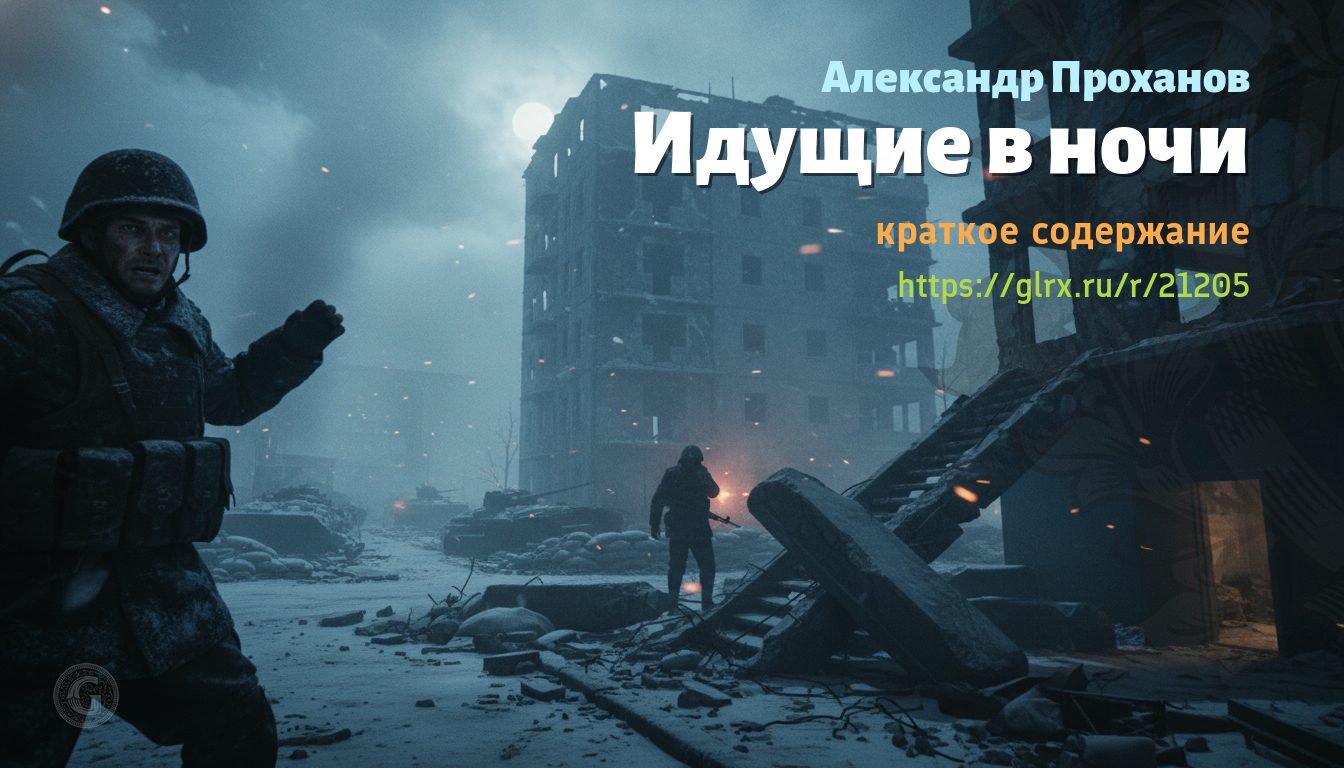
Grozny at night and headquarters plans
On a winter night, Lieutenant Valery Pushkov prepares his motorized rifle platoon for a morning attack. The soldiers are resting in a ruined building, celebrating the birthday of Sergeant Klychkov, nicknamed "Fang." His comrades give him trophy items, and Private Zvonarev sings a spiritual song to the guitar. Fang, a fierce and powerful warrior, is angry at Zvonarev’s peacefulness. Lieutenant Pushkov mentally turns to his father, an intelligence colonel, hoping for his protection.
At the Khankala base, Russian generals are discussing Operation Wolf Creek. Command intends to create a false safe passage for the militants to escape the city by luring them into minefields near the Sunzha River. Colonel Pushkov is supervising the development of the trap. By studying radio intercepts, he is attempting to anticipate the moves of militant leader Shamil Basayev.
Morning assault and ambush
In the morning, Valery Pushkov’s platoon storms the building. The soldiers flee under heavy fire. Valery kills a long-haired Chechen with a knife in hand-to-hand combat. The building is successfully captured. While setting up positions in the basement, Klyk and Zvonarev are ambushed. The militants knock out the lieutenant and drag the two soldiers away through underground tunnels.
Colonel Pushkov surveys the trap route along the Sunzha River. He notices wounded dogs trudging across the frozen crust and the body of a dead woman floating in the water. Later, his father visits Valery on the front lines. The lieutenant is overcome with guilt for the loss of his soldiers. His father comforts him, recalling happy winter days in a garden near Moscow and promising a swift victory.
Positions of militants and interrogation of prisoners
Shamil Basayev inspects his dwindling forces. He visits a school defended by teenagers and attends the funeral of his friend Ilyas. Basayev receives a call from a Moscow tycoon with the call sign Almaz. The oligarch offers safe passage out of Grozny. Basayev suspects deception, but the situation at the front worsens.
Together with the French television reporter Litkin, Basayev visits an underground heroin lab run by a captured Ossetian engineer. Promising the workers freedom, Basayev orders them burned alive with a flamethrower. That night, he visits his Russian lover, Verka, hidden in an underground bunker. Relying on her card readings, Basayev is inclined to leave the city.
Captured Russian soldiers are interrogated by Adam, the head of Chechen intelligence. A frightened Sergeant Klychkov breaks down, agrees to convert to Islam, and records an audio message to Lieutenant Pushkov asking him to stop the artillery. Private Zvonarev refuses to betray his faith and his homeland. Before dying, he sees an angel descending for his soul. Adam slits his throat on camera, while Litkin dispassionately records the execution.
The work of a reporter and the death of a lieutenant
Reporter Litkin wanders through ruined neighborhoods. He photographs wounded dogs devouring a dead body, a murdered mother surrounded by frozen, motionless children, a brutally tortured man with crucified hands, and a painted prostitute on an icy porch. Reveling in death, he encounters the blissful artist Ziya. Ziya is painting a fresco about the reconciliation of slain enemies in heaven. The artist gives Litkin information about a Russian officer willing to sell him a plan for a safe exit.
The next day, Valery Pushkov’s platoon storms the Art Museum. A recording of Klychok’s voice is heard from within the building, pleading not to use tanks, lest the hostages die. The lieutenant calls off fire support and leads the soldiers inside. The building turns out to be booby-trapped. A powerful explosion kills the lieutenant and his men.
Upon learning of his son’s death, Colonel Pushkov descends into the sewer tunnels with a special forces team. He finds Valery’s battered body under the rubble. Pain gives way to cold rage and a thirst for absolute vengeance.
Contact and the beginning of the exodus
Posing as a corrupt officer, Colonel Pushkov meets Adam in the courtyard of the artist Ziya. He hands over fake minefield maps and receives a heavy bag filled with dollars. Basayev decides to personally test the Russian and takes him along with him in a column attempting a breakout. A teenage suicide bomber, Vakha, sacrifices his life to blow up a Russian tank, distracting the federal forces.
That night, Basayev’s column of thousands leaves Grozny. The militants pull sleds loaded with weapons, the treasury, and heroin, and lead prisoners and Basayev’s Russian mistress. Litkin films the exodus. The column moves along the icy Sunzha River, slowly emerging onto the snowy shore.
Defeat of the column
The trap snaps shut. Mines detonate, and a barrage of machine gun fire erupts. The sky lights up with orange flares. Chechen fighters are blown up by mines, thrashing around in the crossfire. The standard-bearer falls, his legs torn off.
Colonel Pushkov stands under fire, jubilant, watching his enemies perish. A mine blast tears off his legs. Bleeding profusely, he dies, seeing a star-shaped ladle before him and remembering peaceful days. Basayev is seriously wounded, losing a foot, but a loyal guard carries him into the steppe. A stunned Klychkov escapes in a broken boat down the black river. Litkin, who was filming the carnage, attempts to swim to safety, but is shot by a special forces ensign on the other bank. Adam dies in a mine blast, begging for death before the ghost of Zvonarev, whom he killed. Remnants of Basayev’s forces reach the village, where surgeons amputate the leader’s leg in the field.
Echo of war
At a luxurious villa near Moscow, the tycoon Parusinsky hosts a reception. Politicians, bankers, and directors cynically divide up spheres of influence. Parusinsky openly discusses the creation of a new Eurasian state and the mechanisms for overseeing the future president. The chosen one appears at the reception, calmly informing the guests of the defeat of the Chechens.
At headquarters in Khankala, the generals celebrate the destruction of the enemy. Watching Litkin’s captured videotape, they notice the body of Colonel Pushkov among the dead. The commander personally flies a helicopter to the Sunzha River. A special forces soldier rappels down to the bloody crater, snags the dead officer with his carbine, and his body floats gently above the snowy battlefield.
In Moscow, Valentina Pushkova and Antonina Zvonareva experience a terrible loss on the same night. Valentina sees a ruined, charred Kremlin, collapsing into the abyss. Antonina dreams of an empty church and her murdered son, dressed in golden priestly vestments, blessing her as she leaves.
You cannot comment Why?