"Napoleon’s Convoy. Book 2. White Horses" by Dina Rubina, summary
 Automatic translate
This book is the second part of a large-scale literary trilogy, published in 2019. The plot focuses on the coming-of-age of Aristarkh Bugrov and Nadezhda Prokhorova. The most important detail about this book lies in its deep historical subtext, linking the fates of its modern-day heroes with the mysteries of the War of 1812. The text is richly saturated with elements of provincial Soviet life, Roma flavor, and the harsh realities of the crumbling empire of the late 20th century.
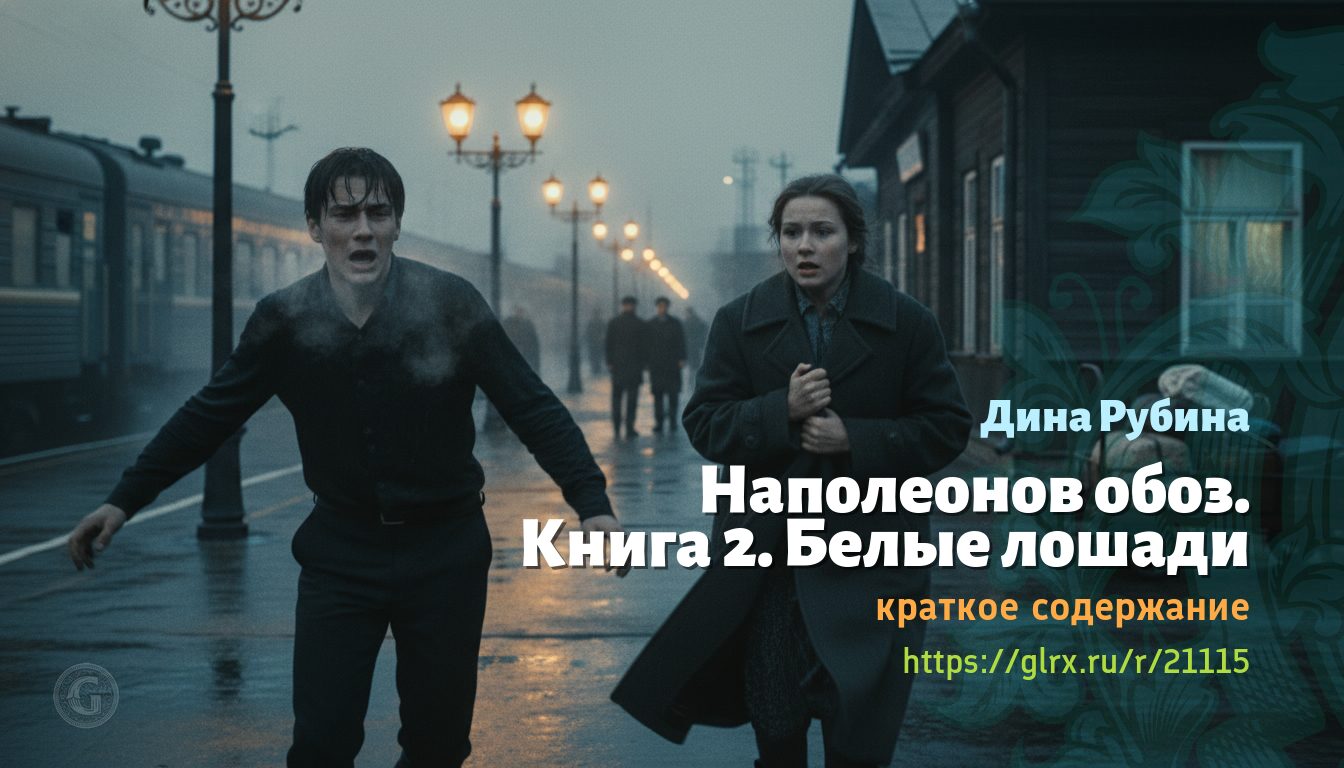
Youth
Vyazniki teenagers Aristarkh and Nadezhda are inseparable. Aristarkh becomes close to the local settled gypsies. He regularly fights with his peer, Tsagar, but the two later become fast friends. Tsagar teaches his friend how to handle horses and takes him out at night. He shows the young man his favorite, a pearl-white mare named Maika. Nadezhda lives in a bustling, large family. Her stepfather, Pyotr Ignatyevich, works as a restorer at the local history museum.
The master has a gift for restoring antique furniture and mechanical musical instruments. The stepfather calls the children "My little angels." The lovers spend summer days on a deserted sandy island in the middle of the Klyazma River. Under the shade of a spreading silver willow, they read books, sunbathe, and enjoy each other’s company. One day, in the river, Aristarkh’s legs cramp. He begins to drown. Nadezhda rushes to his aid and, with incredible effort, pulls him to shore.
Aristarkh’s father suddenly dies of a heart attack right on the train platform. The boy grieves over the loss. Soon, he meets a young gypsy woman named Papusha at the station. She mockingly tells him, "You’re afraid to break through." Aristarkh leaves with a traveling camp for two months. Papusha becomes his passionate mentor, teaching him the intricacies of carnal love. The young man repays her with all the money he has earned.
Returning home, the boy finds the door dark and locked. A terrible revelation emerges: during his absence, right at Nadezhda’s sixteenth birthday party, her mother choked on a plum pit and died. Soon after, the school’s old music teacher, Vera Samoilovna, collapses during a concert. In the hospital, the dying woman tells Aristarkh the incredible story of his ancestor. As an aide-de-camp to Eugène de Beauharnais, he accompanied the retreating French convoy. The ancestor hid part of the plundered treasure in the marble fireplace of a palace near Moscow, and later buried the treasure chest at the bottom of a freezing lake.
Betrayal
After passing his exams, Aristarkh leaves for Leningrad to study. Nadezhda remains behind to care for her father, who is dying of cancer. During his brief visit, the student proposes to Nadezhda in secret. Father Nikolai, a priest, performs the ceremony in an ancient church in the village of Kholui. Aristarkh spends his student days in a dingy dormitory, where he befriends the jovial Lev Kvint. Later, Aristarkh moves into a spacious communal apartment with a strange old man. Moisei Ginzburg survived German captivity and the horrific Soviet camps under the name of Musa Baksheev, a Tatar. A huge, ancient tortoise lives in Ginzburg’s room.
Nadezhda’s sister, Anna, arrives in Leningrad. Aristarkh reluctantly shows her around the halls of the Hermitage. That evening, they drink Armenian cognac in Ginzburg’s room. That night, Anna, exuding her sister’s familiar scent, sneaks into Aristarkh’s bed, half-asleep. They become physically intimate. Realizing the cruel substitution, Aristarkh experiences profound shock. In a panic, he flees the apartment into the cold street.
Misfortune befalls Aristarkh from another direction. His young, thriving mother dies of a massive stroke. Before her death, she manages to tell her son a false surname — Graevskaya. Aunt Natalya confesses that during the years of repression, the family adopted the orphaned child of repressed Jews. The old Jewish woman had transported the girl on trains, saving her from an orphanage. Aristarkh is devastated by years of lies from his loved ones. In an old museum box belonging to a French orchestra, he finds Vera Samoilovna’s hidden dissertation and the original yellowed manuscripts of a French ancestor. The notes confirm the existence of the treasure.
In search of clues, Aristarkh goes to his old neighbors, the Matveyevs. The neighbors’ son, a crime boss named Pavel, attacks the student with an axe. A brutal, bloody fight ensues. Pavel severely beats the boy and throws him into a cold, deep glacier to die. The crippled Aristarkh is miraculously saved by the gypsy Tsagar and his brother Mikha. The gypsies pull their friend out of the pit, knocking down the old lock with a heavy mace.
Breakup
Pyotr Ignatyevich dies. According to his will, he leaves the house to his youngest daughter, Nadezhda. A vicious family quarrel erupts at the wake. An envious Anna tells her sister about the night she spent with Aristarkh. In a rage, Anna beats her sister, plunging her head under a faucet of boiling water. Nadezhda is plunged into utter despair. She waits for a call from her beloved, but he remains cowardly silent on the phone, unable to find the right words. The pregnant Nadezhda decides to commit suicide. Early in the morning, she goes to a high cliff and fearlessly jumps into the icy river.
A young Gypsy named Mikha tracks down a drowning girl. He pulls her out of a river whirlpool on his white mare, Maika. A talented surgeon, Stepan Ashotovich, literally pieces together the patient’s shattered bones. He reassuringly tells her, "In two months, you’ll be galloping." The pelvic injuries are horrific. The girl relearns to walk the hospital corridors on crutches. Anna arrives in the ward and announces that she’s expecting Aristarkh’s child. She will give birth secretly from her fiancé, Roman. Her treacherous sister plans to abandon the baby at the maternity hospital. Nadezhda forces her to sign renunciation papers and promises to take her nephew for herself.
Having sold her house, a strengthened Nadezhda moves to Lyubertsy, near Moscow. She successfully works at the local newspaper under the good-natured Inga Tigranovna. Nadezhda interviews visiting celebrities and advises the robbed musician Sergei Robertovich. At the appointed time, she picks up a baby boy from the hospital. Clutching the tiny bundle, she falls to her knees before the crib and shrilly screams the name of her former lover.
Aristarkh is having a hard time recovering from the beating and the breakup with his wife. He falls into a deathly apathy. He refuses to eat or drink, staring silently at the wall. Old man Ginzburg calls a Chinese psychiatrist, who, with medication, brings the young man back to normal. Aristarkh begins working as a paramedic in the Leningrad ambulance service.
The criminal daily life of the 1990s forever forged his character. Saving poisoned children, gang warfare, and drunken brawls became a drudgery. One day, armed militants forced him to resuscitate a cold corpse. He tried in vain to find Nadezhda, but surgeon Stepan Ashotovich strictly guarded the secret of his absconding patient. In 1995, Aristarkh received a summons to the district military registration and enlistment office. Wanting to avoid conscription into the Chechen war, he hastily applied for a visitor’s visa. The young man dropped everything and flew to Israel at the invitation of his friend Lev. Aristarkh arrived at Ben Gurion Airport on the day of Yitzhak Rabin’s assassination. The air of his new country greeted him with a heavy, humid heat.
You cannot comment Why?