"Essences:
From Complexity to Simplicity and Backwards" by Albert Camus, summary
 Automatic translate
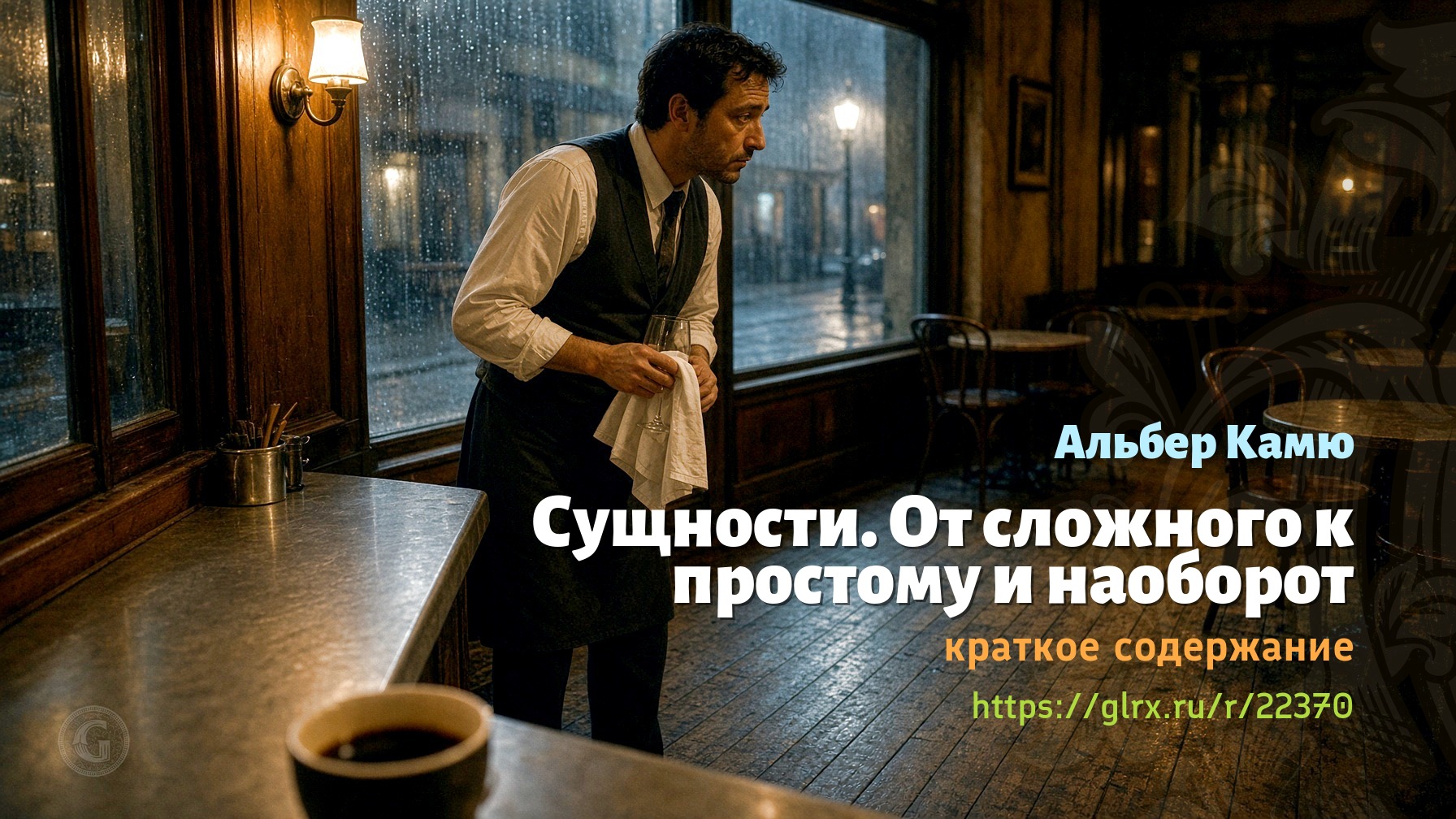
This book is a direct comparison of the fundamental ontological and ethical views of two twentieth-century French thinkers. Sartre’s thought collides with Camusian rebellion. Their intellectual dispute reveals a profound gap between the abstract phenomenological description of the structures of being and the immediate experience of tragic human destiny. Being opens up to consciousness. Sartre wrote the treatise "Being and Nothingness" in 1943 after his release from war captivity, and Camus published the essay "The Myth of Sisyphus" in 1942 and completed the book "Rebel Man" in 1951. The collection was published in 2021.
The volume was published without a serial number in the "Philosophical Duel" series by Rodina Publishing House. The bookshelf has been replenished with adjacent issues. It features "Despotism and Democracy" by Denis Diderot, "The Love of Destiny" by Lucius Annaeus Seneca, and "Liberty is the Health of the Soul" by Jean-Jacques Rousseau.
The origins of phenomenological ontology
Philosophical thought decisively rejects the outdated dualism of a hidden inner nature and the superficial shell of the object under consideration. There is no hidden underbelly of things. Electric current is entirely exhausted by the totality of recorded physical and chemical reactions, like the deflection of a laboratory galvanometer, and the genius of the novelist Marcel Proust is expressed solely by the series of volumes he wrote, without any incomprehensible otherworldly substance beyond them. Being reveals itself through phenomenon. A sudden attack of nausea reveals this fundamental presence without any need for the preliminary metaphysical constructs of the old scholastics. Understanding does not exhaust the phenomenon of a table. The wooden furniture near the window remains a dense clot of impenetrability, requiring an endless description of its qualities to maintain its independent status in the real space of the room.
Consciousness is always directed toward a transcendent object. Any cognitive act presupposes a pre-reflective awareness of oneself as the knower, excluding Spinoza’s doubling of the idea for the sake of a direct and living relationship with surrounding objects. The mind avoids bad idealism. The perceptibility of a thing rests on the ontological proof of the pre-reflective subject, whose impulse confirms the presence of a transphenomenal being, utterly alien to divine creation from the void and unaware of internal gaps within its own density. Being remains identical to itself. The massive monolith of existence excludes internal divisions, surpasses human measures of activity, and rises above illusory attempts to subordinate the present to an external design.
The decompression of being and facticity
The existence of consciousness is defined by a constant distance from itself. Identity is destroyed here. Any person’s faith inevitably turns into a vague, tormenting anxiety due to the presence of an inner witness, as the awareness of one’s own conviction immediately ruptures the monolithic density of certainty and transforms the spiritual impulse into an elusive play of mirrors. Nothing divides the thinking subject. The resulting rift deprives consciousness of peace, forcing the person to continually recreate the project of their own existence amidst the random scenery of the surrounding world. The situation holds the subject with an iron grip. A waiter in a city café is forced to perform the required professional gestures, maintaining his status as an employee through the continuous denial of complete identity with this service role.
Human reality suffers from a lack. The waning crescent of the new moon in the night sky is perceived as incomplete solely by the project of a full, luminous disk, just as a tormenting physiological thirst reveals the desired fullness of a glass of clean, cool water. Value looms as an unattainable ideal. The surrounding objects appear as a vast complex of tasks, forcing one to repair a leaky roof in order to keep dry office ledgers behind the walls of a factory building. Time is fragmented by external connections. The flying arrow of ancient Zeno oscillates between continuous disappearance and the affirmation of its specific location, confirming the precarious nature of universal time, whose empty form is sustained solely by the ecstatic thrust of human expectation into the future.
The world is engulfed by practical activity. The worker wears thick canvas overalls to protect his body from the street dirt, earns a living, and ensures the smooth functioning of the office. The object points to the goal. Knowledge remains the pure presence of existence before the gaze of the observer, where rocks, trees, and wooden furniture remind the lonely person of the unbridgeable distance between things and the emptiness of consciousness. The subject encounters its own reflection. The intense search for the absolute being of things returns the researcher to the boundaries of the human mind. The knowable remains alone. The surrounding natural forms press silently from all sides, forcing the observer to recognize the unbridgeable gap between the real object and the attempts of thought to appropriate its solid essence.
Awakening the Absurd
The mechanical cycle of everyday habits one day cracks before an unexpected question. Getting up gives way to a tram. Four hours of morning office work, a cheap lunch, an evening factory shift, a familiar dinner, and a night’s sleep are repeated for weeks until sudden boredom awakens the dormant consciousness to make a final choice of the path ahead. Stone denies human presence. The surrounding hills lose their cozy, illusory meaning, revealing the primal hostility of dense matter to the shocked observer on the city street. A telephone booth conceals alien words. The meaningless facial expressions of a citizen gesturing behind the glass evoke a sharp attack of disgust, revealing the deafness of the surrounding space before the insistent cry of a mortal being.
Philosophers acknowledge the impotence of reason. Heidegger declares existence to be pure anxiety in the face of an inevitable end, Kierkegaard extols the saving scandal of paradoxical faith, and Lev Shestov bitterly rebels against the dead truths of rationalism in the name of human hope. Absurdity rules the world. The human mind demands impossible clarity, confronted by the deafening silence of the universe and recognizing its own doom to exist within the narrow confines of its allotted earthly life.
The Metaphysics of Destruction by the Marquis de Sade
The Marquis de Sade launched a furious assault on accepted moral norms. The creator is portrayed as the executioner. The innocent Justine is struck by lightning before the eyes of the triumphant criminal Noircey, confirming the Bastille prisoner’s dark conviction of the cruelty of the supreme power that rules the world. The writer responds with crime. Natural instinct is elevated to the sole law of rebellious existence, demanding complete possession of others’ bodies for the sake of satisfying boundless sexual desire. Thirst demands power. Lonely nobles isolate themselves from the world behind impenetrable fortress walls, establishing a brutal daily routine in their castles for the mechanical torture of defenseless victims.
The regulations sanctify universal suspicion. The destruction of another’s life destroys lust itself in the moment of triumph, forcing the executioners to endlessly search for fresh flesh for the short-lived illusion of absolute power. The victims quickly run out. The rulers, left in empty casemates, turn their weapons against each other, as the accepted law of naked force refuses to recognize any limits or compromises. The castle is strewn with corpses. The rebellious logic of total denial leads the rebel to the dead end of Charenton’s solitary madness, transforming an attempt at limitless liberation of instincts into a grim prison accounting of executions and voluntary acceptance of death on the scaffold. Literature provides refuge. The rejected author transfers his frantic fantasies to paper, seeking to extend the destructive challenge beyond the grave.
Sade’s experience warns posterity. The attempt to establish unlimited freedom through the dehumanization of man turns living beings into the subject of a laboratory experiment under the watchful eye of a brutal regime. The walls of the Bastille come to life again. Twentieth-century theorists of cruelty will eagerly adopt the regulations of barbed-wire-fenced prisons to establish camp order.
The Law of Virtue and the Terror of Saint-Just
In his famous treatise on the social contract, Jean-Jacques Rousseau creates a new, strict civil religion of absolute reason, replacing the previous theocratic monarchy with universal, sovereign popular consent. The general will is infallible. Saint-Just applies these theoretical propositions to the trial of King Louis XVI, categorically declaring monarchy an eternal, indelible crime and demanding the immediate execution of the crowned head to fully restore the trampled sovereignty of the oppressed people. The execution marks the desacralization of history. On January 21, 1793, the fall of the king’s head under the guillotine finally shatters the divine right of monarchs.
Formal morality breeds terror. Saint-Just’s ideal republic demands Spartan virtue, declares opposition factions sacrilegious traitors to the fatherland, and transforms the guillotine into the primary logical argument for the merciless purification of society. The Revolution has frozen amidst denunciations. The tribune, rejected by the Convention, greets the death sentence with icy silence, confirming the bitter truth of the inevitable collapse of abstract dogmas before living nature. The scaffold closes off the hopes of the era.
The Dialectic of Recognition and the Cult of History
Georg Hegel sought to overcome the Jacobin terror by integrating reason into the flow of historical development. Truth becomes dynamic. The fundamental human connection is revealed by the philosopher through a mortal battle between two consciousnesses for mutual recognition, giving birth to the figures of master and slave. Slave labor transforms nature. Transcendental values are finally transferred by the German dialectical system to the distant end of time, justifying all violence in the current historical process and transforming the totalitarian state into the highest earthly embodiment of the universal spirit. Ludwig Feuerbach deifies man. Earthly politics is declared the new religion of the masses, sweeping away the last vestiges of faith in retribution after death.
Friedrich Nietzsche diagnoses European nihilism. The philosopher refuses to judge the earthly world in the name of fictitious otherworldly entities, demanding from the strong man a fearless acceptance of the necessity of the cosmic game. Zarathustra’s apostle proclaimed catastrophe. Later political predators distorted the noble call to creativity, turning the will to power into a weapon of state violence and concentration camps.
Karl Marx combined revolutionary rebellion with the bourgeois cult of factory industrial production. Economics dictates historical laws. Drawing on the English political economy of David Ricardo, the thinker predicted an inevitable proletarian revolution resulting from the unbridled concentration of private capital and the hopeless impoverishment of the factory workers on the eve of the imminent final collapse of the bourgeoisie. Actual history refuted this assumption. Joint-stock companies dispersed property among small holders, technological progress gave birth to an influential middle class, and the position of the proletariat significantly improved despite dogma. Scientific messianism became a utopia. Authoritarian socialism sacrificed the living freedom of workers to state accumulation of capital, enslaving humanity under the banner of an unattainable future paradise of earthly justice.
You cannot comment Why?