"At the Head of the End" by Leah Arden, summary
 Automatic translate
"At the Head of the End" by Leah Arden is a 2024 novel and the final book in the main trilogy "Threads of Fate," where the story of Kassia, Mikel, and Kai moves beyond a private drama to the fate of Daoria, Palageda, and the world of men. This book closes the threads begun in the first two parts and leads the plot to its denouement through the mysteries of the Crossing, the ancient mistakes of the gods, and a reexamination of the very structure of worlds.
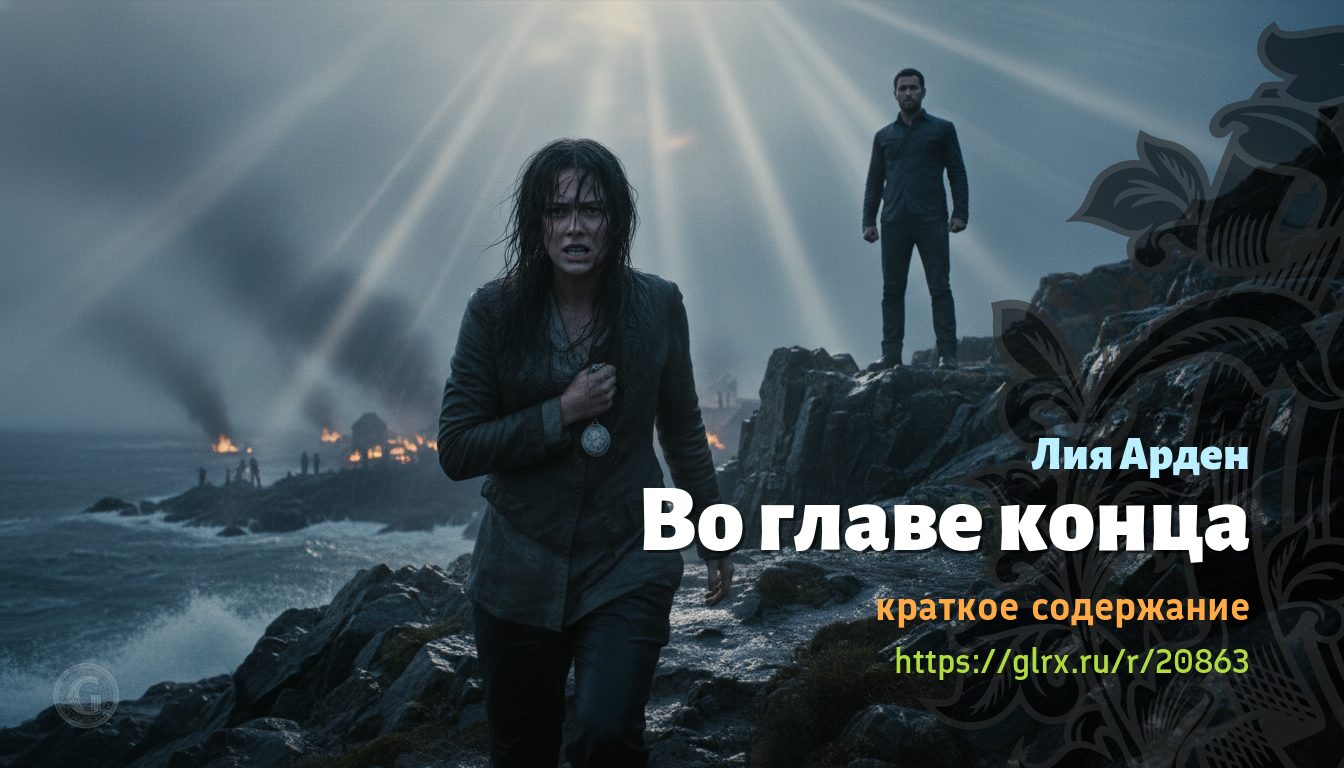
The plot begins immediately after the tragic events of the previous chapter: Kassia is focused on saving Kai and is willing to go where almost no one goes voluntarily, while Mikel is left to deal with the consequences of his own failed plan. Their positions initially seem incompatible, because each is confident in their own truth and sees a different way to protect their loved ones and their people. From this point on, the novel is built on two converging lines — the personal and the political — and both quickly cease to be the private affairs of a few characters.
Cassia’s main path leads through the Crossing and the hidden lands of Phantas, where familiar laws cease to apply, and time, sound, smell, and even the sense of the body become unstable. She travels through a space where consciousness constantly falters, traces vanish, and nightmares and fantasies gain an almost tangible force. She needs this path not for the sake of a heroic feat per se, but for a very specific purpose: to find the answer that will allow her to return Kai and understand what truly happened to her long before these events.
As Cassia moves forward, she increasingly encounters not an external enemy, but memory, guilt, and the misinterpretations of old stories. Through conversations with Hypnos, Vesta, and other participants in these ancient events, the story of Ilira, the altered desire, the birth of Mikel, and the price paid to save the child and Cassia herself is revealed. It emerges that her life was originally tied to the Crossing far more closely than she thought, and the ancient drama between gods and mortals did not end in the past but has extended into the present.
Mikel’s story unfolds in parallel, with less mystical fog, but far more power, violence, and humiliating compromises. He lives amidst advice, orders, palace suspicion, and the interests of others, trying to keep the situation from collapsing completely while the dead multiply, funerals take place, and allies and prisoners alike are equally vulnerable. Lexa’s fate is portrayed particularly bleakly: her plight reminds Mikel that the struggle has long since transcended the boundaries of honest confrontation and has long since affected those who have no control over their own lives.
The novel persistently demonstrates that Mikel and Cassia are connected by deeper connections than mere kinship and a chance union. The revelations about Ilir, Hypnos, Elion, and Camael change our understanding of Cassia’s origins, the meaning of Vesta’s prophecy, and the very reason why her existence could prove fatal to Mikel’s world. Arden pursues this narrative without abrupt breaks: each new confession doesn’t cancel the previous one, but rather clarifies it and makes the characters’ old decisions more tragic.
The middle of the book revolves around an attempt to understand the precise end foretold and whether it can be stopped without sacrificing one of the worlds. The heroes weigh dire options: leave everything as is, allow millions to perish, transfer the disaster to the human world, or sacrifice one people for another. Against this backdrop, Vesta’s vision of a new world becomes especially important, because for the first time, she offers not a choice between two catastrophes, but a break with the very pattern that has driven Daoria and Palageda toward yet another war.
From this point on, the book noticeably shifts tone: instead of a struggle for one side to win, a struggle begins for the right to imagine a different outcome. Hypnos, the Fates, Moros, Cassia, and Mikel are forced to talk not about revenge and old grievances, but about how to preserve life in a place where the old order has exhausted itself. The final tension arises here, as the heroes are forced to abandon convenient explanations, acknowledge old mistakes, and accept that there will be no return to the old normal.
Kai’s storyline in this part is particularly painful. He is brought back alive, but his rescue doesn’t mean simple happiness: after his ordeal, his memory and connection with Kassia are shattered, and he remembers her differently than she had hoped. For Kassia, this is almost a new loss, because the man for whom she went through Phantas and the Crossing is back at her side, but their intimacy must be rebuilt, this time without the support of his former support.
The finale brings all the plotlines together, where the end is understood not as a triumph of destruction, but as the demise of the old world order. The threat to Daoria, Palageda, and the people is met not by a simple military victory, but by a decision that breaks conventional boundaries and offers a chance to avoid mass destruction. This decision comes at a high cost to all involved: no one emerges unchanged, and personal relationships are as damaged as the political order and the power of the gods.
After the denouement, the book doesn’t close immediately, and this move is precisely what it needs. Kassia, having survived everything that happened, disappears for months, concealing herself in the human world, living by her work and refusing to meet with those who continue to search for her. Kai, Moros, and Ivo continue their search, and in one of the final episodes, it is revealed that Ivo had long ago found Kassia by phone, but was waiting for a moment when a conversation would be possible and wouldn’t lead to another escape.
The personal denouement occurs after the storm, in a space far quieter than most of the novel. Kai and Kassia’s meeting is built not on loud confessions, but on an attempt to relearn how to be together, to talk about what had previously been hushed up, and to restore a living feeling to their relationship, not just pain. The very last touch is deliberately domestic: a conversation about the cherry tree, a date, and the promised dessert on the table bring the story to a peace that the characters have long been deprived of.
Ultimately, the book closes the trilogy as a story about the price of salvation, about the gods’ mistakes visited upon children, and about people forced to choose between their loyalty and the right not to repeat the same cruelty. Arden brings all the main plots to their conclusion — the mystery of Cassia’s origin, Mikel’s tragedy, Kai’s fate, the meaning of the prophecy, and the question of what, exactly, lies at the heart of the end. The novel’s ending is emotional, bittersweet, and radiant at once, because it doesn’t undo the losses they’ve suffered, but gives the characters what they’ve been seeking throughout the book — the chance to move on, free from the grip of their former fate.
You cannot comment Why?