Viktor Pelevin’s "KGBT+" Summary
 Automatic translate
"KGBT+" is Viktor Pelevin’s nineteenth novel, published on September 29, 2022, by Eksmo. The action takes place in a dystopian future ("the era of green power," circa 206), already described in detail in his previous book, "Transhumanism Inc." (2021): the world is divided between the Open Brain corporation, which manages the implants of living people, and "TRANSHUMANISM INC.", which stores the brains of the wealthy in underground cerebrocontainers. The novel is structured as an autobiography of the celebrated KGBT+ performer — an artist who streams directly to listeners’ neural implants — and consists of two large parts: "The Straight Man" and "The Late Man."
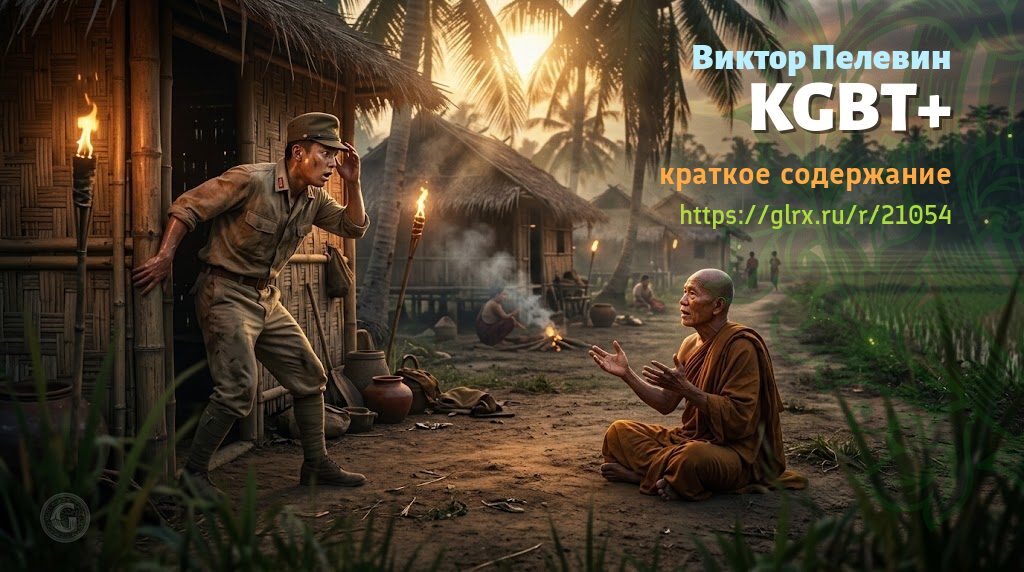
The Straight Man. Bahia House
The first part is written from the perspective of an unnamed Japanese officer, a descendant of a samurai family and a failed Buddhist bonze. The hero received a free-spirited European education at Tokyo Imperial University, spent several years in Zen monasteries, studying koans and meditation, and never found a true answer to the question of suffering in the practice of the Great Vehicle. Having broken with monasticism due to the publicity surrounding his personal story, he joins the ranks of the imperial army and ends up as a staff translator in Burma, where the war is raging against the retreating British troops.
In the village where his unit is stationed, the hero meets a learned monk from Rangoon — a former philosophy professor who founded a monastery called "Bahiya House." Their long evening conversations are structured as an intellectual duel between two Buddhist traditions: Japanese Zen and Burmese Lesser Vehicle. The monk wittily rebuts the officer’s arguments about the "emptiness of all phenomena," demonstrating that understanding emptiness alone does not end suffering — it merely relabels a rabid dog, but doesn’t remove it from the yard.
The Udana sutra "On Bahiya" becomes the center of their conversation: the wanderer Bahiya, dressed in tree bark, caught up with the Buddha right on the city street and demanded an immediate teaching, citing the possibility of death at any moment. The Buddha responded with a few phrases: "In what is seen, there is only what is seen. In what is heard, there is only what is heard. In what is sensed, there is only what is sensed. In what is perceived, there is only what is perceived. If you achieve this, you will no longer be in this… and this is the end of suffering." The monk explains: the personality arises as a layer of internal commentaries on direct perception, and suffering and the personality are "twin sisters," inseparable from one another. If the commentaries cease, so will suffering.
The officer begins practicing this method. Over the course of several weeks, he experiences a series of profound insights: first, he discovers that the ordinary mind exists in "motionless representations" — frozen pictures of the world, as if drawn for the emperor by servants — rather than in the living flow of reality. Then, even more profoundly, he sees that he himself is composed entirely of "signals and flashes coming from the unknown," and that his "sense of self" is an optical effect, not a fact. The monk points to parallels with Plato’s cave and with the Greek skeptic Pyrrho of Elis, who, according to legend, gained wisdom in India with Alexander’s troops.
Toward the end of the Burmese period, the hero tells a monk about a prophetic dream from Guadalcanal and a sense of impending doom. The monk completes the story of Bahiya: immediately after his conversation with the Buddha, he was killed by a "cow and her calf," just as the same cow and her calf had previously killed several other great ascetics. According to the monk, this is the code of the ancient ascetics: "the cow" is the previous existence, the "calf" is the new one, based on it. Bahiya consciously left his body and passed into another birth. This is precisely what the officer is advised to do when the time comes.
The war shifts — and the hero actually dies. Already "in the bank" (a cerebrocontainer), he tracks the fate of his belongings, sold at auction, discovers a young Russian couple making love at the "Samsara" amusement park in Moscow, and realizes the woman became pregnant that very night. He decides to use the "cow and calf" method to be born to this couple and start life anew — hoping in this new birth to realize his long-held dream of creativity.
The Late Man. KGBT+
The second part is the confession of an accomplished driver. Kay (KGBT+), the son of that same couple, Ivan and Nyasha, known from "Transhumanism Inc.", grows up in the Good State (former Russia), ruled by compassionate Bolsheviks led by the Fatherland’s Uncle, General Sudoplatonov. Orphaned early (Nyasha’s mother died, and Ivan also perished), he ends up in a specialized school training Praetorians — special services with broad powers.
Alongside his studies, Kay discovers a talent for vbroki — performances during which, through a neural implant, he transmits to listeners not just poetry set to music, but direct meditative states. This genre is called B2B (brain-to-brain streaming); ordinary performers are called "crapers," but Kay becomes a top-tier vbroki performer. The nickname KGBT+ is made up of the first letters of "Kai and Gerda" plus a plus sign — in the tradition of the "code of fluid meanings," where a nickname abbreviation carries multiple meanings simultaneously.
Kay’s meteoric rise is accompanied by a deep dependence on producer Lucefeodor: they develop a complex relationship, in which Kay eventually discovers that Lucefeodor has been exploiting him for years through his lover, Gerda. An attempt to assassinate the producer with a Praetorian combat drone (a "cumulative fly") ends in failure: Lucefeodor seizes control of the drone, destroys it, and then places Kay under forced neural control — "slave mode." This episode reveals the true structure of power: Lucefeodor is connected to structures far higher than that of an ordinary producer.
Against the backdrop of personal catastrophe, Kay experiences the stages of a dizzying public career — streams like "Catastrophe," "Letitbism," and others are taking over the planet. "Letitbism" (from the English "let it be") is his main artistic idea: to be present in what is happening without judgment or commentary, allowing everything to be exactly as it is. Essentially, it’s the same practice of the Bahiya Sutra, only translated into the format of mass performance.
Kay spends eighty-two years in prison on charges he himself claims are justified: his beatings, albeit unintentional, had serious consequences for the citizens of the Good State. Released on the occasion of his anniversary, he publishes these memoirs — both as a public confession and a practical guide to success in life, addressed to those who wish to follow in his footsteps.
- Аскетизм и христианство
- Виктор Орта: бельгийский архитектор
- Виктор Вазарели: художник оп-арта
- Виктор Слоан, ирландский фотограф изобразительного искусства: биография, фотографии
- Экспозиция картин и гравюр
- Развитие европейской портретной живописи
- Развитие портретной живописи в эпоху Возрождения
- Хранение картин
- Живопись эпохи Ренессанса
You cannot comment Why?