Dmitry Glukhovsky’s "Twilight," a summary
 Automatic translate
This book is a mystical fantasy story about the nature of reality, the illusory nature of existence, and the end of the world. Created in 2007, the text blends historical facts with fantastical assumptions. The story is told from the perspective of a lonely Moscow translator, Dmitry Alekseevich. His life changes radically after receiving an unusual commission. The loneliness and boredom of everyday life give way to a kaleidoscope of incredible events.
In 2014, the novel won the European literary prize Utopiales in France as the best work in the fantasy and mysticism genre.
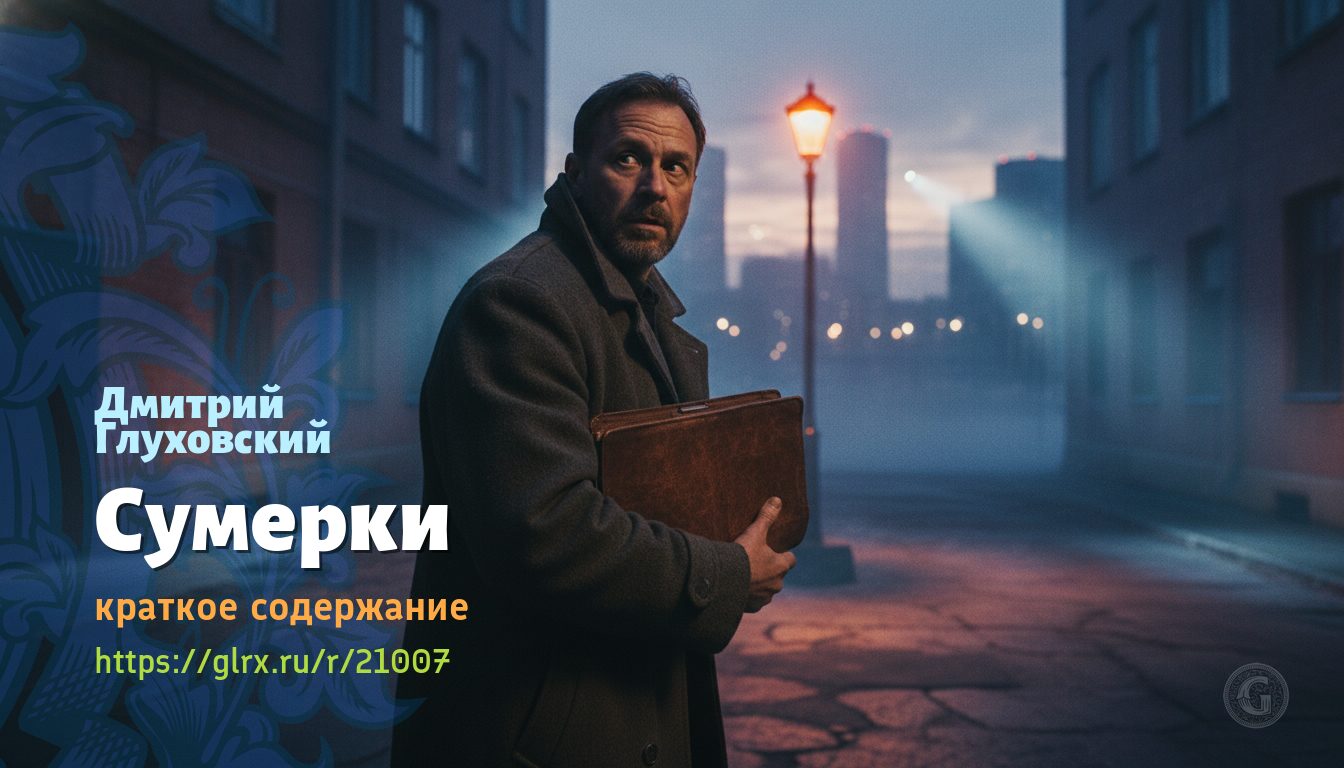
The beginning of the expedition
Dmitry Alekseevich earns his living translating manuals and instructions for household appliances. He takes orders from a small bureau on Arbat Street, housed in a wooden building that once housed a children’s library. Clerk Semyonov hands Dmitry a luxurious leather folder containing a highly paid assignment. Inside are yellowed pages of Old Spanish text, printed in Gothic script. The document begins immediately with the second chapter. The first part has been lost, and the previous translator has vanished without a trace.
The text turns out to be the authentic diary of a Spanish conquistador. The author describes a military expedition in 1562. A detachment under the command of the noble lords Vasco de Aguilar and Jerónimo Núñez de Balboa is heading deep into the Yucatán Peninsula. The Spaniards are accompanied by the monk Brother Joaquin. The mission has been entrusted to them by the abbot of the Franciscan monastery, Diego de Landa. Fifty soldiers are to find lost Indian temples and recover sacred pagan books. Three baptized Mayan Indians — Gaspar Chu, Juan Nachi Cocom, and the half-breed Hernán González — show the conquistadors the way. The soldiers carry carts for the treasure.
The events in the diary quickly take a sinister turn. The Indians are frightened by the purpose of the expedition. The guides fear the vengeance of the old gods. Soon, the expedition faces its first disasters. Ten soldiers, led by Núñez de Balboa, disappear without a trace during an unnatural thunderstorm. The Spaniards find an empty clearing with no signs of a struggle. The guide, Gaspar Chu, is found dead on a stone altar. His chest is cut open, and his heart is torn out. The remaining guides lead the soldiers deep into the jungle. Food is scarce, and the hunters hunt howler monkeys.
Strange omens
Dmitry Alekseevich works at night by the light of a desk lamp. Reading an ancient manuscript has a profound effect on his state. He buys the works of the Soviet historian E. Yagoniel and studies Mayan customs. He discovers the truth about the events of the sixteenth century. Diego de Landa really did stage a massive auto-da-fé in the city of Mani on July 12, 1562. The inquisitor burned thousands of idols and almost all the written records of this great civilization.
Reality around Dmitry begins to distort frighteningly. News reports of monstrous earthquakes in the Middle East and devastating tsunamis in Asia. The unnatural cries of a forest jaguar echo through a Moscow courtyard at night. The translator experiences vivid dreams of ritual sacrifices. He dreams of a white, bearded captive at the top of a pyramid, his beating heart ripped from his chest.
On an old radio, the hero accidentally picks up a broadcast from the Native American station "World of the Maya." The announcer reports on a war between the states of Mani-Tutuk-Xiu and Kochvakh. Later, in a subway car, a strange little boy silently speaks of a sick, dying god.
In the diary, the events become even more terrifying. The Spanish camp is attacked by ferocious Canul warriors. Soldiers die from poisoned arrows. Wounded Spaniards scream in pain at night. The detachment crosses deadly swamps. Two soldiers drown in the quagmire, pulled to the bottom by invisible creatures. The Spaniards die en masse from swamp fever. The Indians protect themselves from the disease with a foul-smelling ointment.
The half-breed Hernán González, overcome by terror at the approaching punishment, hangs himself from a tree. The last guide, Juan Nachi Cocom, confesses that he is leading the party to the abandoned city of Calakmul. Hidden there is the main Native American relic — the "Chronicle of the Future." The manuscript contains the exact date of the end of the world. Diego de Landa desired this book for power over the minds of the natives.
Invasion of reality
Tensions are rapidly escalating in Moscow. A clerk, Semyonov, is murdered at a translation agency. The police seal off the building. Blood splatters the office floor, but the body disappears. That night, a gigantic creature attempts to break down the steel door to Dmitry’s apartment. The monster kills his neighbor, Serafima Antonovna, who came out to hear the noise. In the morning, Major Nabatchikov, a criminal investigator, interrogates Dmitry. The police officer accuses him of founding a cult and confiscates the translated chapters of his diary.
Later, the major dies under mysterious circumstances. That night, Dmitry sees Nabatchikov’s corpse on Gogolevsky Boulevard. The dead body moves like a puppet on invisible silver strings. The corpse returns the briefcase containing the documents to Dmitry. Dmitry becomes drunk on whiskey from the horror of the experience.
Dmitry’s dead dog appears to his master in a dream. The animal leads the translator to a locked gray gate. Waking up, he finds this gate in reality behind the library. It opens onto a long, unmarked street in Itzamna. The road is lined with houses from various eras. Dmitry walks along the deserted road and reaches a huge memorial museum.
The museum’s exhibitions are dedicated to the Soviet actress Valentina Anisimova. The protagonist understands the connection: Anisimova was the wife of Yuri Knorozov, a real-life Soviet scientist who deciphered the Mayan language. The museum halls are filled with models of pyramids, ancient weapons, and wax figures of priests.
Solving the mystery
Dmitry steps into an old elevator marked "Itzamna." The elevator rides upward for several dozen minutes. Beyond the door is an ordinary hospital room. The walls are covered with old photographs of the La-5 aircraft and expeditions to Mexico. Inside is the elderly Yuri Knorozov. The scientist is dying of inoperable brain cancer in a cancer center.
The old man explains a shocking truth to the stunned translator. The entire world around Dmitry, Moscow, and the universe itself, is a massive hallucination of Knorozov’s dying breath. The mind of the dying genius has woven a reality from memories, newspaper articles, and scientific papers. Earthquakes, tsunamis, and hurricanes are physical spasms of pain from the real Knorozov, lying under IV drips. Through the window of the hospital room, Dmitry sees the surgical room containing the scientist’s real body.
The old man’s subconscious created Dmitry for one purpose. The translator must read and interpret the ending of the Spanish diary. The diary serves as a message from the despairing part of the scientist’s soul. Knorozov wants to know the date of his death and seeks salvation in ancient texts.
Dmitry reads the final chapter. The surviving conquistador, Luis Casa del Lagarto, recounts the climax of the expedition. The detachment reached a white-stone road, the sacbe. The road drained the soldiers’ lives. Friar Joaquin betrayed his comrades. The Jesuit killed the soldiers, took the Indian scrolls, and threw Luis into a dry cenote.
Native American priests pulled the conquistador from the depths. The priest revealed the meaning of the prophecy to the Spaniard. The end of the world would come when the supreme god Itzamna died. Cataclysms would shake the earth, then the world would be engulfed in eternal darkness. The Maya disappeared because of their belief in a falsely calculated date for the apocalypse. The Native Americans destroyed their own cities and retreated into the forests.
The prophecy forbids calculating the exact hour of the world’s end. Dmitry conveys this thought to Knorozov. Man is mortal, and the end is inevitable. Waiting for the appointed time turns life into a death cell. Uncertainty brings hope and peace. The old man accepts these words. Knorozov calms down and gives up the struggle. He gives the translator the first chapter of the diary.
Waiting for the finale
Dmitry returns home. The apartment is plunged into darkness. The power is out. The city freezes before the end. The hero reads the first chapter. Luis Casa del Lagarto reports that he replaced the "Chronicle of the Future" with a fake. The Spaniard took the real book to Madrid. Inquisitor Diego de Landa burned the fake in the square.
Dmitry understands the inevitability of his approaching end. He climbs onto the roof of his house. A dark, earthquake-ravaged Moscow stretches out around him. Dmitry sits on the edge of the ledge. He looks east. He awaits the first ray of sun. Dmitry will sit here until the fading consciousness of a dying old man erases his universe forever.
You cannot comment Why?