Rinaldo and the Magus of Ascalon
Giovanni Battista Tiepolo
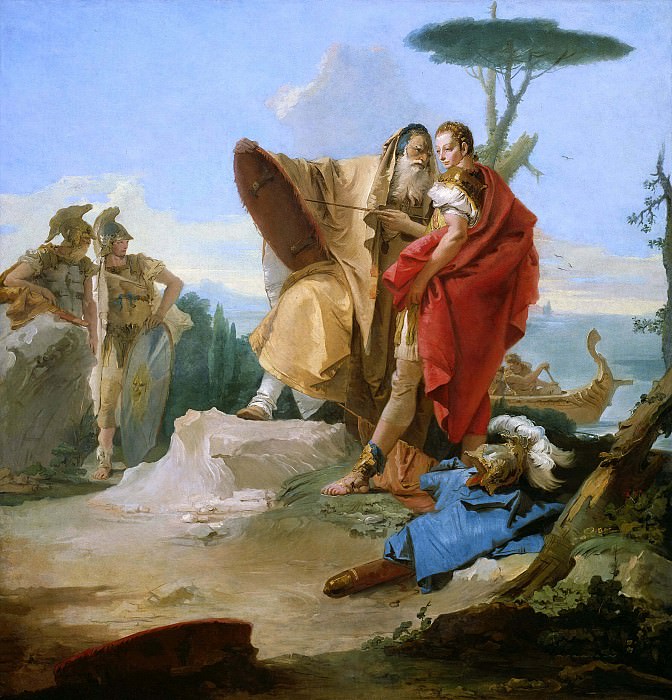

Giovanni Battista Tiepolo – Rinaldo and the Magus of Ascalon
1742-45. 182.9 x 188
Edit attribution
Download full size: 2456×2560 px (0,6 Mb)
Back to album: Giovanni Battista Tiepolo
Location: Art Institute, Chicago.
Album navigation:


![- The Adoration of the Christ Child [Workshop]](http://j5.galerix.ru/O/1234690653/4931.webp)


You cannot comment Why?
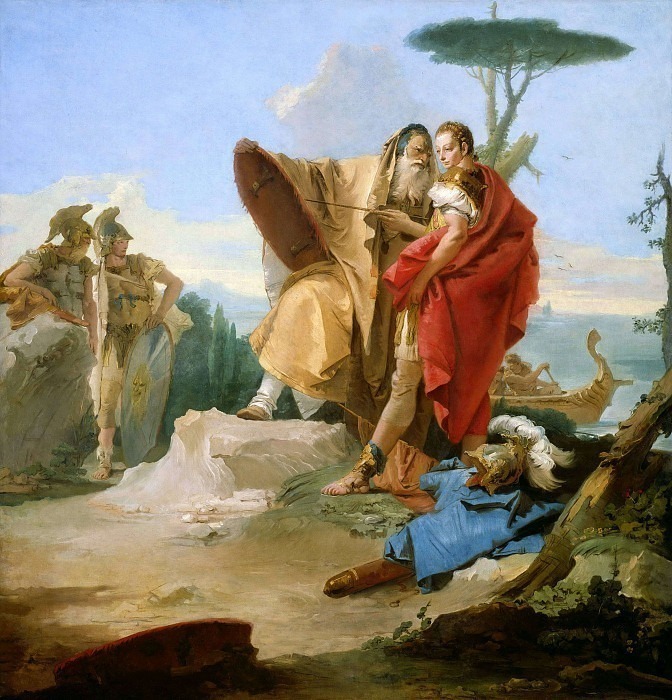
To the left, two armored soldiers observe the interaction from a distance, their posture suggesting both vigilance and restrained curiosity. They are positioned on a lower level, further emphasizing the elevated status of the central figures. A fallen figure lies prostrate at the base of the promontory, his blue garments contrasting sharply with the surrounding earth tones. He appears defeated or incapacitated, adding an element of conflict to the narrative.
The landscape itself is rendered in a manner that prioritizes atmosphere over precise detail. The sky occupies a significant portion of the canvas, its pale blue hue suggesting a sense of vastness and openness. A lone tree dominates the background, its foliage providing a visual anchor amidst the expansive vista. A small boat rests on the waters edge, hinting at potential escape or further journey.
The painting’s subtexts revolve around themes of power, knowledge, and subjugation. The older man likely represents a figure of wisdom or magical authority, using his influence to manipulate or guide the younger warrior. The red armor worn by the young man signifies valor and strength, but also perhaps vulnerability in the face of this superior intellect. The fallen figure embodies defeat, possibly symbolizing the consequences of resisting such power.
The composition’s arrangement creates a dynamic tension between the figures. The diagonal line formed by the older mans gesture draws the viewers eye towards an unseen point, suggesting that the encounter is part of a larger narrative arc. The contrast in age and attire further underscores the disparity in their roles, while the distant soldiers serve as silent witnesses to this pivotal moment. Overall, the work conveys a sense of intrigue and impending action, leaving the viewer to ponder the nature of the relationship between these characters and the ultimate outcome of their interaction.