Painting and Photograph Restoration:
What’s the Difference and What’s the Similarity?
 Automatic translate
An art restorer and a person sorting through a box of old family photos seem to be working on the same task: restoring the image to its original appearance. In reality, they operate according to different rules, and understanding this difference can save them from much frustration.
Three principles on which museum restoration is based
The modern school of restoration emerged in the mid-20th century, largely thanks to the work of Cesare Brandi and his "Theory of Restoration." From this emerged the principles that are considered professional standards today.
Reversibility. Anything the restorer adds to the work must be removable without damaging the original. Varnishes, tints, and restorations are selected so that the next generation of specialists can remove them and rework them in their own way. Restoration is not a final solution, but a hypothesis that can be revised.
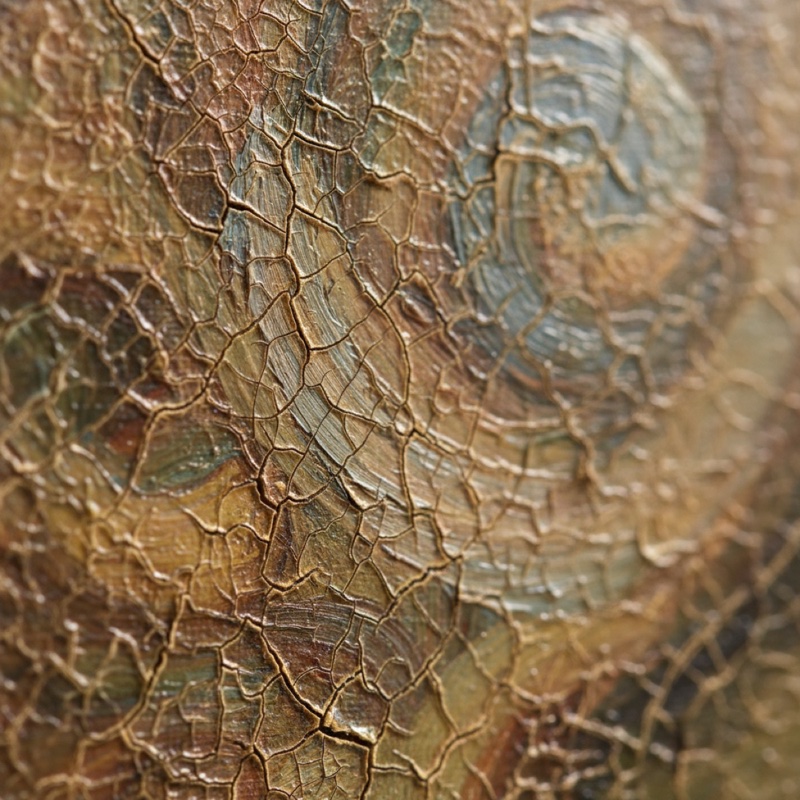
Minimal intervention. The goal isn’t to make it "as good as new," but to stop deterioration and make the work legible. Craquelure — a network of fine cracks on the surface of the paint layer — is not removed: it’s a natural aging process, part of the work’s life. Removing it would erase the painting’s age.
Distinctiveness. The restored losses are not disguised as the original’s work. Special techniques exist, such as tratejo, where the gap is filled with fine vertical strokes that are visible up close and blend together at a distance. A viewer approaching closely should be able to discern the artist’s hand and the restorer’s.
These three principles lead to the following: the restorer does not add to what he doesn’t know. If a fragment is completely lost and there is no documentary evidence — old photographs, original sketches, or copies — the gap remains neutrally shaded.
Why is it different with an old photograph?
A family photo is not a museum piece, and the rules for it are different, although the logic is similar.
The first difference is fundamental: a photograph has a negative, while a painting does not. A painting exists in a single copy, and the loss of the paint layer is irreparable. A photograph, on the other hand, is originally a limited edition. Even if the print is destroyed, the image may be preserved in another print held by relatives. Therefore, before undertaking restoration, it’s worth asking around — sometimes the same frame can be found in better condition.
Second, a paper photograph deteriorates faster than an oil painting. Under normal conditions, a painting can last for centuries. A 20th-century print on gelatin silver paper is far more vulnerable: it fades from light, yellows from the acidity of album paper, and creases with every turn. Color photographs from the 1970s to 1990s suffer the most — the dyes of those years are unstable, and the characteristic red-pink color shift is familiar to anyone who has opened an old album.
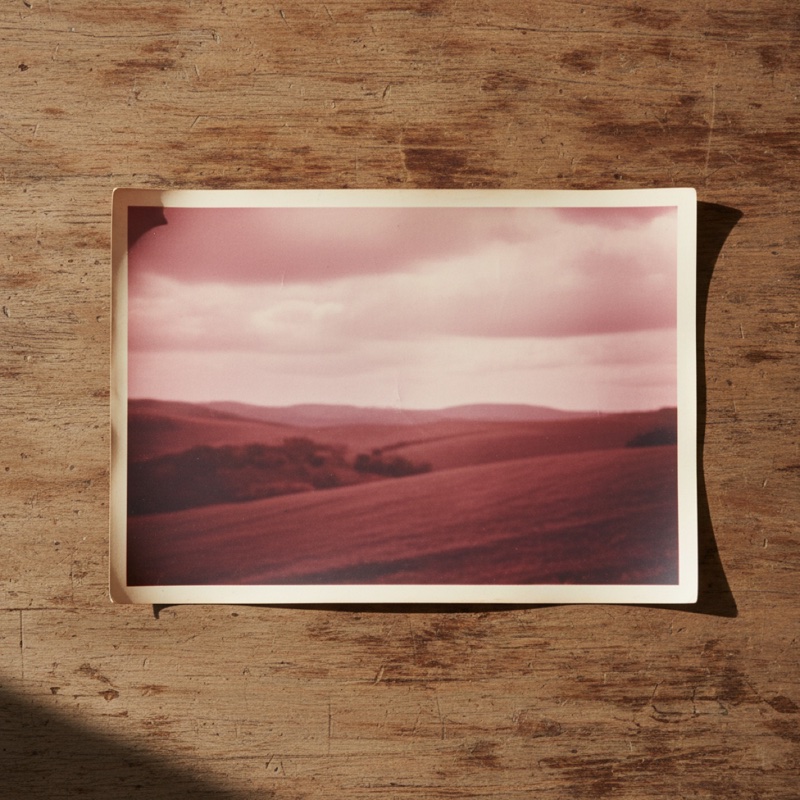
Third, and most important for practice: a digital copy is indestructible. Digitization is something painting doesn’t have in principle. By scanning a photograph, you stop the clock: the paper can deteriorate as much as it wants, but the image is already preserved.
What to do with your home archive
The order of actions is as follows.
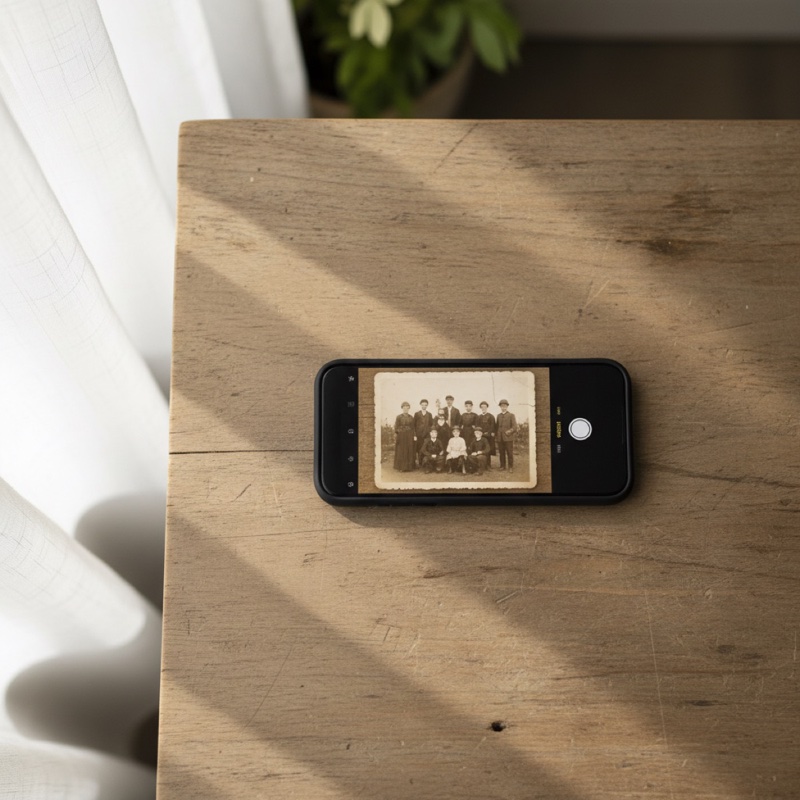
First, digitize, then everything else. This is the only irreversible step in the right direction. A scanner produces the best results — 600 dpi for regular photos, 1200 for small ones. If you don’t have a scanner, a phone will do: diffused light from a window on a cloudy day, camera perfectly parallel to the photo, remove the glass from the frame, fill the frame completely. Direct sunlight and a flash create a glare that ruins half the image.
Don’t throw away originals. This is a direct analogy to the museum principle: the original has value in itself, regardless of the quality of the copy. The reverse side often contains inscriptions, studio stamps, and dates — half the value of an archive is there.
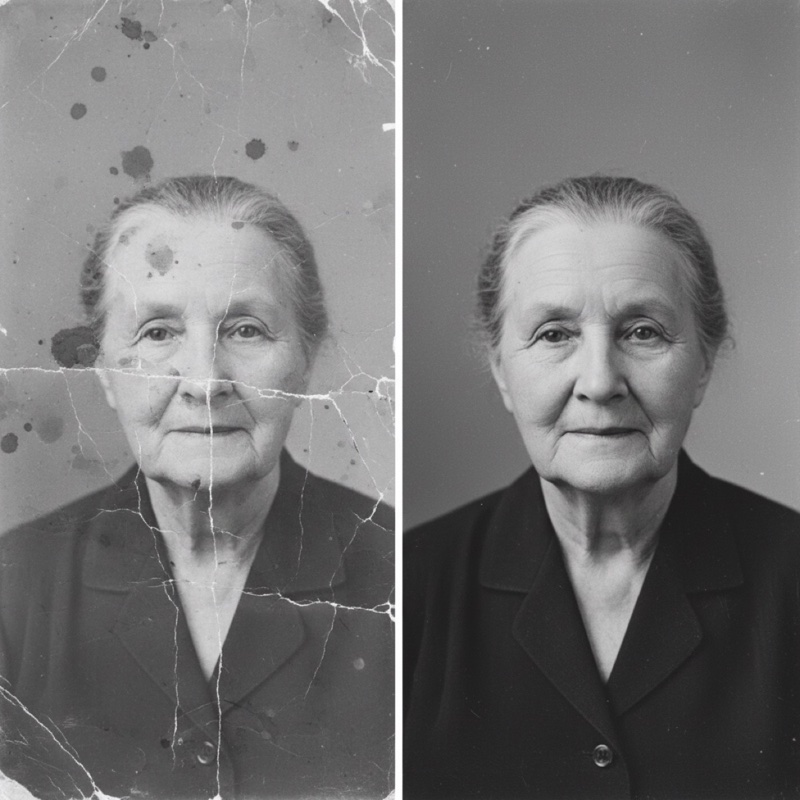
Processing is done on a copy. Here, we have something restorers didn’t have twenty years ago — image processing powered by a neural network. The difference from conventional filters is fundamental: the algorithm is trained on millions of images and "understands" that the scratch was a cheekbone, and that the stain was the fabric of a dress. It doesn’t blur the defect with adjacent pixels, but rather builds up what was most likely there. This restoration of old photographs takes about a minute and doesn’t affect the original file: the output is a new copy, while the original scan remains intact. This is reversibility in its everyday form — if you don’t like the result, delete it and try again. Among those operating in Russia, ART Umnetics, for example, offers this type of processing: no VPN required and payment by regular card, which is often crucial for home archiving.
It’s worth distinguishing between two different, often confused cases. If the photo is old and damaged — the paper is scratched, the color is faded — restoration is what’s needed. However, if the image is recent but poorly taken — dark, noisy, taken on an old phone, or resaved via messenger until it’s blurry — then improving the photo’s quality is a different matter. Different models are technically suitable for these applications, and the results vary significantly. The wrong choice is the most common cause of disappointment: people run a blurry selfie through restoration and can’t understand why it doesn’t improve.
Where is the border?
Here it’s worth returning to the principle of “don’t draw what you don’t know,” because it’s the one that’s violated most often with photographs.
Colorizing a black-and-white photograph is a reconstruction, not a restoration. The color of your grandmother’s dress will be realistic, but not necessarily the same. As a document, such a photograph no longer works — it becomes an artistic interpretation. For a family album, this is fine, as long as everyone understands the convention. For an archive you pass on to children, it’s better to keep both versions.
A missing fragment of a face cannot be restored. If a corner is torn off along with half the face, the program will draw a plausible continuation — but it will be the face of a non-existent person. This is where conventional processing most diverges from museum ethics: a restorer would leave a gap, and the automation will obligingly fill it with fiction. The decision is yours, but it’s worth knowing.
A completely overexposed or black area is empty. There’s no information there, nothing to restore — the same as a lost paint layer.
A heavily blurred frame won’t become sharp. Minor blurriness can be corrected, but camera movement during shooting cannot.
What to do today
Don’t try to cover the entire archive at once — that’s where everyone stops. Take the five most important photos, the ones you’d be most sad to lose. Digitize them, restore them, and show them to your relatives. Usually, after that, you’ll find more boxes you didn’t know about, and people will show up willing to help with labeling.
And label the files. In twenty years, no one will remember who’s in the photo — names and years are the first to disappear, even before the image itself. In museums, this is called provenance, and in a family archive, it’s just as important: a photo without a name quickly becomes just an old photograph of unknown people.