Haitian Creole
 Automatic translate
Haitian Creole developed in the seventeenth and eighteenth centuries in the colony of Saint-Domingue. The language developed on sugarcane plantations, where intensive contact was recorded between French colonists and enslaved Africans. The Africans were brought from various regions of the continent and spoke a variety of languages from the Niger – Congo family. The enslaved people used French vocabulary for basic communication among themselves. They had no access to formal education.
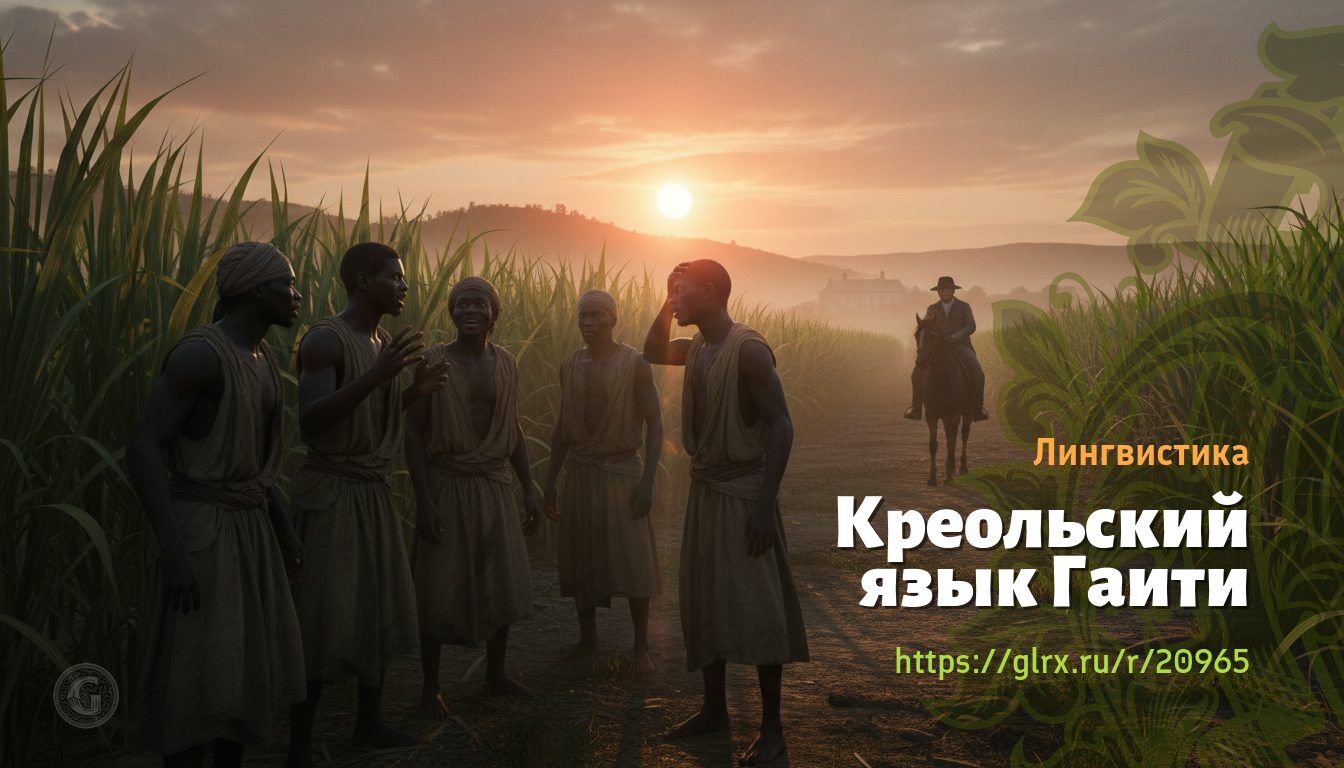
The emerging contact language became a specific form of African resistance to slavery. French colonial authorities recognized the widespread use of this language. The administration translated official public declarations into the local dialect. The ratio of Africans to Europeans in the colony was abnormally high for the region. In the seventeenth century, it was approximately nine to one. By 1789, this ratio had risen to sixteen to one. This demographic factor explains the massive influence of African linguistic structures on the resulting grammar.
The state of Haiti covers an area of 27,750 square kilometers. After independence was declared in 1804, the local language remained the primary means of daily communication throughout the territory. The first written texts appeared even before official independence. A French-Creole lexicon and conversations were published by S.-J. Duquerjoly in 1802. Revolutionary proclamations abolishing slavery were published strictly in this language.
The history of the creation and development of Creole languages in the Caribbean
The Creole languages of the Caribbean are linked by the region’s colonial experience, the slave trade, and the long-term contact between European, African, and indigenous languages. In most cases, their vocabulary is based on one of the European languages — French, English, Portuguese, Spanish, or Dutch — while their grammatical structures differ significantly from metropolitan norms.

Linguistic structure and grammar
The structure of Haitian Creole differs significantly from the standards of classical French. Its vocabulary is primarily borrowed from former colonizers. Its phonetics and syntax are based on West African traditions. Enslaved people absorbed European vocabulary, reworking it through the prism of their own dialects. The new language developed independently of bookish European grammar.
The syntactic status of pronouns is the subject of academic debate. In French, strong pronouns function as noun phrases. Local Creole pronouns have a different syntactic distribution — that is, the order of words in a sentence varies. The specific nature of early contacts between population groups determined a high degree of linguistic hybridization. Hybridization refers to the process of merging elements of different languages into a single new system.
Phonetics and spelling standards
The spelling system has undergone a number of state standardizations. In the early 1940s, under President Elie Lesko, the first attempts to unify spelling rules took place. Modern writing strictly adheres to the phonetic principle. Each sound corresponds to a specific letter or digraph. This rule significantly simplifies the mechanics of learning to read.
Spelling issues are directly linked to school teaching methodology. Standardizing letter symbols helps establish the language’s status as an independent entity. The use of a phonetic alphabet reduces the error rate among the illiterate population. People write words exactly as they sound in spoken language. Local linguists have developed clear rules for the placement of diacritics to denote open and closed vowel sounds.
Sociolinguistics and the phenomenon of diglossia
Sociologists characterize the country’s linguistic environment with the strict term "diglossia." Diglossia is the coexistence of two different linguistic systems within a single society, where each system serves specific social functions. Haitian Creole is the first native language of 95 percent of the population. French has historically been associated with state power, the elite, and prestige. Most citizens use their native language in everyday communication.
The European language dominates formal settings, government institutions, and legal documentation. In 1987, the state constitution officially recognized both languages as state languages. This constitutional recognition was a legal step toward formal linguistic equality. In practice, favoritism toward European languages persists within the state apparatus. Researchers often refer to the current situation as linguistic apartheid.
For decades, the local political elite perceived Creole speech as a primitive form of communication. They view the French system as highly codified and more complex. Ordinary working people rarely use literary French in everyday conversations. Residents often resort to situational code-switching, spontaneously mixing the two lexical bases within a single sentence.
Educational policy and human rights
The school education system directly reflects existing social stratification. Teaching science and humanities subjects in French creates cognitive barriers to learning. Children from exclusively Creole-speaking families experience chronic difficulties in school. The use of a foreign language in the classroom forces students to internalize the false belief that their background is inferior.
This practice negatively impacts the self-esteem of an entire generation. International human rights lawyers classify this educational policy as a direct violation of linguistic rights. In July 2015, the Ministry of Education and the Creole Academy signed a special agreement. The document regulated the promotion of the local language as the primary means of instruction. The practical implementation of these standards has encountered stiff bureaucratic resistance.
Older government officials and teachers clearly prefer French. Human rights organizations regularly call on the international community to address this linguistic gap. Experts view the development of a modern education system based on the native language as the only way to overcome widespread inequality. Documentation translation is slow. Mathematics and physics textbooks are published primarily in foreign languages for schoolchildren.
Cultural status in modern society
Haitian Creole is closely intertwined with national traditions. Concepts of voodoo and zombie mythology arose from African beliefs. These phenomena are conceptualized and conveyed exclusively through local vocabulary. Language serves as the primary vehicle for specific forms of social resilience. Ethnographic fieldwork confirms this. Young Haitians consistently use unique idioms to verbally express their vulnerability. These lexical constructions are deeply rooted in the historical experiences of slum residents.
Public figures are gradually expanding their use of the language in official settings. Former President Joseph Michel Martelly regularly demonstrated code-switching in front of cameras. He deliberately combined European and local phrases during televised debates. Musicians and artists actively use local vocabulary to convey cultural narratives. In the late twentieth century, local speech began to slowly penetrate prestigious academic fields. Independent radio stations broadcast in the language of the majority population.
The publication of specialized texts expands the language’s scope. An archival document on the history of Caribbean architecture was recently published. This work has become a unique precedent for the creolization of architectural history. The document demonstrates the language’s ability to convey complex theoretical information. The adaptation of board games such as Scrabble contributes to the standardization of vocabulary. Users create new terms to describe modern technological processes. Programmers translate operating system interfaces into native languages.
Debates on the social nature of revolution
The Haitian Revolution of 1791–1804 ensured the survival of the local language. Sociologist Jean Casimir analyzes local history through the prism of Creole speech. He views this language as a tool for overcoming colonial oppression. The revolution created profound social upheavals. A gap arose between state institutions and colonial structures. A distance developed between the coastal French-speaking elites and the rural population.
Rural residents, known as "outer people," retained African linguistic roots. Historian David Geggus compiled a demographic database of enslaved people in Saint-Domingue. His archival research covers the period from 1770 to 1791. The scholarly community has actively debated the demographic makeup of the revolutionaries. In the 1990s, a historiographical trend called "Congomania" emerged. This approach viewed the uprising as primarily an African rebellion. Geggus challenges the dominance of Congolese people in these events. He urges researchers to pay attention to the active participation of Creoles in the uprising.
The Impact of African Demographics on Vocabulary
The intense influx of African captives on the eve of the Revolution had an impact on syntax. The newly enslaved learned the local dialect, distancing it from its original European source. Within a short time, even white colonists began to partially adopt this form of communication. Different social groups used the language for different purposes. Tensions between leaders of different social backgrounds are documented in historical chronicles.
Features of situational code switching
Code-switching is a characteristic feature of everyday speech behavior. People spontaneously change their language system depending on the context of the conversation. Linguistic analysis of social media confirms the widespread nature of this phenomenon. Public videos on platforms show widespread lexical mixing.
Many citizens deliberately insert French terms into Creole speech to enhance their social status. The reverse process is less common. Politicians adapt their speech to specific voters. During public speeches, speakers switch to their native dialect to establish an emotional connection with the crowd. Intellectuals use academic French when discussing complex technical terms. This duality of linguistic consciousness creates a unique hybrid culture.
Creolization as a social concept
Anthropologists use the term "creolization" to describe Caribbean societies. Creolization refers to the process of blending diverse cultural elements to form a new, unique entity. This concept competes with the term "transculturation." Researchers Edouard Glissant and Jean Bernabé developed a theoretical framework for analyzing these processes. The specific location of Haiti determined the dynamics of local cultural formation. Caribbean societies evolved in constant dialogue with international trends.
International migration and diaspora
Haitian Creole is spoken far beyond its historical homeland. Approximately thirteen million speakers live in the Caribbean, France, Canada, and the United States. Migration in the twentieth century created large linguistic enclaves in North America. A significant Haitian immigrant community has formed in New York City. Local authorities have faced the need to adapt educational programs for the new residents.
The history of bilingual programs in New York City demonstrates the clash of myths and realities in language planning. American educators initially mistakenly classified Creole as a corrupted dialect of French. This misconception led to the use of ineffective teaching methods. School administrators placed Haitian children in French-speaking classes. Over time, linguists demonstrated the structural independence of this language. The New York City Department of Education subsequently developed specialized teaching materials for Haitian students.
Linguistic modeling and comparative studies
Academic language studies rely heavily on statistical modeling of the genesis of Creole languages. Researchers use computational algorithms to analyze historical texts. Mathematical models help trace the evolution of vocabulary since the colonial period. Linguists compare Haitian data with those of other language families around the world.
Experts avoid systematic biases in comparative analysis of Creole languages. Stratification by lexifier and substrate ensures representative samples. The lexifier is the language that contributed the majority of the vocabulary. The substrate is the language or group of languages that influenced the grammar. Quantitative analysis requires strict areal and genealogical control. Generalizations based on several dialects lead to scientific inaccuracies. Haitian Creole is often used as a baseline model for testing theories of linguistic contact.
Reflection of language in historical literature
The vernacular appears in nineteenth-century literary works. Leonora Sansay’s "Secret History" describes the social realities of the colony of Saint-Domingue. The text demonstrates the limitations of white feminism in the context of slave society. Comparison of the work with the story "Zéliqui, the Creole" reveals the racial contradictions of the era. Authors of the time often ignored the linguistic independence of enslaved Africans.
Written sources from the colonial period document the disdainful attitude of Europeans toward the local dialect. Literary critics analyze these texts to understand the historical dynamics of racism. Writers used stylized Creole speech for comic effect or to create an exotic flavor. This approach deprived the language of its real political power. Contemporary Caribbean authors reject such stylization. They use their native language to create authentic anti-colonial narratives. Novels and poems by local authors are translated into foreign languages while preserving the original syntax.
Religion and the translation of sacred texts
Historically, Catholic and Protestant missionaries conducted services exclusively in French. Most parishioners had no understanding of the sermons. The lack of religious texts in their native languages hindered the development of church communities. This situation began to change in the second half of the twentieth century. Protestant missionaries translated the New Testament by 1960. The Haitian Bible Society, together with international partners, completed a complete translation of the Bible in 1985.
The edition was called "Bib La." Its publication transformed the religious practices of millions of believers. People gained direct access to sacred texts without linguistic barriers. An updated edition of the translation was published in 1999. Bibles International released its version of the New Testament in 2002, with a print run of 13,000 copies. Work on translating the Old Testament continues. The legitimization of language through religion has strengthened its status in society.
Oral traditions and folk wisdom
For centuries, the oral transmission of information compensated for the lack of formal schooling. Anthropologist Michel-Rolph Trouillot studied the richness of local oral traditions in detail. He documented the influence of folk tales on social cohesion during the War of Independence. Proverbs embody the philosophy and life experiences of generations. Locals refer to them with the term "pwovèb." These short phrases originated among ordinary workers, street vendors, and spiritual leaders.
The vocabulary of proverbs reflects the realities of the tropical climate and agricultural labor. The phrase "stupidity won’t kill you, but it will make you sweat" accurately conveys the nation’s pragmatic attitude. Humor helps people cope with daily difficulties. Folklore metaphors are used by speakers during political campaigns to connect with voters. Radio journalists regularly incorporate folk idioms into news broadcasts. Radio remains the primary source of information for residents of remote mountainous areas.
Musical culture and national identity
The compas genre originated from the merengue and rhythms of traditional tanbu drums. In December 2025, UNESCO officially inscribed compas as a World Heritage Site. Musicians perform songs primarily in Haitian Creole. The rhythms unite people of all ages and social backgrounds. The lyrics serve as a means of expressing national pride and homesickness.
For the Haitian diaspora abroad, music serves as an identity card. Teenagers immigrating learn their native language through the lyrics of popular tracks. They speak English at school, use French at work, but switch to Creole on the dance floor. Rara festivals draw thousands of participants to the streets of American and Canadian cities. Musicians use street marches to deliver sharp social commentary. Syncopated rhythms are accompanied by sharp rhyming couplets. Cultural centers in the diaspora organize workshops on deciphering the language play in song lyrics.
Digital space and machine translation
Computational linguistics classifies Haitian Creole as a low-resource language. The lack of digitized texts hinders the training of natural language processing algorithms. Researchers are actively working on developing machine translation systems to assist native speakers. In 2024, programmers released a large dataset for training neural networks. The database contains millions of unique sentences with parallel translations.
Specialists use transfer learning methods to improve the accuracy of automatic translation. Artificial intelligence analyzes the lexical database of related European languages. The acquired knowledge is transferred to Creole grammar models. Neural network adapters demonstrate high efficiency when working with limited text volumes. Social media users generate gigabytes of text messages daily in their native dialect. Electronic dictionaries help standardize spelling among young people. Lexicographers recruit volunteers to create open language databases. John Rigdon has published educational materials, collecting stories from native speakers through creative competitions.
Morphology and syntactic features
Unlike classical French, the local language is characterized by a complete absence of verb conjugations. The verb form remains unchanged regardless of the person or number of the subject. Special grammatical markers are used to indicate tense, mood, and aspect. These particles are always placed before the verb, thus establishing a tense structure. This system is directly borrowed from the West African languages of the Gbe group. It was superimposed on the Romance vocabulary during the development of the dialect on the plantations.
The time of an action is conveyed by several short particles. The marker "te" indicates the simple past tense. The particle "ap" denotes a continuous action in the present or near future. Linguists strictly define the order of these elements in a sentence. They are combined according to strict rules. The combination of the past tense and the continuous aspect forms the complex marker "t ap." The grammar is highly analytical. Shades of meaning are conveyed by individual words, and ending changes are completely absent.
The category of plural nouns also obeys analytical logic. The language lacks the usual European endings for plurality. Countability and quantity are expressed using articles and determiners, which are placed strictly after the noun. Individual lexical units can function as nouns, verbs, or adjectives without changing their external phonetic form. The grammatical category of a word is determined solely by its syntactic position within a specific phrase.
- История создания и развития креольских языков на Карибах
- История японского языка
- Пиджин-английский: происхождение и современное использование
- Исторические турецкие сериалы на русском языке
- Эволюция славянских языков: от праславянского до современных наречий
- Методы документирования и сохранения вымирающих языков
- Влияние французского языка на модную терминологию
- “Родной язык” Эми Тан, краткое содержание
- Изучение иностранных языков сегодня – как, где и зачем
You cannot comment Why?