Manifestation October 17, 1905
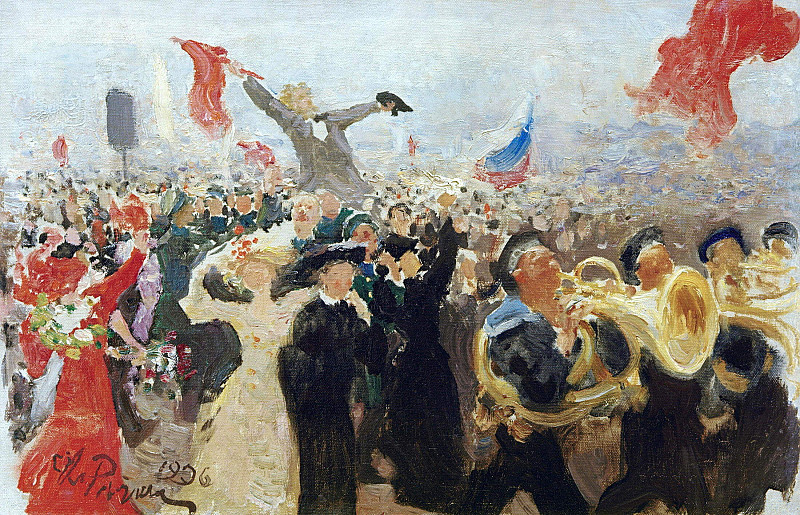
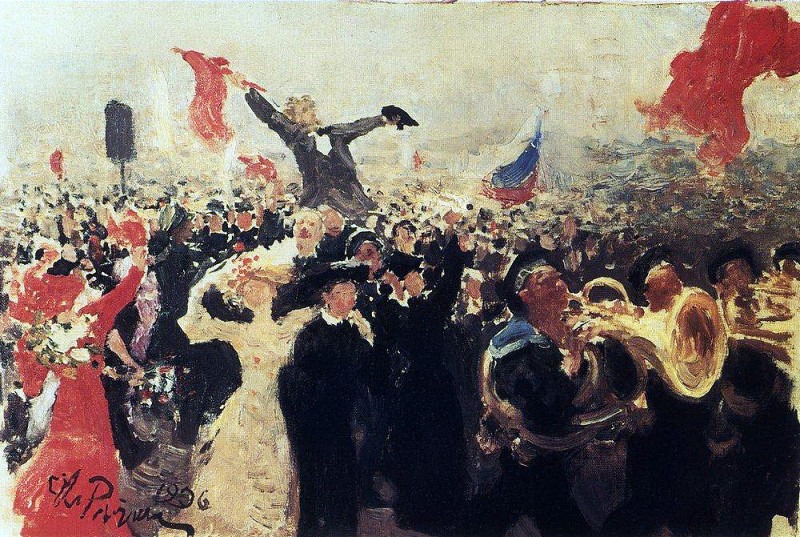

Ilya Repin – Manifestation October 17, 1905
Edit attribution
Download full size: 2200×1414 px (0,6 Mb)
Painter: Ilya Repin
Album navigation:


Ilya Repin is a great Russian artist. He has been well known to the public since his school days, but few know of such a work as The Manifestation of October 17, 1905. The artist wrote the picture back in 1907, as a response to the manifesto of Nicholas II on October 17, 1905. Repin himself said about his work that it is "...the movement of the Russian progressive society ... in the square of the big city in the ecstasy of general jubilation". Everyone who lived in St.
ArtClub
Best Contemporary Atists
Description of Ilya Repin’s painting Manifestation
Ilya Repin is a great Russian artist. He has been well known to the public since his school days, but few know of such a work as The Manifestation of October 17, 1905. The artist wrote the picture back in 1907, as a response to the manifesto of Nicholas II on October 17, 1905. Repin himself said about his work that it is "...the movement of the Russian progressive society ... in the square of the big city in the ecstasy of general jubilation".
Everyone who lived in St. Petersburg in the early twentieth century said about the picture that it very accurately conveys the excitement and mood of the crowd.
The canvas depicts the Russian intelligentsia - philologist V. Prakhov, actress L. Yavorskaya with a bouquet, critic V. Stasov, and people who march with flags and banners. The artist as if stopped time for a moment, he was able to convey the mood of the public, caused by the new state reforms. In his images no falsity, the author very accurately painted the character of the demonstrators.
The work shows the fashion: ladies in hats, men in military uniforms. This detailed elaboration of the foreground allows the viewer to see and feel the spirit and atmosphere of the turbulent times. Repin was able to deeply understand the whole essence of revolutionary protest and capture it in his painting "Manifestation". The task the artist set for himself - to convey the mood of the crowd, so the picture radiates strong emotions.
If you look at the compositional construction of the subject, you can see the typical influence of Post-Impressionism on the master’s hand. I want to pay attention to the broad strokes, careless manner of writing, bright colors, picturesqueness and line dynamics. Repin could very well be a painter of a different style and composition. Not that he did not want to, rather, time and society dictated their own rules. Creative people were constantly under great pressure, especially in the first half of the twentieth century.


You cannot comment Why?
A central figure, positioned slightly above the crowd, appears to be addressing the assembly with a raised arm. This person is surrounded by waving flags – primarily red, but also including one bearing blue, white, and red stripes – which contribute significantly to the sense of movement and emotional intensity. The artist has employed a vibrant palette, emphasizing reds and yellows, which further amplify the feeling of fervor and excitement.
To the right of the central figure, a brass band is depicted in mid-performance. Their instruments gleam with golden highlights, contrasting against the darker tones of the crowd. A woman in a striking red dress stands prominently near the left edge of the canvas, her presence adding a touch of elegance amidst the general chaos.
The overall impression is one of unrestrained energy and collective action. The blurred details and rapid brushwork convey a sense of immediacy, as if the artist were attempting to capture a fleeting moment in time. Theres an underlying tension between the individual figures within the crowd and their participation in this larger event. While some appear engaged and animated, others seem lost or indifferent, suggesting a complex interplay of motivations and emotions within the gathering. The composition avoids clear narrative focus; instead, it prioritizes the depiction of atmosphere and collective sentiment.