A summary of Mikhail Sholokhov’s "The Fate of a Man"
 Automatic translate
The work was created in 1956. The protagonist openly recounts the experience of a Soviet soldier in German captivity, a rare and complex topic for post-war literature.
In 1959, director Sergei Bondarchuk made a film of the same name. The film was a huge success with audiences and won the top prize at the Moscow International Film Festival.
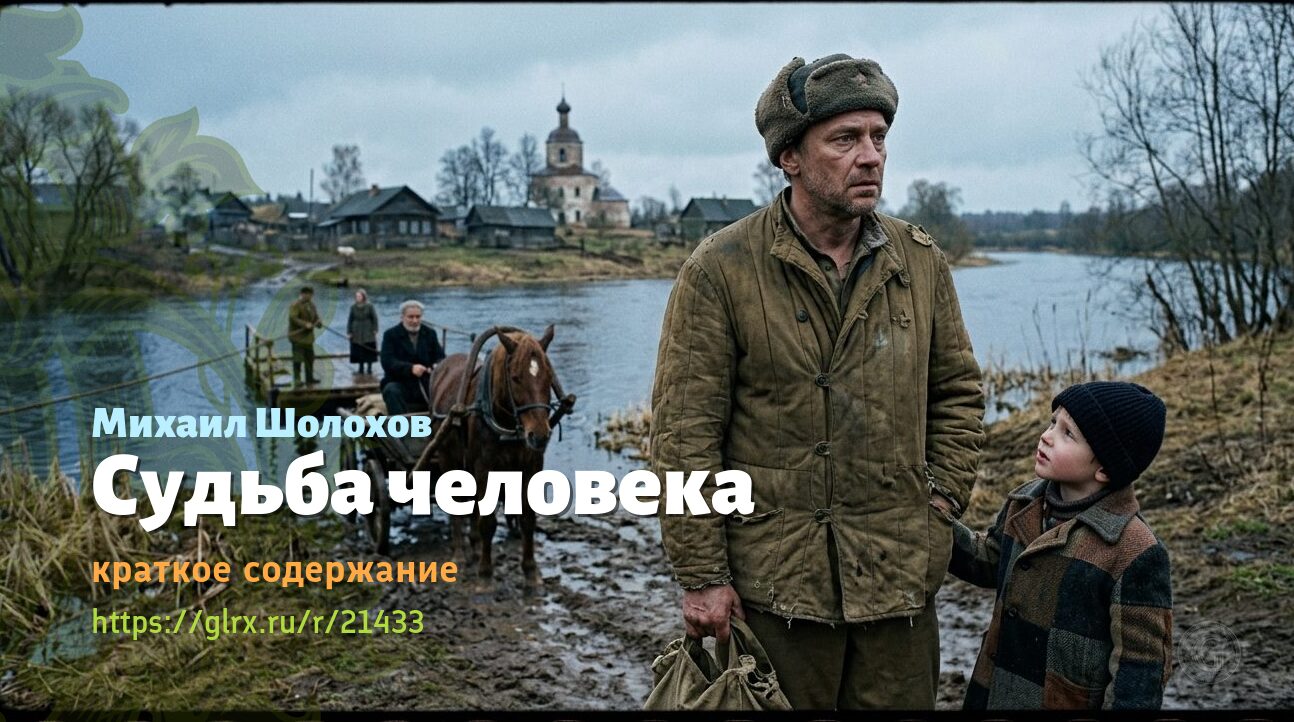
Meeting at the crossing
One spring, the narrator travels by carriage to the village of Bukanovskaya on the Upper Don. Due to the spring thaw, the road is extremely difficult; the horses can barely pull the cart. Near the crossing of the Blanka River opposite the Mokhovsky farm, he is forced to wait for a boat. A tall, stooped man and a small boy of about five approach him near the fence along the riverbank. The man mistakes the narrator for the driver and invites him to share a cigarette. This casual acquaintance, Andrei Sokolov, begins a long story about his life. Andrei’s eyes seem dusted with ash and filled with an inescapable, mortal melancholy.
Pre-war life
Andrei Sokolov was born in the Voronezh Governorate in 1900. During the Civil War, he served in the Red Army in the Kikvidze Division. During the famine of 1922, he went to work in Kuban, which saved him. His parents and sister died of starvation at home. Left alone, Andrei returned to Voronezh, trained as a mechanic, and married an orphan, Irina. His wife turned out to be a kind and understanding woman and never scolded her husband, even if he came home drunk.
The couple soon had children. First, a son, Anatoly, was born, followed by two daughters, Nastenka and Olyushka. In 1929, Andrei learned the automotive trade and began driving a truck. The family lived happily, the children earned excellent grades, and Anatoly showed a keen aptitude for mathematics. Just before the war, they saved up and built a small two-room house near the aircraft factory.
The beginning of the war and captivity
On the second day of the war, Andrei is called up to the front. His family sees him off at the train station. Irina cries and repeatedly repeats that they will never see each other again. Andrei, unable to bear the weight of this farewell, pushes his wife away in irritation. He will remember this act with pain for the rest of his life. Sokolov goes to the front as a ZIS-5 truck driver and writes comforting letters to his loved ones.
In May 1942, near Lozovenki, Sokolov was transporting artillery shells to a forward battery. A heavy shell exploded near the vehicle. Andrei lost consciousness, and when he came to, he realized he was behind advancing German tanks. Soon, enemy machine gunners approached him. The soldiers took his boots and foot wraps and sent him to join a column of Soviet prisoners of war.
Night in a ruined church
The prisoners are driven west. At night, they are herded into a ruined church with a broken dome. It’s raining heavily, and the men are soaking wet. In the darkness, a military doctor resets Sokolov’s dislocated arm. Later, a religious prisoner asks to go relieve himself, not wanting to desecrate the church. A German guard fires a burst of machine-gun fire right through the door, killing the pilgrim and several others.
In the middle of the night, Andrei hears the whispers of two soldiers. One of them, Kryzhnev, plans to betray his platoon commander to the Nazis in the morning. Kryzhnev openly declares that his own shirt is closer to his body. Sokolov decides to intervene. He falls upon the fat traitor and strangles him. This murder leaves a heavy mark on his soul. In the morning, the Germans summon the communists and commissars, but no one responds. The Nazis shoot several people who look like Jews and drive the column onward.
Camps and hard labor
Sokolov ends up in a camp near Poznan. He ponders his plan for a long time and, at the end of May, while digging graves, escapes. Andrei walks east for almost four days, but is caught by detection dogs. The dogs brutally bite the escapee in an uncut oat field. After a month in solitary confinement, Andrei is sent to hard labor. Over the course of two years, he passes through numerous camps in Saxony, the Ruhr, Bavaria, and Thuringia. The prisoners are fed turnip gruel with sawdust and are constantly beaten.
Duel with Muller
In the fall, Sokolov finds himself in Camp B-14 near Dresden. The prisoners are manually chipping stone in a quarry. The production quota is four cubic meters. That evening, in the barracks, an exhausted Sokolov says that one cubic meter is enough for everyone’s grave. Someone reports this to Commandant Müller.
Müller summons Andrei to be shot. In the commandant’s office, the Germans are drinking schnapps and eating lard. The commandant offers Sokolov a toast to the victory of German arms. Andrei steadfastly refuses. Then Müller proposes a toast to his own death. Sokolov drinks the first glass but refuses the snacks. He drinks the second glass and again refuses the snacks. After the third glass, he takes only a tiny bite of bread.
Müller is struck by the Russian soldier’s fortitude and dignity. The commandant declares that he respects worthy adversaries, spares his life, and gives him a loaf of bread with a piece of lard. Andrei struggles to carry the food back to his block. In the barracks, the prisoners divide the food equally with a coarse thread, each receiving a tiny piece.
Escape to your own
By 1944, the Germans began using prisoners as drivers. Andrei was assigned to the Todt construction organization. He drove a fat German engineer major in an Opel Admiral. Soon, they arrived in the frontline city of Polotsk to build defensive lines. Sokolov heard the roar of Soviet artillery and hid a weight and a telephone wire under his seat, preparing to escape.
On the morning of June 29, Andrei drives the major out of town. He waits for a deserted spot on the road and knocks the sleeping German unconscious with a heavy weight. Sokolov takes the pistol, ties the major up with wire, dons a German uniform, and drives at full speed toward the Soviet troops. The car passes through a minefield under crossfire from machine guns and automatic weapons. On the Soviet side, Andrei is met by soldiers. The division commander thanks him for his valuable language and the briefcase full of documents, sends him to the hospital, and gives him leave to go home.
Family tragedy
In the hospital, Andrei writes a letter to his wife. The reply comes from their neighbor, Ivan Timofeevich. It turns out that back in June 1942, a heavy aerial bomb had hit their house in Voronezh. Irina, Nastenka, and Olyushka were killed. All that remained was a deep hole where the shack had once been. Their son, Anatoly, was in town that day. Upon learning of his family’s death, he volunteered for the front. Sokolov traveled to Voronezh, stood by a terrifying crater overgrown with weeds, and returned to his unit that same day.
Anatoly is soon found. He graduated with honors from the artillery school and became a captain. His son commands a battery and has six orders and medals. Andrei is immensely proud of his son and dreams of babysitting his grandchildren after the war. They arrange to meet in Berlin. But on the morning of May 9, 1945, a German sniper kills Anatoly. Sokolov buries his last hope on foreign soil and leaves his unit feeling out of sorts.
Life after the war
After demobilization, Andrei refuses to return to Voronezh. He goes to Uryupinsk to visit a comrade from the front. Sokolov works as a driver in a motor company and often visits the local teahouse. There, he notices a dirty, ragged boy named Vanyushka, with eyes like stars. The boy lives on handouts and sleeps wherever he can. Vanya’s father died at the front, and his mother was killed by a bomb on a train.
Andrei places the boy in the truck and tells Vanya that he is his biological father. The child throws himself on his neck in a fit of wild joy and cries loudly. The childless owners of the house where Andrei lives warmly welcome the boy. The woman pours him cabbage soup and cries by the stove. Sokolov buys Vanya new clothes and bathes him. At night, Andrei often wakes up simply to admire his sleeping adopted son.
In November, an accident occurs: Andrei’s car gets stuck in the mud and hits a cow. A traffic police officer confiscates Sokolov’s driver’s license. During the winter, Andrei works as a carpenter. Later, a friend from the front invites him to the Kasharsky district, promising to help with obtaining new documents. Now Sokolov and Vanyushka walk to Kashar in a marching formation.
Andrei confesses to the narrator that his heart aches greatly. At night, he dreams of his dead wife and children behind barbed wire. He’s afraid of dying in his sleep and frightening Vanyushka. After the story, the men say goodbye. Sokolov and the boy head off to the boat. The narrator watches them go with a heavy sadness. Vanyushka turns and waves his little pink hand. At that moment, the narrator quickly turns away to hide a stinging manly tear.
Test questions for the book
What is the meaning of the title of the work?
The title is profoundly generalizing. The writer describes the personal story of driver Andrei Sokolov as a universal tragedy. The protagonist personifies the entire Soviet people who endured the terrible trials of the Great Patriotic War. The absence of a name in the title elevates the personal tragedy to a universal scale. The hero loses his family, home, and freedom, enduring the hardships of hard labor. However, he retains his inner dignity and the ability to love. The word "man" resonates proudly here. Sokolov endures the blows of fate and remains a true man, capable of genuine compassion.
What is the semantic load of the composition “story within a story”?
The author uses a framing device to give the narrative maximum credibility. The outer frame is a chance encounter with Sokolov at a spring crossing. The inner section is the hero’s own confession. This structure allows the reader to see the events through the eyes of an eyewitness and hear the vivid, emotional speech of a simple soldier. The author’s perspective is completely hidden behind the narrator’s voice, creating a sense of total immersion. The springtime scenery at the beginning of the book contrasts sharply with the terrible events of wartime. Spring clearly points to the rebirth of life after a long spiritual winter.
How is the theme of moral choice revealed in the duel between Sokolov and Commandant Müller?
The scene in the commandant’s office marks the culmination of the hero’s spiritual fortitude. The emaciated prisoner stands before the well-fed Nazis. Müller offers Sokolov a drink to the victory of German arms. Andrei refuses, risking immediate execution. He agrees to drink to his own death. By refusing refreshments after the first two glasses, Sokolov demonstrates to his enemies his complete disdain for death and the lord’s handouts. The enemy is physically stronger, and the exhausted prisoner prevails morally. Müller is forced to acknowledge the Soviet soldier’s unprecedented fortitude and calls off the execution.
Why did Andrei Sokolov adopt the orphan Vanyusha at the end of the story?
Vanyusha saves Andrei from utter despair. After losing his wife, daughters, and son, the hero is left utterly alone. His heart hardens with grief. A meeting with a boy whose parents were killed quickly awakens parental feelings in Sokolov. Adopting the ragged orphan becomes an act of mutual salvation. Andrei gives the child a home and the reliable protection of a father. Vanyusha restores the man’s lost meaning. This ending affirms the triumph of life over death. The heroes find the strength to build a future despite the tragedies they have endured.
Why did Andrei Sokolov kill Kryzhnev in the church?
An episode in a dilapidated church reveals the harsh truth of wartime. A soldier overhears a nighttime conversation between two fellow soldiers. Kryzhnev plans to betray his platoon commander to the Nazis to save his own life. Sokolov makes a quick decision to eliminate the traitor.
This murder is extremely difficult for the hero. Andrei experiences deep revulsion, as if he had strangled a creeping vermin. The man commits a cruel act to protect a comrade. Military expediency demands the immediate elimination of the coward.
How does the escape with the German major characterize the protagonist?
Long months of hard labor didn’t break the prisoner of war’s will. Andrei lands a job as a driver at the Todt construction company. While serving an enemy officer, the prisoner secretly hatches a daring escape plan. Sokolov methodically hides a weight and a coil of wire.
Waiting for the perfect moment, the driver knocks out the major. The hero retrieves the classified papers and breaks through crossfire to the Soviet side. This maneuver demonstrates the soldier’s high level of tactical composure. The man retained a keen sense of mental acuity under constant enemy pressure.
Why does the writer openly show the hero’s addiction to alcohol?
A traumatic experience deprives a former soldier of sleep and basic peace of mind. Returning from the front, Andrei loses his family. The pain of loss forces him to drown his painful memories in alcohol. The author deliberately avoids creating an idealized, poster-like image.
The writer describes a living man with weaknesses. A craving for alcohol marks the limits of human strength. It was in a state of protracted psychological crisis that Sokolov meets little Vanyusha near a teahouse in Uryupinsk. The child literally saves his adoptive father from complete self-destruction.
What detail of Sokolov’s appearance does the author particularly highlight?
The text focuses sharply on the protagonist’s eyes. They look as if they’re thickly dusted with ash. The man’s gaze is filled with a debilitating, mortal anguish. The narrator finds it physically difficult to look into the face of his casual interlocutor.
This detail directly conveys the scale of the grief he endured. The man buried his wife, two daughters, and his adult son, a captain. This outwardly strong worker harbors a frightening emptiness within. The ashes in his eyes become a visible trace of his pre-war life, completely destroyed.
- Summary of "The Air Seller" by Alexander Belyaev
- A decision was made to allocate funding for the construction of an opera house at the Moscow Conservatory
- The Russian Museum opened the exhibition "There is a people’s war …" created from the works of artists of the war years
- A performance based on the first novel by Sasha Sokolov will be shown in autumn in Chelyabinsk
You cannot comment Why?