Secrets of Russian ceramics in the era of Peter the Great – how the tsarist era influenced traditional crafts
 Automatic translate
Pottery in Russia has a long tradition of continuous practice. Pottery, tiles, bricks, and roofing tiles were all produced long before the 18th century in dozens of cities and hundreds of villages. But it was the reign of Peter the Great (1682–1725) that marked the period when ceramic production underwent a radical transformation. The reforming Tsar transformed not only the army, navy, and government administration but also such seemingly "quiet" industries as pottery and tile making. New standards, new designs, new craftsmen — all of this intertwined into a complex history that deserves a detailed examination.
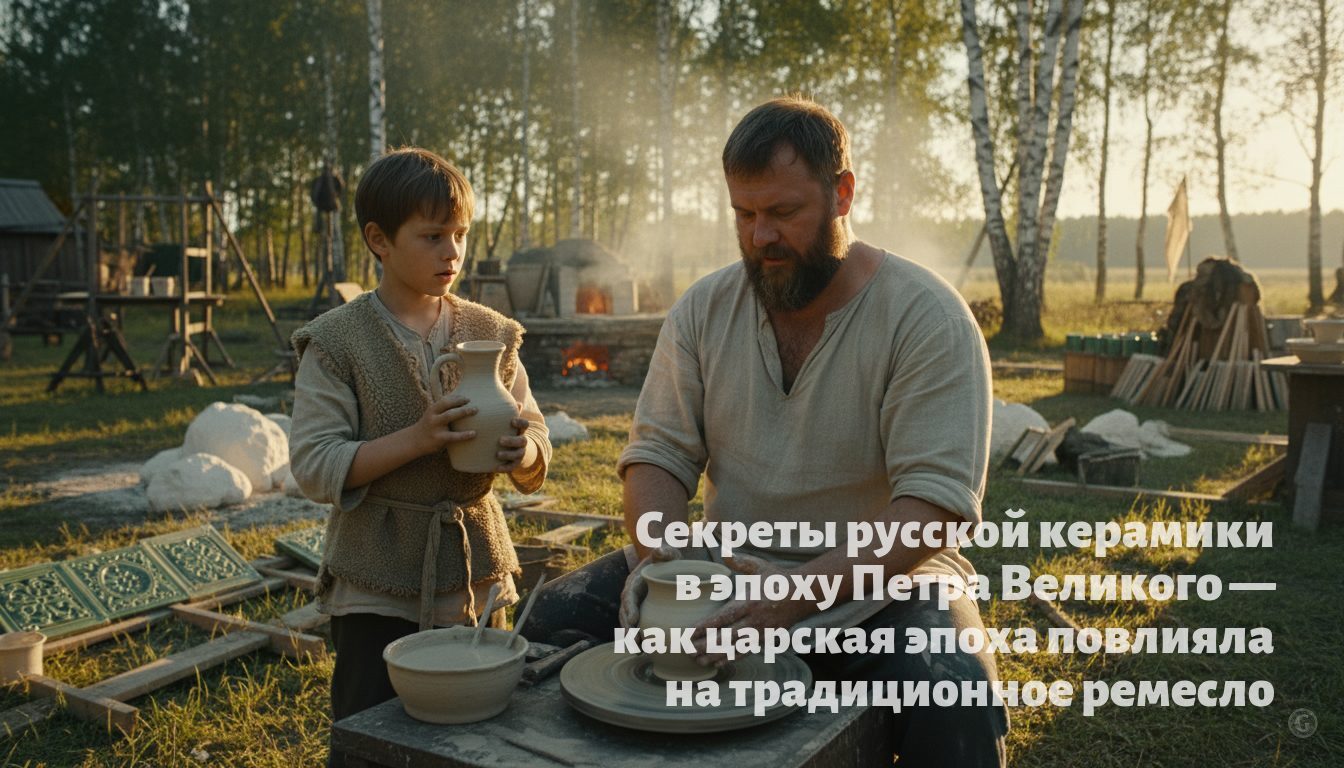
Pre-Petrine Ceramics: What Was There Before the Reforms
Before Peter the Great’s rise to power, Russian ceramics developed according to its own logic. From the 14th to the 17th centuries, pottery industries were concentrated around large cities — Moscow, Yaroslavl, Novgorod, and Pskov. Clayware — pots, jugs, and bowls — was made on hand- and foot-powered pottery wheels. Firing took place in simple kilns at temperatures of approximately 800–900°C.
Tiles occupied a special place in pre-Petrine ceramics. Beginning in the 15th century, Russian artisans produced terracotta tiles for facing stoves and building facades. In the 16th century, so-called glazed tiles, covered with a green glaze, appeared. And in the 17th century, the production of multicolored relief tiles flourished, the secret of which Russian potters adopted from Belarusian masters who mastered the technique of opaque glazes.
These tiles adorned the stoves of boyar chambers and the facades of churches and monasteries. The Intercession Cathedral in Moscow and the churches of St. Nicholas the Wet, St. John Chrysostom, and St. John the Baptist in Yaroslavl still retain their magnificent 17th-century tilework. Yaroslavl became a center of tile art: here, tiles were used to cover window frames, walls, and domes.
Among the regions where pottery was particularly developed, Gzhel, a territory southeast of Moscow, stands out. Historians date the beginning of ceramic production in Gzhel to 1318, when these lands became part of the Moscow Principality. The local white clay was known for its high quality. As early as the 17th century, Tsar Alexei Mikhailovich ordered the delivery of Gzhel clay to Moscow for the production of apothecary vessels.
Pottery in the structure of the Russian city
Before Peter the Great’s reforms, artisans in Russian cities were part of the posad population — urban residents who paid taxes and performed duties. There was no clear organization of craft labor along Western European lines. Potters, brickmakers, and tile makers worked in small workshops, passing on their skills from father to son.
In Moscow in the 1720s, there were 153 different "crafts," each corresponding to a separate workshop. Among potters, there were jug makers and potters — their specializations were quite narrow. Soapmaking and pottery were among the widespread small-scale industries that existed in both cities and villages.
St. Petersburg, founded in 1703, quickly acquired its own craft workshops. Here, entirely new specialties emerged — shipbuilding, compass making, and galley craftsmanship. Against the backdrop of these innovations, traditional pottery crafts also changed.
Reform of handicraft production under Peter I
In 1722, Peter the Great issued a decree introducing the guild system for crafts. All "regular" citizens were divided into two guilds, with artisans belonging to the second. Peter borrowed several principles from the Western European guild system: mandatory apprenticeship, the election of elders, and the requirement to obtain a certificate from a master to open one’s own workshop.
Every craftsman was required to place a personal stamp on their products. Poor workmanship was punishable by fines and penalties, including loss of the right to practice their craft. The Magistrate monitored the quality and quantity of production. To coordinate this work, Peter established the Chief Magistrate, whose duties included supporting industry in Russian cities — both large-scale manufacturing and small-scale crafts.
The state provided loans, assisted with the acquisition of raw materials, and the marketing of finished goods. The goal was pragmatic: to reduce the export of funds abroad and meet the needs of the army, navy, and nobility through domestic production.
For pottery, these reforms meant a transition from spontaneous organization to state control. Master, journeyman, apprentice — the strict hierarchy of ranks and titles characteristic of Peter the Great’s system — was extended to ceramic workshops.
Dutch influence: tiles in the "Galan style"
Peter I’s travels across Europe, particularly the Grand Embassy of 1697–1698, radically altered his aesthetic preferences. In Holland, the tsar noticed the painted faience tiles — Delftware — that decorated the stoves in townspeople’s homes. He found the multicolored Russian tiles, featuring unicorns and floral rosettes, "simple and archaic."
Upon his return, Peter ordered the tile industry to be revamped and to begin producing tiles "in the Galician style" — smooth, white, and painted with blue paint. To this end, he sent Russian artisans to Holland for training.
The first attempts to establish a new production facility were associated with the New Jerusalem (Resurrection) Monastery near Moscow. In November 1709, two Swedish prisoners, Jan Flegner and Christian, were sent there to work as potters. In August 1710, a royal decree followed: "…the Swedes who have been given to the Resurrection Monastery are now ordered to immediately make smooth, white stove tiles in the Swedish style, with blue grass paint on them, like Prince Matvey Petrovich Gagarin, from good soil."
The text of the decree makes it clear that the tsar was dissatisfied with the first samples. Peter described in detail exactly what tiles he needed, citing a specific example in the house of Prince M. P. Gagarin. Nevertheless, he ordered the production of a large quantity of tiles — enough for ten stoves. Thus began the gradual replacement of old Russian tiles with new ones, oriented toward European tastes.
Ceramics of the Summer Palace and the Menshikov Palace
The first batches of Dutch faience tiles arrived in St. Petersburg between 1714 and 1718. They were used to decorate the interiors of Peter the Great’s Summer Palace and the palace of his closest associate, Alexander Danilovich Menshikov.
The Menshikov Palace on Vasilievsky Island became one of the most striking examples of the use of tilework during the Peter the Great era. The four interiors were clad in 27,810 painted blue-and-white tiles. Some were brought from Holland, while others were made at the Strelnikovsky and Yamburzhsky brick factories, as well as in various workshops in St. Petersburg.
Russian artisans quickly adopted the new style. They treated Dutch tiles in the same way the Dutch had once treated Chinese porcelain: they adopted the general idea and adapted it to their own conditions. The tiles were hand-painted, each one unique, although the artist might use a stencil at the initial stage of painting. To this day, the Menshikov Palace remains a monument to the Peter the Great era, where one can see the original tiled interiors.
The Transformation of Tile Art: From Relief to Painting
The transition from old Russian tiles to new ones was not instantaneous, but spanned decades. In the 17th century, Russian tiles were three-dimensional, relief tiles, often multicolored, with a deep rump (a box-shaped projection on the back for fastening to the stove). During the Peter the Great era, tiles became flat, smooth, with painted designs on a white background.
Initially, the painting was monochrome — blue on white, in imitation of Delftware. But by the end of the 18th century, the palette had expanded. Artists began using brown, green, and yellow glazes. The subjects also changed: abstract ornaments were replaced by scenes from the lives of people of different social classes, thematic sketches, bouquets, and birds.
Tiles began to be assembled into panels — large compositions that became part of the architectural decor of complex stoves. This transition from individual tiles to tiled "pictures" is one of the characteristic innovations of the Peter the Great and post-Petrine eras.
Gzhel ceramics and Peter the Great’s reforms
The Gzhel ceramics industry, which had existed since the 14th century, received a new impetus under Peter the Great. The signature blue-and-white painting, which later made Gzhel masters famous, emerged under the influence of Peter the Great’s fashion for Delftware. After visiting Holland, the tsar praised Dutch blue-and-white pottery, and the fashion for such pieces quickly spread to Russia.
Gzhel masters took the principle of their European counterparts — painting with cobalt on a white background — as a basis, but imbued it with their own content. Local motifs, the characteristic plasticity of forms, and the distinctive rhythm of ornamentation — all of this distinguished Gzhel products from their Dutch counterparts.
In the first half of the 18th century, Gzhel artisans, in addition to tableware, produced bricks, pottery pipes, tiles, and simple clay toys, which they exported to Moscow fairs. Production remained small-scale and artisanal, but volumes grew.
In 1723, Peter the Great’s decree established incentives for entrepreneurs capable of "introducing and disseminating curious art" using local raw materials. The Manufactures Collegium specifically noted the need to develop the valuable craft of producing white clay tableware: "…discussing all valuable tableware made from white clay and exported to Russia from other countries, and in Russia such white clay is found, from which there is hope that all valuable tableware and tobacco pipes can be made in Russia."
Grebenshchikov’s first precious metal plant
In 1724, Afanasy Kirillovich Grebenshchikov opened a tsenin factory in Moscow — the first enterprise in Russia to produce majolica with painted designs on wet enamel. Initially, the factory produced smoking pipes. Later, tiles were added, and in the late 1730s, enameled tableware.
Grebenshchikov received the status of official supplier to the court. His factory became a link between the old Russian ceramic tradition and the new, European-oriented production. Grebenshchikov’s majolica combined Russian forms with European decorative techniques.
The very word "tsenina" (from the Persian "chini" meaning porcelain or clay) in the 18th century referred to ceramics with a white enamel coating. Tsenina production became one of the industries that the state deliberately stimulated — through incentives, orders, and quality control.
The Search for Porcelain: Peter’s Dream
Peter I was one of the first to learn of the invention of Saxon porcelain, presumably from Elector Augustus II the Strong himself. The German alchemist Johann Friedrich Böttger created the first European porcelain in Meissen between 1708 and 1710, and Peter made persistent attempts to replicate this success.
In 1712, while visiting the Prussian king’s residence in Oranienburg, the tsar viewed two rooms decorated in the "Chinese style" and was impressed. On his orders, a "Chinese" (or "Lacquer") Cabinet was created in the Monplaisir Palace in Peterhof between 1719 and 1722, and the first purchases of oriental porcelain for the royal residences began.
In 1717, Peter invited a certain Peter Eggebrecht from Dresden, sent Yuri Kologrivov to the court on a secret mission, and paid substantial sums to a Chinese agent — all in the name of uncovering the secret of porcelain production. These attempts, during Peter’s lifetime, were unsuccessful: the creation of Russian porcelain only took place in the 1740s and 1750s, under Elizabeth Petrovna.
Nevertheless, it was Peter the Great’s impulse that set the process in motion. Without his persistent interest in European technology, the path to Russian porcelain might have been much longer.
Dmitry Vinogradov and the Birth of Russian Porcelain
Although porcelain production in Russia began after the death of Peter the Great, its origins lie in Peter’s modernization program. In 1744, Empress Elizabeth Petrovna commissioned the establishment of a porcelain manufactory on the banks of the Neva. For this purpose, they hired the arcanist Christopher Conrad Gunger — a man with a dubious reputation who had previously worked in Vienna and Venice.
Gunger spent two years unsuccessfully trying to produce porcelain. He was assigned a young Russian scientist, Dmitry Ivanovich Vinogradov, a graduate of the St. Petersburg Academy of Sciences who had studied with Lomonosov in Germany. Unlike Gunger, who followed established recipes, Vinogradov approached the matter experimentally: he conducted experiments, compared the results, and recorded them in a special journal.
At the end of 1746, using Gzhel white clays, Olonetsk quartz, and alabaster, Vinogradov produced satisfactory porcelain by firing at 600–900°C. The second firing, after glazing, was conducted at approximately 1400°C. The main challenge lay in the purity of the process — protecting the snow-white mass from combustion products.
Vinogradov designed the mills for preparing the batch (the mixture of components) and the kilns for firing himself. The clay was prepared in Gzhel and then transported to the capital in brick form. Vinogradov’s fate was tragic: for the slightest failure, he was deprived of his salary and subjected to corporal punishment. The outstanding scientist was treated like a convict. He died in 1758 at the age of thirty-eight.
Ceramic production technology of the Peter the Great era
Ceramic production in Russia at the beginning of the 18th century was based on several technological processes, each of which required specific skills.
Clay preparation included mining, curing, washing, and mixing. Russian potters used various types of clay: red ferruginous clays for simple household pottery, and white kaolin clays (primarily Gzhel clay) for higher-quality wares. The clay was mixed with sand, crushed quartz, and sometimes crushed granite or shell rock to strengthen the shard.
Shaping was done on a potter’s wheel, either hand- or foot-powered. Wooden molds with carved designs were used for tiles: the clay mass was pressed into the mold, and after drying, the finished tile, with its relief, was removed. With the transition to smooth Dutch tiles, the need for carved molds diminished, but the role of the artist increased.
Firing was carried out in kilns — ceramic furnaces of various designs. Firing temperatures for plain ceramics ranged from 800–900°C, while for glazed tiles, they reached 1000–1050°C. The higher temperatures required for porcelain (1350–1400°C) were not yet available in Russia during Peter the Great’s time.
Glazing — applying a vitreous coating to the surface of a piece — was one of the most complex processes. For glazed tiles of the 17th century, a lead glaze with copper oxide was used, producing a characteristic green color. During the reign of Peter the Great, tin glazes were developed, creating a white, opaque background for painting — this was the technology used in Delft.
Raw materials: clays, paints, glazes
Russia possessed rich deposits of ceramic raw materials. The Gzhel deposits of white clay were the most famous, but not the only ones. White and light clays were also mined in the Olonetsk province (Karelia), near Arkhangelsk, and in several regions of central Russia.
Red clays containing iron oxides were ubiquitous. They were suitable for producing bricks, simple tableware, and coarse tiles. Finer items required clays with low iron content — the kind used in Gzhel.
Cobalt, the main pigment for blue and white painting, was imported from abroad during Peter the Great’s time. Russian cobalt ore deposits were discovered later. Tin white for glazes was also imported: tin came from England and Saxony.
This dependence on imported raw materials was one of the problems Peter sought to address. The search for local sources of minerals for ceramics, glass, and porcelain went hand in hand with geological exploration for ores for metallurgy.
Captured masters and foreign specialists
A characteristic feature of the Peter the Great era was the involvement of foreign artisans in the development of Russian production. This was particularly evident in ceramics.
Swedish prisoners captured during the Great Northern War (1700–1721) were among the first whom Peter employed in tile production. Jan Flegner and Christian, sent to the Resurrection New Jerusalem Monastery in 1709, were tasked with making stove tiles in the "Swedish manner." Using prisoners of war for artisanal purposes was common practice at the time.
In addition to prisoners, Peter also invited hired specialists. Ceramicists, glassmakers, and dyers arrived from Holland, Germany, and Sweden. Not all of them proved competent — the story of Gunger, who failed in his porcelain production, is a case in point.
Russian craftsmen, in turn, traveled to Europe for training. Peter the Great sent people to Holland to study tile and faience production techniques. Upon their return, they passed on their acquired knowledge to local potters — an exchange that shaped a new Russian school of ceramics.
Brick production and building ceramics
In addition to decorative tiles and tableware, Peter the Great’s reforms affected building ceramics. The construction of St. Petersburg required colossal quantities of brick. Brick factories — Strelnikovsky, Yamburzhsky, and others — were founded in the first years of the new capital’s construction.
Bricks of the Peter the Great era differed from traditional Russian ones. Peter introduced standards for size and quality: bricks had to be of a certain shape, evenly fired, and free of cracks and chips. Each brick was stamped with the manufacturer’s mark — similar to how artisan potters stamped their products.
Local red clays found along the banks of the Neva and in the environs of St. Petersburg were used to produce building ceramics. Firing took place in large floor-standing kilns, capable of producing thousands of bricks at a time. During the construction of St. Petersburg, the demand for bricks was so great that in some years, restrictions were imposed on stone construction in other cities to channel all resources toward the new capital.
Petrine Baroque and ceramic decor
The architectural style that developed between 1703 and 1730 was called "Petrine Baroque." It differed from European Baroque in its restrained forms, but it also made extensive use of decorative elements, including ceramics.
Dutch and German motifs were combined with Italian and French influences. Building facades were decorated with stucco and, less commonly, ceramic inlays. Inside, stoves remained the primary source of ceramic decoration — they were lined with smooth, painted tiles.
In Peter the Great’s Summer Palace, designed by Domenico Trezzini between 1711 and 1714, ceramic interior tiling became a distinctive design element. Dutch tiles were combined with German ones and, later, with domestic ones produced at factories in St. Petersburg and the Moscow region.
The blue and white palette of Delft tiles harmonized with the overall sobriety of Peter the Great’s interiors. This style proved enduring: blue and white tiles remained popular in Russian homes throughout the 18th century and beyond.
Manufactories and factories: from workshop to enterprise
One of Peter the Great’s innovations was the transition from small craft workshops to manufacturing. In ceramics, this process was slower than, say, in the textile industry, but it still happened.
St. Petersburg’s brick factories were typical manufactories: division of labor, dozens of workers, and government orders. Tile workshops also expanded — instead of one or two potters, teams now included molders, kilns, and painters.
The state encouraged the creation of new enterprises through a system of benefits, privileges, and direct orders. The Manufactures Collegium, established in 1719, oversaw the development of industry, including ceramics. Loans for organizing production, assistance with raw materials, and support in marketing products — all of this was part of Peter the Great’s economic policy.
At the same time, small-scale pottery production did not disappear. In villages and small towns, artisans continued to work alone or in family teams, supplying the local market with simple household utensils. The two modes of production — manufacturing and artisanal — coexisted, complementing each other.
Ceramics and everyday life of Peter the Great’s time
Peter the Great’s reforms affected the everyday life of Russians, and ceramics were no exception. In the new buildings of St. Petersburg, Russian stoves were no longer built; they were replaced by Dutch stoves with tiled cladding. This was not simply a technical choice, but part of a general move toward the Europeanization of Russian lifestyles.
Tableware also changed. Traditional clay pots and bowls gradually gave way to more elegant earthenware and semi-earthenware pieces — albeit still affordable only to wealthy city dwellers. Imported ceramics from Holland, Germany, and England began appearing on the tables of nobles and wealthy merchants.
At the same time, demand for domestic equivalents was growing. This became a powerful incentive for Russian artisans: by imitating European examples, they refined their own techniques. The boundaries between "imported" and "homegrown" gradually blurred — Russian tiles from the early 18th century are sometimes difficult to distinguish from Dutch ones without special analysis.
Ceramics and military needs
Ceramic production during the Peter the Great era also served military needs. Bricks were used to build fortresses — the Peter and Paul Fortress, the Kronstadt Fortress, and border fortifications. Clay pipes were used in fortifications and water supply.
A less obvious connection is through the apothecary industry. Ceramic vessels for storing medicines, powders, and ointments were essential for army pharmacies and hospitals. Gzhel clay, already attached to the Apothecary Prikaz under Alexei Mikhailovich, continued to be supplied for medical needs under Peter the Great. In 1770, the entire Gzhel ceramic artel was assigned to the Apothecary Prikaz.
Aesthetics of Fracture: Russian and European
The Peter the Great era in the history of Russian ceramics marks a clash of two aesthetic systems. The Russian tile tradition of the 17th century gravitated toward polychromy, volume, and rich ornamentation. The Dutch school, by contrast, was built on monochrome graphics, flatness, and intimate subject matter.
Russian masters didn’t simply copy Dutch models. Penetrating into workshops "just beyond St. Petersburg," European motifs were transformed. Blue-and-white tiles became embellished with details unfamiliar to the Delft painters: Russian landscapes, figures in national dress, and ornaments harking back to ancient Russian traditions.
This fusion produced original works that didn’t belong entirely to any one tradition. This is the unique feature of Petrine ceramics — it stands at a crossroads, absorbing and reworking various influences.
Quality and control issues
The implementation of new standards faced serious difficulties. Qualified craftsmen were few, training was slow, and the equipment remained primitive. Even with Peter’s personal oversight, the results were often unsatisfactory — as demonstrated by the incident with the tiles from the Resurrection Monastery, where the Tsar was dissatisfied with the first samples.
Problems arose at every stage. Uneven firing resulted in defective batches. Glazes peeled or cracked. Paintings blurred during firing due to improperly selected pigments. The scaling of production exacerbated these difficulties: what an experienced artisan could achieve in a single piece was often impossible to reproduce in mass production.
The system of hallmarks and fines introduced by Peter the Great only partially solved the problem. Without fundamental knowledge of the properties of materials — the chemistry of glazes, the physics of firing — achieving consistent quality was extremely difficult. This knowledge came later, in the second half of the 18th century, with the development of natural sciences in Russia.
Post-Petrine period: inertia and development
After Peter the Great’s death in 1725, the administrative system he had created generally continued to function, although the pace of reform slowed. Between 1727 and 1736, peasants were finally assigned land and lost the right to freely leave their masters. This negatively impacted the development of crafts: the influx of free labor into the cities declined.
Workers in manufactories were assigned to their factories. Manufacturers were prohibited from purchasing villages adjacent to their factories until 1747. Craftsmen lost the right to accept farms and contracts — that is, to engage in trade. All this hindered the development of private initiative in ceramic production.
However, the foundation laid by Peter proved solid. The guild organization, quality standards, and familiarity with European forms and technologies — all of this continued to flourish. The Gzhel crafts grew. Grebenshchikov’s tile factory continued to function. Tile workshops in St. Petersburg and Moscow produced commissions for palaces and private homes.
In 1744, twenty years after Peter’s death, a porcelain manufactory was founded — the future Imperial Porcelain Factory. A few years later, Dmitry Vinogradov created Russian porcelain. And in 1766, the Scotsman Francis Gardner founded a private porcelain factory in Verbilki, which for the next century supplied noble estates and merchant houses throughout Russia with its products.
Regional features of pottery production
By the early 18th century, Russia was not a homogeneous country in terms of ceramic crafts. Each region had its own traditions, determined by the composition of local clays, climate, trade links, and cultural contacts.
Novgorod and Pskov artisans have long produced black-burnished ceramics — ware with a distinctive dark, glossy finish achieved through restorative firing and polishing the surface of the still-raw piece with stone or bone. This type of ceramics continued to be used in everyday life even during the time of Peter the Great, especially in rural areas, where European innovations were slow to arrive.
Yaroslavl artisans, renowned for their tile decoration in the 17th century, faced the need to adapt during the Peter the Great era. The old polychrome tradition began to compete with the new Dutch fashion. Some workshops switched to producing smooth painted tiles, while others continued to work in the old style, catering to the provincial market, less susceptible to capital trends.
In southern Russia — in the regions adjacent to the Black Sea and Volga regions — ceramic traditions were influenced by Eastern cultures. Glazed wares with turquoise coatings, harking back to Golden Horde and Central Asian designs, were found here. Peter the Great’s reforms had a lesser impact on these remote regions.
The role of monasteries in ceramic production
For centuries, monasteries have been centers of craft production. Ceramics are no exception. Large monasteries had pottery workshops that supplied the monastery and surrounding settlements with pottery.
The Resurrection New Jerusalem Monastery, where Peter the Great sent Swedish prisoners to produce tiles, already had its own tile-making tradition. During the reign of Patriarch Nikon in the 1650s and 1660s, ceramic workshops were established there, producing multicolored tiles for the cladding of the monastery cathedral — one of the largest architectural projects of the 17th century.
Peter effectively utilized existing infrastructure — workshops, kilns, clay reserves — to implement new technologies. This was typical of Peter’s approach: not to create from scratch, but to reorient existing resources toward new tasks.
Other monasteries — the Trinity Lavra of St. Sergius, the Solovetsky Monastery, and the monasteries of Rostov the Great — also had ceramic production facilities, but their role in Peter the Great’s reforms was less prominent. The state’s main efforts focused on enterprises in the capital and the Moscow region.