"Ilya Repin" by Korney Chukovsky, summary
 Automatic translate
Korney Ivanovich Chukovsky’s memoir and biographical work on the renowned Russian artist was written over several decades and published in 1937. This book is a vivid psychological portrait of Ilya Efimovich Repin, based on twenty years of neighborly interaction in Kuokkala, joint editing of the memoirs, and an in-depth study of the artist’s creative path. The author captures the complex character of a genius, in whom sincere shyness and gentleness in everyday life were combined with a fierce, uncompromising defense of truth in art.
Acquaintance in Kuokkala and the paradoxes of character
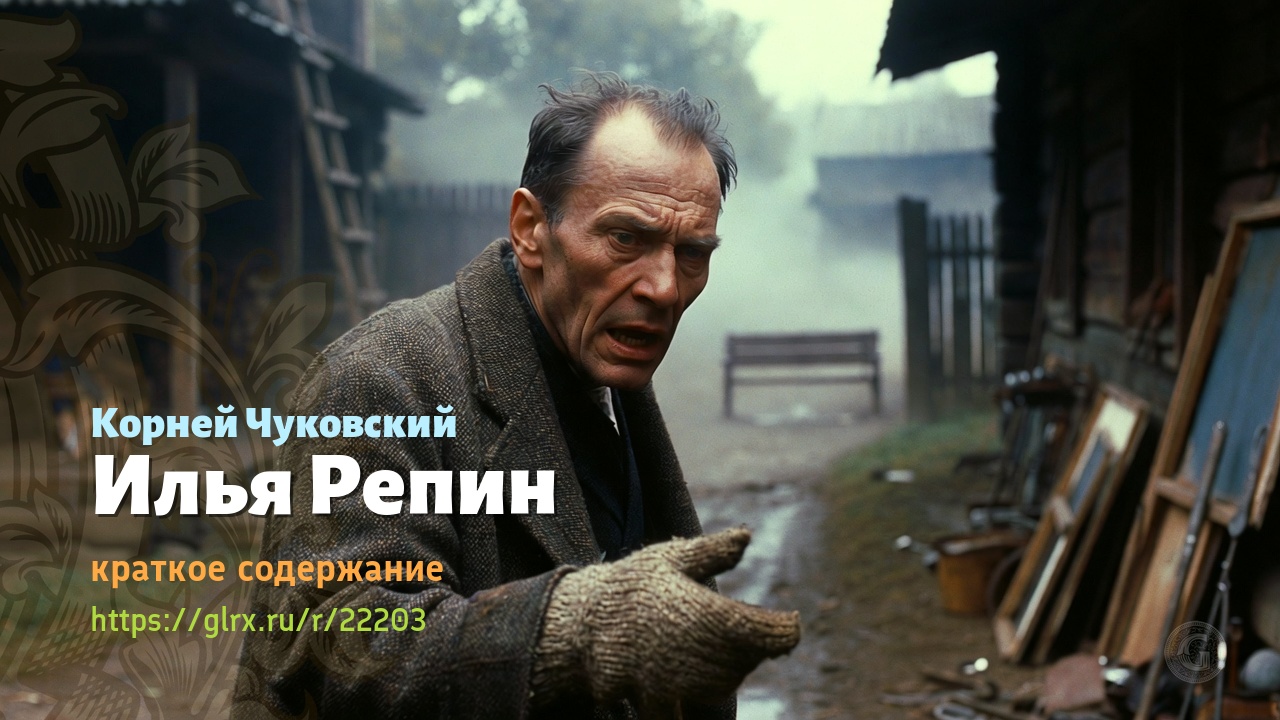
The author met the artist in the dacha village of Kuokkala around 1908, when Repin unexpectedly climbed the steep stairs to the young writer’s attic with a letter from a mutual acquaintance. The renowned artist struck the narrator with his modest appearance: short, weather-beaten, wearing a worn overcoat and knitted peasant mittens. In everyday life, he blended in completely, dining at a vegetarian cafeteria for 30 kopecks, riding horse-drawn trams or walking, chopping wood and cleaning his studio himself. Repin categorically rejected deference to rank and sincerely admired the virtues of others.

The artist’s gentleness and deference instantly vanished when his cherished convictions were challenged. Defending his views, he spoke with extreme harshness and directness. Repin broke completely with the critic Vladimir Stasov over his assessment of the Old Masters, harshly reprimanded Chukovsky for his superficial review of Kramskoy, and at a St. Petersburg exhibition of leftist artists, he publicly lambasted the paintings. Near his home stood a bench nicknamed the "Bench of Great Anger": there, Repin would angrily trample on the illiterate forgeries that St. Petersburg collectors brought in hoping to confirm their authenticity.
Spartan life and thirst for knowledge
Repin was distinguished by a phenomenal curiosity and a passion for science. He spent hours questioning scientists, raptly attended Vladimir Bekhterev’s lectures on hypnosis, thoroughly studied astronomy, and, at age 70, walked to the station in a winter snowstorm to deliver a lecture on Ancient Egypt. He avidly followed new literary works, admired the prose of Vladimir Korolenko, Leonid Leonov, and Sergeyev-Tsensky, and was well acquainted with and fond of Nekrasov’s poetry. The artist spent negligible amounts on himself, but willingly helped literary figures in need, donated his paintings to museums, and financed the drilling of wells in his native Chuguev.
The artist led a strict lifestyle and never succumbed to ailments. He slept year-round outdoors or in an unheated room with the windows wide open, packing his entire family into long hare-fur sacks. Every Wednesday, the gates of the Penaty estate were thrown open to all comers: guests were treated to Lenten dishes of herbs and vegetables, and at a round table with a rotating center, ordinary diggers, millionaires, and professors were drawn by lot. The master respected all labor immensely, patiently unraveling every string on parcels, and maintaining the strictest punctuality in all matters.
Civic views and rebellion against academicism
From his youth, Repin espoused the democratic ideals of the 1860s. For years, he dreamed of painting "The Execution of Chernyshevsky," detesting the tsarist dignitaries, autocratic oppression, and reactionaries. The artist openly glorified Paolo Trubetskoy’s bold monument to Alexander III, despite the disapproval of the royal court. In 1906, he immediately broke off his twenty-year friendship with the writer Zhirkevich after learning that the latter had published in a reactionary publication.
In 1914, the artist conceived the idea of opening a labor academy of applied arts in Chuguev — a free "Zaporizhzhia of Art," devoid of ranks, classes, diplomas, and bureaucracy. The First World War prevented the realization of this bold plan. On his seventieth birthday, Repin learned of the outbreak of hostilities and responded to the historical upheaval with patriotic sketches, simultaneously producing a drawing of a German worker wheeling the Kaiser out in a wheelbarrow.
Creative feat and hypnosis of nature
Repin devoted himself to his art with unparalleled passion, working from dawn to dusk, literally torturing himself with labor. He repainted each painting dozens of times: he spent over twenty years working on "Pushkin on the Neva," erasing and re-creating hundreds of variations of the composition. When his right hand began to wither in old age, the master learned to paint with his left, hanging his palette around his neck with straps. Even on the brink of death, the artist continued to paint the vibrant painting "Gopak," dedicated to the memory of the composer Modest Mussorgsky.
When creating portraits, Repin experienced a genuine feeling of love for his sitter. During sessions, he conversed continuously with his sitters, bringing their faces to life and bringing a sparkle to their eyes. The first sessions often produced striking results, but subsequent revisions sometimes left the painting dry. The artist possessed an unrivaled gift for expressing the essence of a person’s soul through every fold of clothing and turn of the head, which was powerfully expressed in the monumental painting "Religious Procession in Kursk Province."
The ideological basis of painting and overcoming aestheticism
The fundamental principle of Repin’s realism remained the subordination of painting technique to the inner essence of nature. In the 1890s, the artist experienced a temporary crisis, declaring war on ideological art and proclaiming the supremacy of pure form. This period was marked by a series of creative failures, among which the weak painting "Get Away From Me, Satan!" stood out. Experience convinced the artist that his talent would only blossom when his brushwork was animated by profound civic thought and compassion for humanity.
The concept for the famous "Barge Haulers on the Volga" arose from a profound indignation at the contrast between the drudgery of ragged people and the carefree public on the banks of the Neva. Even during his travels abroad in Italy and Austria, the artist’s attention was drawn not so much to classical monuments as to the toil of the poor. The true power of Repin’s realistic art was determined by the inseparable union of virtuoso technique and social sensitivity.
The torment of self-criticism and inner fortitude
The artist detested flattery and was constantly tormented by the perceived imperfections of his paintings, sincerely believing himself to be a less-than-talented worker. He resented the critic Stasov’s laudatory articles and asked his friends to make the most caustic comments. Yet, deep down, Repin maintained an unshakable confidence in his own calling. He resolutely refused to rework "Tsarevna Sophia," despite the criticisms of authorities, and steadfastly defended the compositional harmony of "The Zaporozhian Cossacks."
The master demonstrated his greatest mental fortitude in January 1913, when a mentally ill maniac slashed his painting "Ivan the Terrible and His Son Ivan" with a knife. Upon learning of the incident, Repin maintained an outwardly icy calm, suppressed his despair, and immediately left for Moscow, where the painting was restored thanks to a complex scientific restoration led by Igor Grabar.
Life in Penates and friends at home
The artist’s second wife, Natalia Borisovna Nordman, ran the household, handled correspondence, and created a valuable archive of newspaper articles about her husband’s work. Her fanatical adherence to strict vegetarianism, wearing pine shavings, and preaching self-care drew ridicule from the press. In 1914, she fell seriously ill, secretly retreated to a Swiss hospital for the poor, and died alone, refusing financial assistance.
Repin’s home was often visited by prominent figures of Russian culture. Chukovsky started the famous handwritten almanac "Chukokkala," to which Repin was the first contributor, sketching the clearing of a fallen pine tree. The master admired the poetry of the young Vladimir Mayakovsky, discerning a powerful realistic spirit behind his futuristic form, and he readily conversed with Velimir Khlebnikov and David Burliuk.
Repin as a master of words and the years of isolation
The artist possessed an outstanding literary talent, masterfully crafting dialogue, captivating folklore, and a knack for dramatizing events. His memoir, "Distant, Close," was created with the active editorial assistance of Chukovsky, who verified facts, dates, and syntax. Thousands of Repin’s letters represent invaluable examples of Russian epistolary prose, filled with reflections on the purpose of art and the fate of the people.
After 1917, Kuokkala was ceded to Finland, cutting the artist off from his homeland. The artist suffered from profound loneliness in the émigré community, maintaining contact with Petrograd through Chukovsky’s letters. Despite his failing health, he continued painting until his last days. Ilya Efimovich Repin died on September 30, 1930, and was buried in the garden of the Penaty estate, leaving behind a magnificent portrait gallery of the era and timeless canvases of Russian national history.
You cannot comment Why?