A summary of "Summer Residents" by Maxim Gorky
 Automatic translate
Maxim Gorky’s play, written in 1904, is a poignant social drama that exposes the ideological crisis of the Russian intelligentsia on the eve of the First Russian Revolution. The author meticulously documents the growing gap between the privileged class and the common people. The intelligentsia is depicted as weak, disconnected from real work, and mired in empty talk.
The work has been adapted for film several times. In 1966, director Boris Babochkin made a film of the same name, which became a renowned example of Soviet cinema.
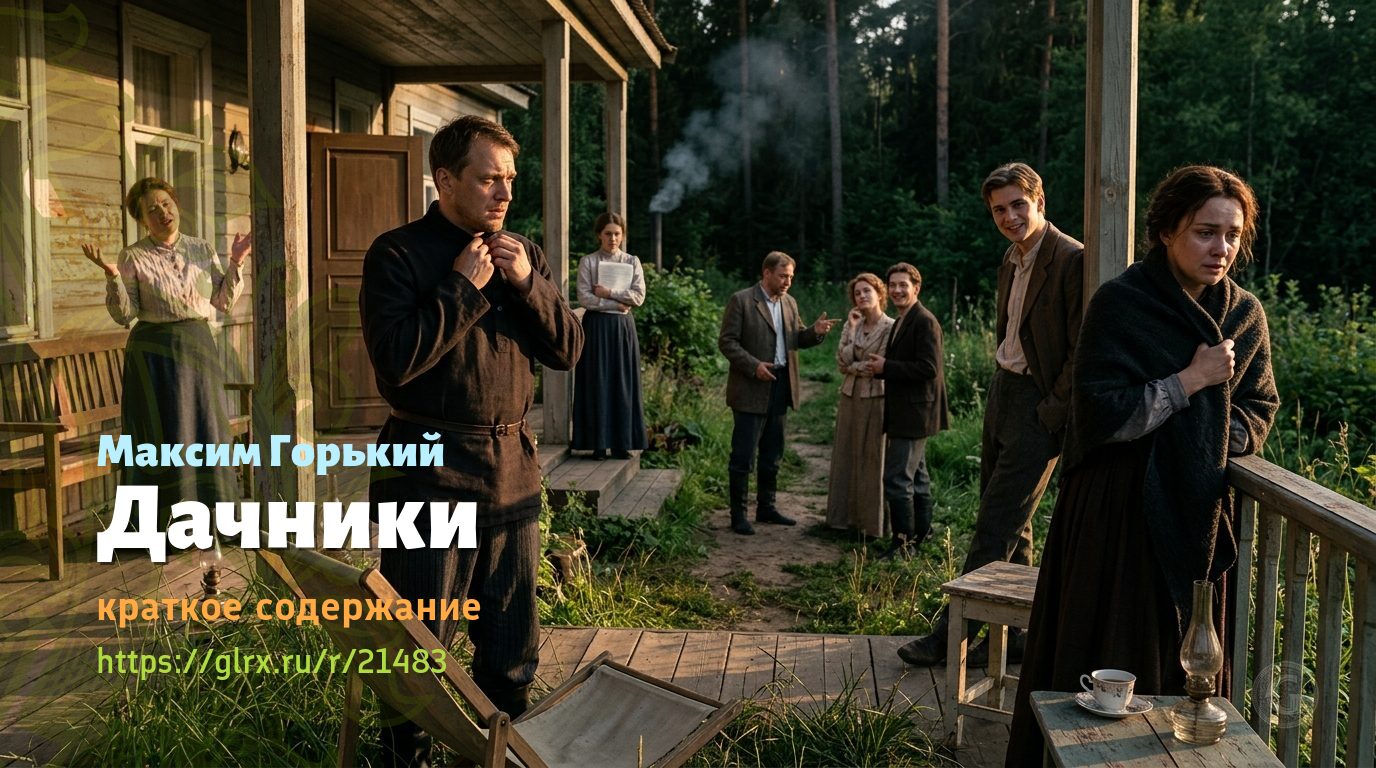
Life at the Basovs’ dacha
The action unfolds at the rented dacha of lawyer Sergei Vasilyevich Basov, where the local community gathers in the evenings. The lawyer’s wife, Varvara Mikhailovna, acutely feels the emptiness of her existence. She is estranged from her husband, who leads an idle lifestyle and dismisses his wife’s emotional torment. Varvara’s brother, Vlas, works as Basov’s clerk. The young man constantly clowns around and recites his own poetry. Behind this clownish facade, he conceals a profound disgust for the environment.
Engineer Pyotr Ivanovich Suslov is cynical and disdains those who try to appear better. He often quarrels with his wife, Yulia Filippovna. She is openly bored in her marriage and openly flirts with Basov’s assistant, Nikolai Zamyslov. This young man is known for his frivolity and readiness for any adventure. Basov’s sister, Kaleria, composes melancholy poetry and suffers from loneliness. She is twenty-nine years old and has no hope of settling down in her own life.
Doctor Dudakov’s wife, Olga Alekseyevna, constantly complains about her children and her difficult life. Her husband is exhausted by his work at the hospital and irritated by the nagging of his superiors. Among the guests, Pavel Sergeyevich Ryumin stands out. He is prone to melancholy and secretly loves Varvara Mikhailovna, but hides behind beautiful philosophical phrases. Doctor Marya Lvovna counters him. This intelligent woman encourages meaningful work. Soon, the renowned writer Yakov Petrovich Shalimov arrives at the dacha. In her youth, Varvara idolized him, but now she sees a tired and narcissistic man.
Growing discontent
The events shift to a forest clearing in front of the Basovs’ dacha. Engineer Suslov’s uncle, the wealthy merchant Semyon Semyonovich Dvoetochie, arrives to visit. He has sold his old factory and is now seeking the warmth of family, but Suslov greets his relative very coldly. Vlas openly mocks the complacency of the vacationing dacha-goers. Writer Shalimov complains to Basov about the arrival of a new, unfamiliar reader. Writing no longer brings him joy. Varvara Mikhailovna is completely disillusioned with her former idol.
Local drama enthusiasts, led by Zamyslov, are rehearsing a charity play. Marya Lvovna accuses Shalimov of losing his creative fire. The writer is angered by her forthrightness. Sonya and student Zimin quietly discuss the future. The young man is planning a long trip away, hinting at underground revolutionary work. Vlas frankly admits to Marya Lvovna that he is suffocating in the local vulgarity. The young man wants to find the true meaning of life and is ready to change. Suslov has a bitter argument with his wife over her provocative behavior. He threatens to shoot Yulia someday, but she only mocks her husband.
Varvara Mikhailovna clashes with her childhood friend, Olga Alekseyevna. The doctor’s wife envies the Basovs’ comfortable life. She hints that Varvara married for convenience and is deliberately not having children. These unfair words deeply wound the protagonist. Vlas becomes increasingly attached to Marya Lvovna. The young man sees her as the only bright person among the assembled guests and kisses her hands in a fit of passion. Basov accidentally notices this and rushes to spread the news of his clerk’s affair.
Picnic in the forest
Summer residents are having a picnic. A rug with snacks and wine is spread out in a forest clearing. The men drink and tell jokes. The women sit separately and share thoughts about the meaninglessness of their existence. Varvara Mikhailovna recalls her mother, a simple laundress. That hard work seems far more meaningful to her than the current well-fed idleness among cultured people.
Vlas finds Marya Lvovna and openly declares his love. The woman is frightened by the strength of her feelings. She is thirty-seven years old, has gray hair, and fears being ridiculed. Varvara Mikhailovna overhears this difficult conversation. She convinces Marya Lvovna not to give up her personal happiness because of foolish prejudices. Sonya also fervently supports her mother. The girl believes that together they will create a new, strong family, based on friendship and honest work.
Meanwhile, Ryumin decides to reveal his feelings to Varvara Mikhailovna. He complains about his life and asks for her love. She coldly rejects him, disgusted by his spiritual weakness and constant complaints. Ryumin is crushed by this harsh rejection. A drunken Suslov cynically declares that all lofty ideals are fictitious. Yulia Filippovna continues to provoke her husband, handing him a pocket revolver and suggesting they shoot themselves together. Shalimov attempts to woo Varvara Mikhailovna. She gives him a flower and rejects his false advances.
Denouement and rebellion
That evening, everyone gathers again on the Basovs’ terrace. Old Colon decides to leave with Vlas. He is deeply disappointed in his nephew and plans to build schools in his hometown. Varvara Mikhailovna directly accuses her husband of unscrupulousness. She has learned of his dirty deal with Zamyslov, from which they plan to make a large sum. Kaleria reads her new poems about white falling snowflakes to the guests.
In response, Vlas recites a harsh, mocking poem about "small, boring little people" seeking satiety and peace. This provokes a storm of emotions. Suslov explodes with anger. He lashes out harshly at Marya Lvovna, accusing her of moralizing. Suslov shouts that they are all the children of the bourgeoisie and the poor, who were starved in their youth. Now they just want to eat well and rest peacefully. The engineer declares that he cares nothing for lofty ideas or public duty.
A huge scandal erupts. Varvara Mikhailovna loses control and unleashes her anger on those around her, calling them wretched monsters who have poisoned her soul. She firmly declares that she is leaving her husband forever. Suddenly, a shot rings out in the forest. The watchman, Pustobayka, leads out the wounded Ryumin. The weak-willed philosopher attempted suicide, but faltered and only wounded himself in the shoulder. He is unbearably ashamed of his physical and spiritual failure.
Varvara Mikhailovna, accompanied by Vlas and Marya Lvovna, leaves the dacha, leaving her past life behind. Kaleria sobs in despair, not knowing where to go. Sonya takes her hand and leads her away. Suslov and his wife head home. Basov and Shalimov are left alone at the set table. The writer indifferently dismisses everything that has happened as rhetoric and hysteria, then calmly pours himself some wine. The play ends with the quiet, drawn-out whistle of the night watchmen.
You cannot comment Why?