A summary of Maxim Gorky’s "Childhood"
 Automatic translate
This autobiographical novella describes the harsh realities of life in a provincial middle-class family in nineteenth-century Russia. Written in 1913, the text avoids romanticizing the past, depicting everyday cruelty, greed, and ignorance as the norms of everyday life. The novella was adapted for the screen by director Mark Donskoy: in 1938, a film of the same name was released, earning high praise from audiences and film scholars.
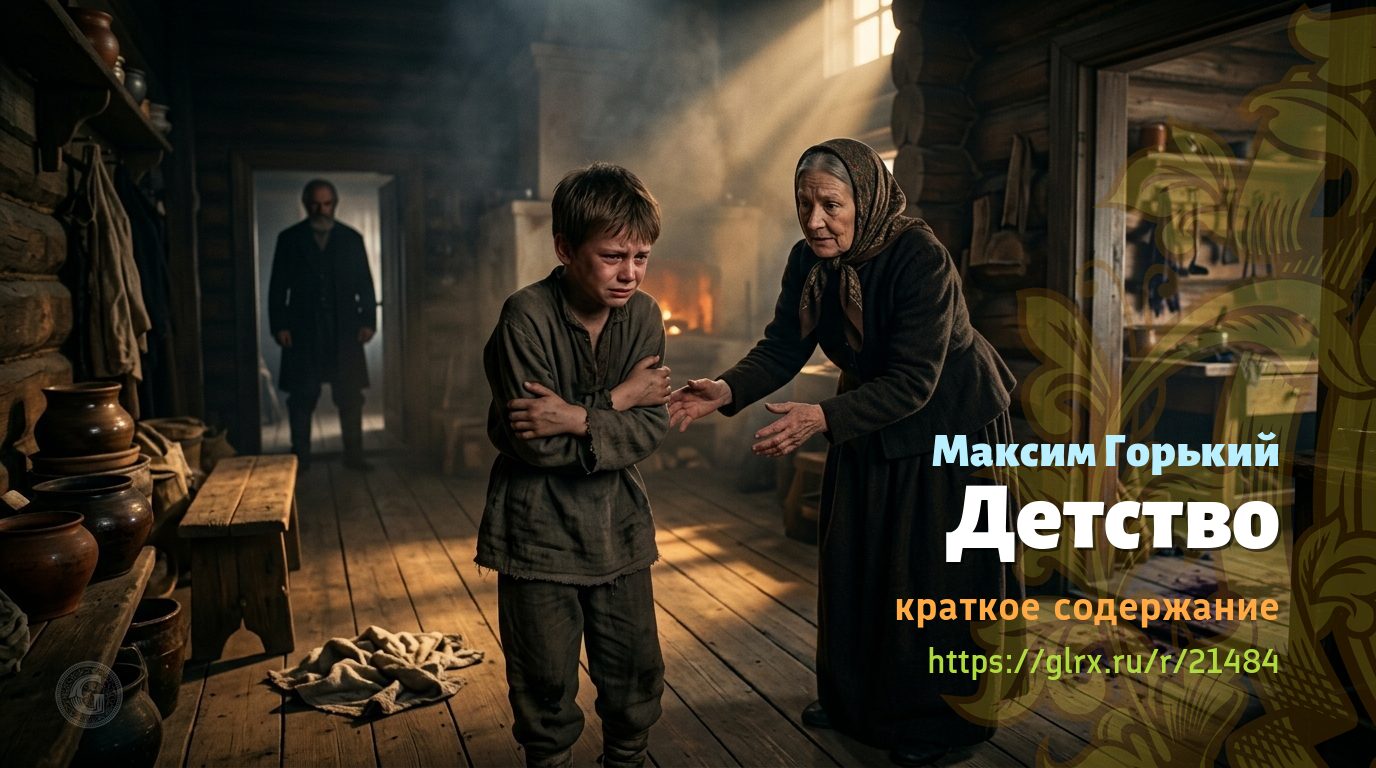
The book opens the author’s autobiographical trilogy. This series also includes "Among People" and "My Universities," which describe the subsequent stages of the protagonist’s development.
Father’s death and relocation
As a young boy, Alexei Peshkov suffers a profound loss. His father, Maxim, dies of cholera in Astrakhan. His mother, Varvara, grieves deeply, and his newborn brother, Maxim, dies during a steamship voyage up the Volga. Alexei meets his grandmother, Akulina Ivanovna. She amazes him with her remarkable kindness, tells him captivating stories, and reveals to the boy a brighter, more compassionate side of life. His grandmother binds everything around her with an unbroken thread of love.
The family arrives in Nizhny Novgorod, at the home of Vasily Kashirin, their grandfather. The house is filled with a stifling atmosphere of mutual hatred. Uncles Yakov and Mikhail constantly quarrel, demanding an immediate division of the property and the dyeing workshop. They fear that Varvara will take her share of the dowry. The children live in constant fear, and the adults regularly engage in brutal fights. The quiet Aunt Natalya is intimidated by her husband.
Punishments and Master Tsiganok
The grandfather imposes strict rules and spanks his grandchildren on Saturdays for the slightest infractions. On the advice of his cousin Sasha, Alexey dyes the festive white tablecloth blue. For this, the grandfather brutally beats the boy with rods until he loses consciousness. During his illness, the grandfather visits Alexey, brings treats, and tells him about his difficult past as a barge hauler. The boy’s attitude toward his grandfather changes.
A young apprentice, Ivan Tsyganok, a foundling raised by the Kashirin family, works in the workshop. He often puts his hand under the rod to soften the blows Alexei receives. Tsyganok dances brilliantly at festive parties to Uncle Yakov’s guitar, doing the work of two. The uncles envy him. While carrying a heavy oak cross to the cemetery, they force Ivan to carry the butt. Tsyganok trips, the cross crushes him, and the young man dies.
Fire and Faith
Life in the house is full of sudden disasters. A fire breaks out in the dye shop. Grandmother displays remarkable courage: she fearlessly carries a bucket of copper sulfate from the fire to prevent an explosion and calms the frightened horse, Sharap. That same restless night, Aunt Natalya goes into premature labor, from which she dies.
Alexey notices a clear difference between his grandmother’s God and his grandfather’s God. His grandmother’s God is merciful, loving all earthly creatures, close and understandable. His grandfather’s God is a harsh judge, constantly demanding obedience and punishing sins. His grandfather teaches Alexey Church Slavonic and the Psalter, demanding the strictest discipline. The boy quickly masters the alphabet.
Division of property and a good deed
The brothers finally divide the property, and Grandfather buys a new house on Polevaya Street, renting out the ground floor as a tavern. Uncle Mikhail regularly comes at night, wreaks havoc, smashes down doors with stakes, and threatens to kill Father. Grandfather defends the house with a club. During one of these sieges, a drunken Mikhail breaks Grandmother’s arm.
Soon, the grandfather sells this house and buys another one on Kanatnaya Street. A strange tenant moves into one of the rooms. They nickname him "Good Deed." He conducts chemical experiments and smelts lead. Alexey becomes close friends with this man. The tenant teaches the boy to think independently and react quickly to insults. The Kashirin family drives him out.
Street manners and neighbors’ children
Alexey spends a lot of time in the yard. He chats with a lame drayman named Pyotr, who tells horrific stories about the cruelty of his former owners. It later emerges that Pyotr is connected to a gang of church robbers. When the police arrive, the drayman slits his throat with a saddle knife in an abandoned pit in the garden.
Three Ovsyannikov brothers live behind the fence. Alexey watches their friendly games. When the youngest brother accidentally falls into a well, Alexey immediately helps pull him out. The boys begin to communicate secretly through a hole cut in the fence. The stern Colonel Ovsyannikov notices this and rudely throws Alexey out of the yard.
The Return of the Mother
Varvara returns to her father’s house. She tries to teach Alexei secular literacy and force him to memorize poetry. The boy struggles with rote memorization and distorts lines, which greatly angers his mother. Her grandfather insistently demands that Varvara marry the one-eyed watchmaker, but she flatly refuses.
His mother became close to a nobleman, Yevgeny Maximov. They had a quiet wedding, after which the newlyweds left for Moscow. Alexey stayed with his grandfather, building a shelter in the garden and catching songbirds. After some time, the couple returned and took Alexey to Sormovo, a workers’ settlement about seven and a half kilometers from the city.
Life with a stepfather and poverty
In Sormovo, Alexei’s stepfather works in the factory office. He’s cold, constantly quarreling with the pregnant Varvara, and buying food coupons from the workers at half price. For these scams, he’s fired. His mother brutally beats Alexei with a belt for street fights with local kids.
One day, the boy finds a ruble in his stepfather’s books and buys Andersen’s fairy tales. For this, he receives a severe punishment from his mother, and his stepfather tells his colleagues about it. The family moves back to the city. The stepfather takes an mistress. During another argument, he kicks Varvara in the chest. Alexey lunges at his stepfather with a bread knife. Varvara gives birth to a weak child, Nikolai.
Street freebooters
Grandfather goes bankrupt, lends out money at interest, and completely divides the household with Grandmother. They cook food in separate pots and strictly measure out their tea portions. Grandmother begins making lace to sell and even becomes a nanny. Alexey goes to school, but clashes with the priest and the teacher. His school affairs improve after meeting Bishop Chrysanthus.
To earn his living, Alexei collects bones, rags, and paper. On weekends, he joins a group of Sloboda boys. They steal boards from warehouses on the banks of the Oka River. The group has its own rules of mutual understanding and camaraderie. They share their meager earnings, help each other, and spend time chatting at the local cemetery.
The death of the mother and the ending
In August, Alexei’s mother begins to fade. She can’t speak, has a severe cough, and suffers from physical exhaustion. On Sunday, she asks her son to call his stepfather, tries to wipe her face with a handkerchief, and suddenly dies right before Alexei’s eyes.
After his mother’s funeral, the grandfather declares he no longer intends to support his grandson. He is given a direct order to earn his own living. The boy is forced to leave his family forever. These events conclude with the grandfather’s words: "Go out into the world."
You cannot comment Why?